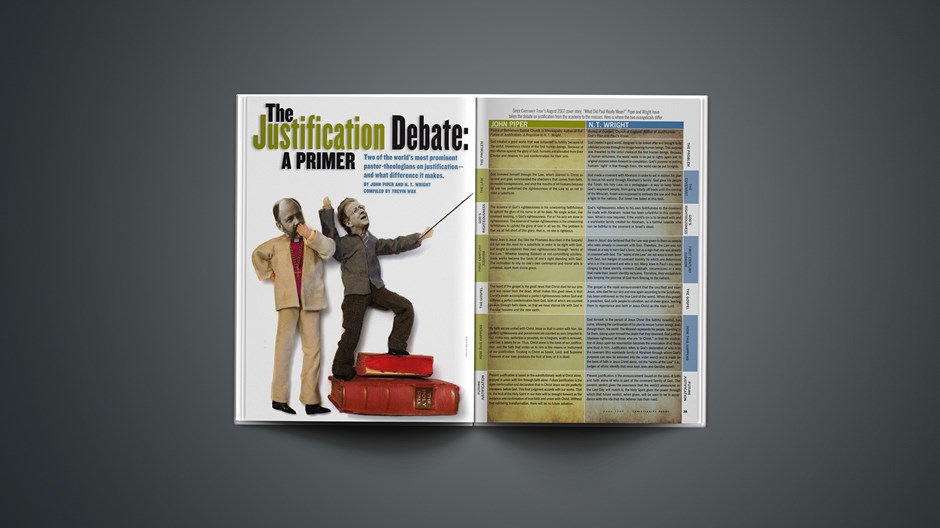
Since Christianity Today's August 2007 cover story, "What Did Paul Really Mean?" Piper and Wright have taken the debate on justification from the academy to the masses. Here is where the two evangelicals differ.
Download a PDF of this article here.
Piper: God created a good world that was subjected to futility because of the sinful, treasonous choice of the first human beings. Because of this offense against the glory of God, humans are alienated from their Creator and deserve his just condemnation for their sins.
Wright: God created a good world, designed to be looked after and brought to its intended purpose through his image-bearing human beings. This purpose was thwarted by the sinful choice of the first human beings. Because of human sinfulness, the world needs to be put to rights again and its original purpose taken forward to completion. God's purpose in putting humans "right" is that through them, the world can be put to rights.
The Law
Piper: God revealed himself through the Law, which pointed to Christ as its end and goal, commanded the obedience that comes from faith, increased transgressions, and shut the mouths of all humans because no one has performed the righteousness of the Law so as not to need a substitute.
Wright: God made a covenant with Abraham in order to set in motion his plan to rescue his world through Abraham's family. God gave his people the Torah, his holy Law, as a pedagogue—a way to keep Israel, God's wayward people, from going totally off track until the coming of the Messiah. Israel was supposed to embody the law and thus be a light to the nations. But Israel has failed at this task.
God's Righteousness
Piper: The essence of God's righteousness is his unwavering faithfulness to uphold the glory of his name in all he does. No single action, like covenant keeping, is God's righteousness. For all his acts are done in righteousness. The essence of human righteousness is the unwavering faithfulness to uphold the glory of God in all we do. The problem is that we all fall short of this glory; that is, no one is righteous.
Wright: God's righteousness refers to his own faithfulness to the covenant he made with Abraham. Israel has been unfaithful to this commission. What is now required, if the world's sin is to be dealt with and a worldwide family created for Abraham, is a faithful Israelite who can be faithful to the covenant in Israel's stead.
Piper: Many Jews in Jesus' day (like the Pharisees described in the Gospels) did not see the need for a substitute in order to be right with God, but sought to establish their own righteousness through "works of the Law." Whether keeping Sabbath or not committing adultery, these works became the basis of one's right standing with God. The inclination to rely on one's own ceremonial and moral acts is universal, apart from divine grace.
Wright: Jews in Jesus' day believed that the Law was given to them as people who were already in covenant with God. Therefore, the Law was not viewed as a way to earn God's favor, but as a sign that one was already in covenant with God. The "works of the Law" are not ways to earn favor with God, but badges of covenant identity by which one determines who is in the covenant and who is not. Many Jews in Paul's day were clinging to these identity markers (Sabbath, circumcision) in a way that made their Jewish identity exclusive. Therefore, their exclusivism was keeping the promise of God from flowing to the nations.
The Gospel
Piper: The heart of the gospel is the good news that Christ died for our sins and was raised from the dead. What makes this good news is that Christ's death accomplished a perfect righteousness before God and suffered a perfect condemnation from God, both of which are counted as ours through faith alone, so that we have eternal life with God in the new heavens and the new earth.
Wright: The gospel is the royal announcement that the crucified and risen Jesus, who died for our sins and rose again according to the Scriptures, has been enthroned as the true Lord of the world. When this gospel is preached, God calls people to salvation, out of sheer grace, leading them to repentance and faith in Jesus Christ as the risen Lord.
How This Happens
Piper: By faith we are united with Christ Jesus so that in union with him, his perfect righteousness and punishment are counted as ours (imputed to us). In this way, perfection is provided, sin is forgiven, wrath is removed, and God is totally for us. Thus, Christ alone is the basis of our justification, and the faith that unites us to him is the means or instrument of our justification. Trusting in Christ as Savior, Lord, and Supreme Treasure of our lives produces the fruit of love, or it is dead.
Wright: God himself, in the person of Jesus Christ (the faithful Israelite), has come, allowing the continuation of his plan to rescue human beings, and, through them, the world. The Messiah represents his people, standing in for them, taking upon himself the death that they deserved. God justifies (declares righteous) all those who are "in Christ," so that the vindication of Jesus upon his resurrection becomes the vindication of all those who trust in him. Justification refers to God's declaration of who is in the covenant (this worldwide family of Abraham through whom God's purposes can now be extended into the wider world) and is made on the basis of faith in Jesus Christ alone, not the "works of the Law" (i.e., badges of ethnic identity that once kept Jews and Gentiles apart).
Article continues below
Future Justification
Piper: Present justification is based on the substitutionary work of Christ alone, enjoyed in union with him through faith alone. Future justification is the open confirmation and declaration that in Christ Jesus we are perfectly blameless before God. This final judgment accords with our works. That is, the fruit of the Holy Spirit in our lives will be brought forward as the evidence and confirmation of true faith and union with Christ. Without that validating transformation, there will be no future salvation.
Wright: Present justification is the announcement issued on the basis of faith and faith alone of who is part of the covenant family of God. The present verdict gives the assurance that the verdict announced on the Last Day will match it; the Holy Spirit gives the power through which that future verdict, when given, will be seen to be in accordance with the life that the believer has then lived.















 While we pray for peace, we need moral clarity about this war.
 We’ve got little information on Jesus’ appearance and personality. But that’s the way God designed it.españolFrançais
 How groups like Hillsong learned to let go of the literal in favor of creative collaboration.españolPortuguês






