Which is more scandalous? The multitudes of Christians who think they need to earn their salvation by being good? Or the throng of Christians who think that holy living doesn't matter so long as they have prayed the sinner's prayer? Pastors' answers will largely indicate how they feel about the justification debate, even if they haven't fully read the newest books from two of the debate's main players: John Piper's The Future of Justification: A Response to N.T. Wright and N. T. Wright's Justification: God's Plan and Paul's Vision.
"Justification is central to what I do," said Ryan Fullerton, pastor of Immanuel Baptist Church in Louisville. "Justification is part of the air we breathe as a ministerial staff." Fullerton says the debate has strengthened his commitment to the traditional Reformed understanding, not only because of his reading of the biblical text but also because of his congregants' struggles.
"I believe that ultimately, the central problem on every human mind is guilt, and this problem is only remedied through justification by faith alone," he said. "I once sat down with our counseling pastor to discuss a number of diverse counseling situations. We found that the root problem in each was a misunderstanding or failure to apply this doctrine. I am trying to help guilty sinners know how they can have a right standing with God."
Unfortunately, "front-loading 100 percent assurance of heaven when you die based on an assent to Reformation doctrine hasn't created a vibrant, revolutionary Christian community," said John Frye, pastor of Fellowship Evangelical Covenant Church in Hudsonville, Michigan. "As a pastor, I believe Wright's perspective puts teeth in the New Testament exhortations to stay true to an authentic following of Jesus Christ and persist to the end."
The doctrine can sound like bad advice, said Kevin DeYoung, "but I look at Galatians and Romans and think, 'If people hear us talking about justification and don't almost think that we are giving them license to sin, we aren't preaching grace strong enough.' "
DeYoung, senior pastor of University Reformed Church in East Lansing, Michigan, wonders if justification as identity in a community would be seen as good news.
"I may not be doing justice to Wright's position, but I know that if I tried to explain justification as Wright does, very few people in my congregation would understand it, and few would take real comfort in it," he said. "Whenever I nail a strong justification sermon and emphasize that nothing we do provides any ground for our right standing with God, I'll get e-mails thanking me for such a freeing message."
Piper's extended focus on God's sovereignty can be very difficult to present as good news too, said Michael Spencer, campus minister at a large Christian boarding school in Oneida, Kentucky. "Wright, on the other hand, has greatly helped me be able to use the concept of the lordship of Jesus as the central point in ministry, without making the sovereignty of God a constant bar that must be met." The idea of being declared right with God is central to justification, he said. But so are the implications of a new King and a new kingdom. "Wright has helped me integrate discipleship more clearly into my presentation of the gospel offer."
Yes, both messages are central to the gospel, said Mark Driscoll, pastor of Mars Hill Church in Seattle. But that doesn't mean both are what's meant by the term justification. Discipleship is best talked about in terms of regeneration or sanctification, he said. "Together, justification and regeneration explain both our legal standing before God and lifestyle with God."
But even those two concepts do not adequately describe the Christian gospel, said Derek Leman, rabbi of a Messianic Jewish congregation in Atlanta. "The issue is God redeeming and bringing to perfect consummation all things and calling us to be part of it, a process which begins with justification. Justification is entering school, not graduating from it. I do not make the focus of my teaching how to be justified, a point I regard as elementary and to be moved far beyond," he said.
Additionally, Leman said, "as a Messianic Jewish leader, it is important to me to keep issues of Jewish and Gentile identity in the New Testament at the forefront—something I feel Wright does far better than Piper."
While several pastors praised Wright's and Piper's books as models of civil theological debate, David Swanson says Piper and his supporters have come across as "less generous and humble than I'd hope. On an emotional level, this makes Wright's view more intriguing. But I've tried not to dismiss the traditional Reformed view of justification out of hand because of the rhetoric." Swanson, pastor of community life at Chicago's New Community Covenant Church, said the debate has changed his ministry mostly in that "I'm more convinced of the mysterious nature of atonement and justification. I'm grateful that Scripture gives us ways to talk about it, but I'm hesitant to explain the mystery in too much detail."
Article continues below
The debate has provoked precisely the opposite response from Hershael York, pastor of Buck Run Baptist Church in Frankfort, Kentucky. "I find myself emphasizing these themes of God declaring us righteous, even though we are not, and imputing his own righteousness to us," he said. "Knowing that the dear people to whom I preach may hear this challenged by voices that have been otherwise trustworthy makes me a wary shepherd on watch against anything that would disturb the safety and security of my sheep."















 While we pray for peace, we need moral clarity about this war.
 As my doubts about his teachings grew, so did a secret fascination with Jesus.
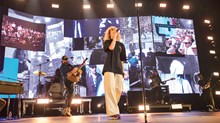 How groups like Hillsong learned to let go of the literal in favor of creative collaboration.españolPortuguês






