Should your doctor prescribe prayer as part of your treatment? According to a study of 1,134 physicians this past December by Health Care Direct Research, the majority of doctors (70 percent) believe miracles are possible today. Yet fewer than 29 percent believe that the outcomes of medical treatments are related to "supernatural forces" or "acts of God."
Studies on prayer in medicine have a way of demarcating the battle lines between saints and skeptics: Christians long for scientific proof of the efficacy of prayer. Critics, waiting for the opposite, hope to undermine religious faith. For better or worse, we have seen many attempts to measure the healing effects of intercessory prayer. The first known studies were published in 1873 by English polymath Francis Galton. He found no statistical evidence that prayer prolonged life or reduced stillbirths (though his findings would not meet today's criteria for a controlled prospective study).
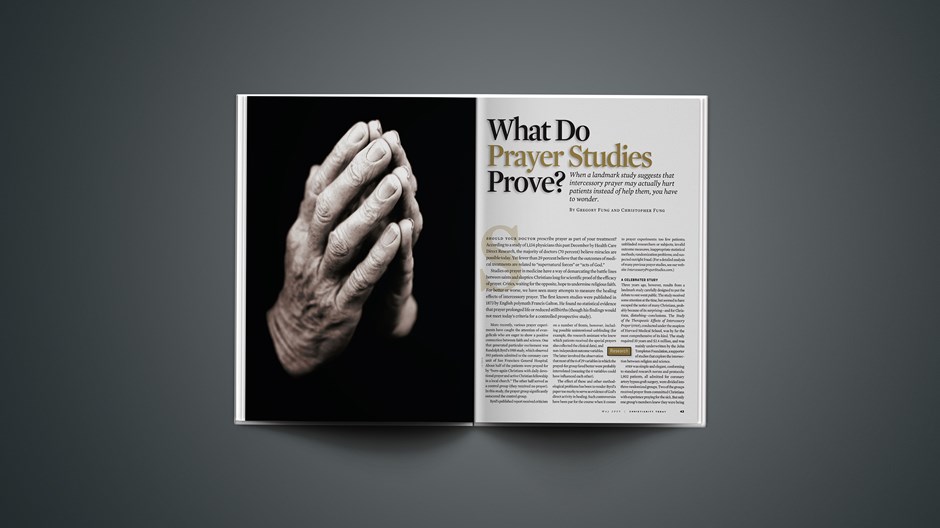
More recently, various prayer experiments have caught the attention of evangelicals who are eager to show a positive connection between faith and science. One that generated particular excitement was Randolph Byrd's 1988 study, which observed 393 patients admitted to the coronary care unit of San Francisco General Hospital. About half of the patients were prayed for by "born-again Christians with daily devotional prayer and active Christian fellowship in a local church." The other half served as a control group (they received no prayer). In this study, the prayer group significantly outscored the control group.
Byrd's published report received criticism on a number of fronts, however, including possible unintentional unblinding (for example, the research assistant who knew which patients received the special prayers also collected the clinical data), and non-independent outcome variables. The latter involved the observation that most of the 6 of 29 variables in which the prayed-for group fared better were probably interrelated (meaning the 6 variables could have influenced each other).
The effect of these and other methodological problems has been to render Byrd's paper too murky to serve as evidence of God's direct activity in healing. Such controversies have been par for the course when it comes to prayer experiments: too few patients; unblinded researchers or subjects; invalid outcome measures; inappropriate statistical methods; randomization problems; and suspected outright fraud. (For a detailed analysis of many previous prayer studies, see our website IntercessoryPrayerStudies.com.)
Three years ago, however, results from a landmark study carefully designed to put the debate to rest went public. The study received some attention at the time, but seemed to have escaped the notice of many Christians, probably because of its surprising—and for Christians, disturbing—conclusions. The Study of the Therapeutic Effects of Intercessory Prayer (STEP), conducted under the auspices of Harvard Medical School, was by far the most comprehensive of its kind. The study required 10 years and $2.4 million, and was mainly underwritten by the John Templeton Foundation, a supporter of studies that explore the intersection between religion and science.
STEP was simple and elegant, conforming to standard research norms and protocols: 1,802 patients, all admitted for coronary artery bypass graft surgery, were divided into three randomized groups. Two of the groups received prayer from committed Christians with experience praying for the sick. But only one group's members knew they were being prayed for. The result: The group whose members knew they were being prayed for did worse in terms of post-operative complications than those whose members were unsure if they were receiving prayer. The knowledge that they were being prayed for by a special group of intercessors seemed to have a negative effect on their health.
The two groups that were unsure of whether they were receiving prayer were also compared. One group actually received prayer (the same group mentioned above), while the other did not. This time, the group that had received prayer experienced more major complications than the group without additional prayer. In other words, the study seemed to show that prayer—at least prayer from strangers—might be bad for one's health. The results were disappointing to those who had hoped to see the positive effects of additional intercessory prayer. (They also may have been surprising to skeptics who were expecting no effect at all.)
Many have questioned the validity of the study, including the authors themselves, who worried that "… being aware of the strangers' prayers … may have caused some of the patients a kind of performance anxiety. It may have made them uncertain, wondering, am I so sick that they had to call in their prayer team?" Evangelicals' responses have included the observation that many of the patients, after all, were either praying for themselves or had friends and family praying for them (96 percent reported having others praying for them). This reality could drown out any effect of the additional prayers. Other Christians claim that intercessory prayer investigations are problematic, given the various New Testament examples of physical healing through direct, in-person prayers—a scenario that would be impossible to test in any double-blind way. A third response has been, as one high-profile hospital chaplain said, that "God is not subject to scientific research."
Article continues below
C.S. Lewis anticipated a carefully designed prayer study, but did not think it would show any positive, measurable "results." "The trouble is that I do not see how any real prayer could go on under such conditions," Lewis said. "Simply to say prayers is not to pray; otherwise a team of properly trained parrots would serve as well as men for our experiment." He argued that this approach to prayer treats it "as if it were magic, or a machine—something that functions automatically"—an accusation unintentionally but prophetically aimed at STEP and the other well-meaning attempts to measure the effects of prayer. If Lewis is right, such attempts always end up trying to measure something more akin to magic than a real movement of God.
Ironically, STEP actually supports the Christian worldview. Our prayers are nothing at all like magical incantations. Our God bears no resemblance to a vending machine. The real scandal of the study is not that the prayed-for group did worse, but that the not-prayed-for group received just as much, if not more, of God's blessings. In other words, God seems to have granted favor without regard to either the quantity or even the quality of the prayers. By instinct, we might selfishly prefer that God give preferential treatment to those who are especially, deliberately, and correctly prayed for, but he seems to act otherwise.
True to his character, God appears inclined to heal and bless as many as possible. It is as if he can barely restrain himself—though he often does—from supernaturally intervening and disrupting the nature of the universe to care for those he loves, whether they acknowledge it or not. Did God answer the prayers of the study's official prayer teams? Yes. But more than that, he answered the prayers of the patients, of their friends and relatives, and perhaps even of those who may not have known they were praying.
Article continues below
Why Pray?
If this is true about our God, then a nagging question arises: "Why put so much effort into praying if God is already so generous?" This is another way of asking the real but unspoken question: "What is the minimum required of me to get my prayers answered?" Such questions expose the weakness of our modernist desire to know if prayer "works." In finding that God is in fact constantly answering prayers, we stumble upon the deeper and more disturbing reality that his answers often don't give us the where, when, or how that we originally sought.
Scripture attests to this reality. God, for example, answered Israel's prayers for release from Pharaoh's hand, but his answer—when it finally came—was unexpected, unpredictable, and anything but tame (as a generation left in the desert could attest). His answer to Israel's prayers for release from Caesar's grip proved even more unanticipated and, for many, simply unacceptable. Thus, it is no surprise that Jesus taught us to pray "thy will be done," as he himself prayed all the way through Gethsemane. In all this, we discover that our obsession with whether prayer works is the wrong question. We know prayer works. The real question is, are we prepared for God's answer?
Not surprisingly, those who were prepared for God's answer to Israel's cry for the Messiah were people who prayed. Anna the Prophetess, who spent the bulk of her life worshiping in the temple, was one of the first to recognize him. Lydia, who saw the truth of the gospel and opened the door to Philippi, was in the right place at the right time because she was praying. Thus, we pray not only because God answers our prayers. We also pray so that we might recognize and receive God's answer, know how to respond, and perhaps see God himself.
Most physicians believe in miracles, and in the cause-and-effect reality of their jobs. Miracles happen, but they happen to all because we are loved by God, whether we are in rebellion or not. What is left to physicians, and to us, is how we will respond. We would be wise to avoid magical or mechanical claims about the gospel. STEP encourages us to believe that God is eager to answer our prayers with seemingly little regard for our competence in prayer or, at times, even our orthodoxy. This ought to give us confidence to act, believe, and work alongside the good and generous King, who calls us to advance his kingdom, bring healing to the world, and pray.
Article continues below
Gregory Fung studied biochemistry at Harvard and is currently the Boston divisional director of InterVarsity Christian Fellowship. Christopher Fung is a pathologist and a member of LaSalle Street Church, Chicago. They are son and father, respectively.
















 While we pray for peace, we need moral clarity about this war.
 We’ve got little information on Jesus’ appearance and personality. But that’s the way God designed it.españolFrançais
 How groups like Hillsong learned to let go of the literal in favor of creative collaboration.españolPortuguês






