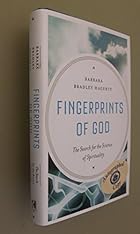
Fingerprints of God: The Search for the Science of Spirituality
Author
Barbara Bradley Hagerty
Publisher
Riverhead Hardcover
Release Date
May 14, 2009
Pages
336
Price
15.43
Michael Hughes was 22 years old when he had a mystical experience at a Maryland Catholic church. "It was almost as if I had wandered into the magical place," he recalls. "I sat down and felt a really strong sense of sacredness." He said he encountered "Something"—"an intelligence to be sure, but it felt like an intelligence that imbues everything."
That this religious experience was prompted by Hughes's ingesting some psychedelic mushrooms gets to the heart of the issues Barbara Bradley Hagerty discusses in Fingerprints of God: The Search for the Science of Spirituality (Riverhead). Do mystical experiences point to God or to mere brain chemistry?
Hagerty, an award-winning religion correspondent for National Public Radio, wrote the book because she wanted to understand her own spiritual experiences. The ex-Christian Scientist began asking questions like, "Is there a spiritual world every bit as real as the phone ringing in my kitchen?" and, more specifically, "Are spiritual experiences simply electrical storms in the brain, or do they indicate contact with a spiritual world?"
She pursues this self-admittedly ambitious topic by interviewing mystics famous (like writer Sophy Burnham) and not, and scientists who study genes, the brain, and spiritual experiences. She says she wanted to research this like an investigative reporter who backs up "every line of every story … with hard evidence," but it's clear that her personal passions at times reign supreme.
For example, in trying to discern whether genes play a role in spiritual sensitivity, Hagerty interviews Dean Hamer, author of The God Gene. She notes that many scientists severely criticized Hamer's 2004 book for being "shallow, sensational, and published without the scrutiny of other scientists." But after noting this, she goes right ahead and interviews Hamer, never seriously questioning his methods or conclusions.
She does give equal time to one of Hamer's critics, Francis Collins, author of The Language of God and onetime director of the National Human Genome Research Institute. He doesn't think there is a God gene because spirituality "is much too complicated and interwoven with every aspect of your personality, of your consciousness, of your sense of who you are."
Hagerty even acknowledges that Collins has the better argument: "Why does Hamer's view of science seem intriguing, while Collins's view of the world seems true?" she asks. Still, she pushes her project forward.
It slowly becomes clear that there is little hard evidence to prove that mystical experiences are of divine origin. Even pinpointing the specific areas of the brain that manufacture such experiences is difficult. In the book, conclusions are regularly qualified with "probably," "likely," "some scientists speculate," and "one could argue." Hagerty's search is fascinating but, in the end, a bust. It turns out Hagerty is less interested in hard evidence and more in exploring a tantalizing idea.
Still, Fingerprints of God does reinforce the reality that the brain and spiritual experiences are connected. Mystical experiences are so dependent on the brain, it fact, that we can manufacture them with psychedelic drugs. Materialists conclude that mystical experiences are nothing but the product of brain chemistry. But Hagerty rightly objects: "If there were an 'Other' who wanted to communicate with us, of course He or She or It would use the brain to do so. … Of course God would use the chemistry of our brains to create visions."
Nobody who believes in the Incarnation—in a God who thinks matter matters so much as to take on human flesh to communicate himself—can conclude otherwise. God uses all of our senses to allow us to understand him, so why not the brain, which processes the senses? That drugs or epileptic fits can induce spiritual experiences is not surprising or any more or less significant than that drugs can induce fear or euphoria.
But if so, does that mean the person actually encountered the divine? No one can say for sure, not even the recipient of the experience—which, unless he is a complete narcissist, can only leave the recipient in deep doubt about the authenticity of the experience.
Narcissism has, in fact, been a perennial thorn in mysticism's side. That's why the great Christian mystics, while describing their experiences, taught their disciples to downplay ecstatic moments. Their goal was not to have spiritual experiences, but to see God. So they considered the "dark night of the soul" an essential phase—one in which all sensible spiritual pleasures are withdrawn so that the heart's pursuit of God can be purified of spiritual self-interest.
But Hagerty's conversations with mystics show that the temptation to narcissism—to relish the experience as a "high" that makes me a better person—remains powerful. For example, when Hagerty asks Michael Hughes to compare a non-drug-induced mystical moment with his mushroom-induced one, he says, "Ultimately, I don't really care if it is my brain chemistry doing this. They were equally profound. They both changed me dramatically." For many, an encounter with Reality is less important than how they feel.
Article continues below
The privileging of experience causes Hagerty to stumble badly at the end: "Embracing a particular faith, I came to believe, is a little like hopping in a car," she writes. "You can drive wherever you like: some head to Rome, others to Mecca, or the Wailing Wall. … But what makes the car run is under the hood. … Spiritual experience is the engine that transports you from one place to another" [italics added].
As a "mainstream Christian" (as she calls herself), Hagerty knows that Jesus said he was the Way, the Truth, and the Life, and that no one comes to God but by him. But she concludes, "I could not reconcile the literal statement with my reporting."
She seems unaware that long before the advent of modern science, Christians faced into the problem of religious pluralism. As Paul put it to the pluralistic Athenians, "For as I passed along and observed the objects of your worship, I found also an altar with this inscription, 'To the unknown god.' What therefore you worship as unknown, this I proclaim to you" (Acts 17:23, ESV). Anyone who has a mystical encounter with Reality, many theologians have concluded, is having an encounter with Jesus Christ, whether she recognizes him or not. Furthermore, God has a long history of only revealing himself in bits and pieces—often, it seems, to set people on a spiritual journey that leads to the knowledge of Jesus Christ.
Hagerty's acquiescence to the relativistic spirit of the age suggests that she may have had another motive in writing the book:
"… advances in science, and particularly quantum physics, are offering another description of reality in which all things are guided by and connected to an infinite Mind. … As I absorbed the science, I found this was the 'God' I could defend most easily—not so much a divine 'father' as an infinite creator of law and life."
To paraphrase Augustine, any god whose nature we can "defend most easily" is not likely to be a god worthy of worship. It is certainly not the Christian God, who, even though he has made himself known in Christ, remains to many a "stumbling block" and "folly" (1 Cor. 1:23).
Still, Hagerty has raised crucial issues for Christians to consider, and does so in a way that is accessible to all. As she says, it's all so intriguing, but not all "scientific conclusions" are to be taken at face value.
Article continues below
Mark Galli, senior managing editor of Christianity Today
Did Martin Luther Get Galileo in Trouble? | David Lindberg talks about the early relationship between science and faith and his own journey on the subject (February 1, 2003)
How Computer Nerds Describe God | The founding editor of Wired magazine explains his mission to talk about faith using the vocabulary and logic of science (November 1, 2002)
Have something to add about this? See something we missed? Share your feedback here.
Our Rating
Book Title
Fingerprints of God: The Search for the Science of Spirituality
Author
Barbara Bradley Hagerty
Publisher
Riverhead Hardcover
Release Date
May 14, 2009
Pages
336
Price
15.43
Our digital archives are a work in progress. Let us know if corrections need to be made.




















 While we pray for peace, we need moral clarity about this war.
 As my doubts about his teachings grew, so did a secret fascination with Jesus.
 Beyoncé’s right. Whether listening to Cowboy Carter or reading theology, diversity is a good thing.






