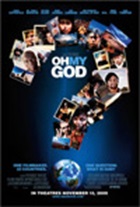
Not everyone sees God the same way. Director Peter Rodger, tired of various people claiming their God is the greatest—and then using that belief as a basis for violence, terrorism, and war—decided to travel around the world and ask people what they thought God is. And, he says, "As a person who wrestles with faith, I needed to determine whether God created man or man created God."
The result is Oh My God, a flashy but insubstantial whirlwind trip around the globe. The film is rendered even more disappointing because of its potential. After all, there is no more interesting or defining question to ask of a person than what they think of God. Even the agnostic somehow has an opinion. God has been a hot topic since the dawn of humankind.
To his credit, Rodgers mostly manages to avoid demonizing or ridiculing his subjects. (Some of them seem pretty crazy, but he doesn't provoke them into it.) He starts out with what seems like a genuinely open heart and inquisitive mind, which is just what a documentarian needs.
Director Peter Rodger
However, through wearying series of interviews and strings of rhetorical questions voiced over pulsing music and heady vistas, the issue becomes more muddied, not more clear. It's patently ridiculous to think anyone can settle the question of God in a 98-minute film, of course, and I'm sure Rodger didn't expect to settle it once and for all, but his bias against the possibility of any religion (with the possible exception of Buddhism) having a valid handle on what God is becomes more and more clear. To Rodger, religion—in any form—is an obstruction to knowing God, and couldn't be a help along the way.
Fair enough. Even many Christians say that they are about relationship, not religion. One of the truest statements in the film comes from Ringo Starr (of all people), who says that "God is love." What he means by "God" and "love" is probably a bit different from what John meant in his first epistle, but he's on the right track.
If a muddled view of God were the film's only drawback, it might be forgiven. An intelligent, compassionate inquiry into the various ways that people have seen God and the manifestations that takes is interesting anthropologically and sociologically, but also important for the thinking Christian, who ought to understand what others believe. A documentary with some depth would be an excellent way to hear people's views from their own lips.
Hugh Jackman shares his views on God
But that's not this film. Instead, we're following Rodger around as he has a kind of existential crisis (which he in fact does in the middle of the film). It lacks any arc beyond its loose inquiry, so it plays more like a music video than a documentary. The experience is dizzying, as we hop from continent to continent, occasionally sitting down with somewhat random celebrities—illusionist David Copperfield, musician Seal, Hugh Jackman, Ringo Starr. The only evangelicals they seem to have been able to dig up are a pastor in Africa who the nationals seem not to like very much, Dr. Tim LaHaye, and possibly the most stereotypical "everyman" possible: a gun shop owner in Texas. (The most evangelical-sounding interviewee is an American Catholic seminarian studying in Rome, who whips out a guitar in the square and leads the tourists in a chorus that calls on the Holy Spirit to fall and fill their hearts with fire.)
The voices who are probably most interesting in this conversation (various imams, for instance, or a pair of peacekeeping religious leaders on the Gaza strip) simply aren't on screen nearly enough. Frankly, I don't care too much about what Baz Luhrmann (writer/director of such films as Australia and Moulin Rouge) thinks God is.
Young monks in school at the Hemis Monastery in North India
The film's gorgeous locations and breathtaking vistas aren't enough to rescue it from its wearying faux seriousness. For a film that's not supposed to be about religion, Oh My God spends an awful lot of time talking about religion, but not at all knowledgeably. I'd wager that your average moviegoer really doesn't know how the views of God differ from Islam to Christianity to Judaism, yet no baseline is established, leaving the viewer with only the vague sense that religions are just oppressive systems of belief based around similar views of the same God, and that Mohammed and Jesus are roughly equivalent figures in their respective religions.
It seems impossible to conduct an honest, intelligent inquiry without at least this basic understanding. One telling moment comes when the filmmaker visits a school in India where children from Christian, Muslim, and Hindu families seem to study, learn, and play happily together. One little girl looks at the camera and says, "I am Hindu, and I believe that there is one true God." If there's anything Hindus believe, it is not that there is one true God.
Ultimately, Rodger succumbs to the trendy idea that religion has done nothing but bad in the world, that God is in all of us, a force that doesn't really care what we believe about it as long as we're pleasant to one another. One might rightly wonder why, if this is the conclusion, we needed the previous hour and a half to get there. There's nothing new said or unearthed in this film. The religious adherent won't have their mind changed, and the person who isn't sure what they believe won't find any help here, either. A topic this important should never be ultimately treated so glibly.
Article continues below
A Bali priest in Bali, Indonesia
What Oh My God does underline is that God, or at least some supreme animating force, is felt by nearly everyone throughout the world. A belief in something is shared among humankind; it's how that belief takes shape that changes. Some believe it is just a force; others believe it is a Person; others think it's simply nature. But we know there's something beyond us.
It's good for Christians—and everyone else—to explore and understand the many perceptions of God, and to thereby tease out what they believe. We are fooling ourselves if we think it's sufficient to know our own beliefs and ignore the very real questions and answers that others have.
Talk About It
Discussion starters
Christians believe that God isn't a what, but a who. When you think about God, how do you picture him?
What does John 14:7-11 say about how we can know who God is?
The film seems to conclude that "God is love." This is a (probably unconscious) echo of several verses in 1 John 4. What do you think the film's interviewees mean when they say that? What does 1 John 4:7-21 say about how Christians can show the world who God is?
The Family Corner
For parents to consider
The film is not rated by the MPAA. It includes an inexplicably graphic scene of animal slaughter. The rough language is bleeped out.



















 While we pray for peace, we need moral clarity about this war.
 As my doubts about his teachings grew, so did a secret fascination with Jesus.
 How groups like Hillsong learned to let go of the literal in favor of creative collaboration.españolPortuguês