It is 1967, and Larry Gopnik's got problems. His wife Judith is leaving him for Sy Ableman, a maddeningly self-assured family friend with an impossibly mellifluous voice. His brother Arthur is living with him, spending most of his time scribbling in a notebook and suctioning the sebaceous cyst on his neck. His children are filching money from him: Sarah for a nose job, and Danny for pot and records. A student is either bribing or threatening him over a failing grade. One of his neighbors is encroaching on his property line; the other, Bathsheba-like, is sunbathing naked. And the pesky guy from the record-of-the-month club won't stop calling, insisting Larry pay up on an account he doesn't remember opening.
Until last week, Larry's life was straightforward, comfortable, even pleasant. He's in good health and up for tenure at the Midwestern university at which he teaches physics. His children attend school, more or less. The Gopniks are upstanding members of their local Jewish committee. Danny's bar mitzvah is fast approaching.
Michael Stuhlbarg as Larry Gopnik
Now, as Judith and Sy blithely make living arrangements for everyone, his children ignore him completely, and threatening anonymous letters are being mailed to the tenure committee, Larry's comfortable world is disintegrating, and he simply cannot figure out what to do. He turns for guidance to his rabbis, but their help is cryptic, at best. Is this God's will? What is God trying to tell him? What can he do to appease the Almighty and let things be put to right again? And unfortunately for Larry—who simply wants to be a mensch, a serious man, a good man with a normal life—his woes are far from over.
A Serious Man, it seems, is the most direct that the Coen brothers have been about their idea of the way the world operates. Their body of work is rife with characters who meet untimely and seemingly random ends, who simply cannot catch a break. But whereas some of them (notably, the Dude in The Big Lebowski) manage to keep their troubles from getting in the way of having a good time, Larry is just snowed under. We're made to understand that Larry will never again be able to live a normal life. As in No Country for Old Men or Burn After Reading or Fargo or nearly any other Coen movie, tragedy and comedy strike simultaneously and at random; life is absurd, and it might be senseless.
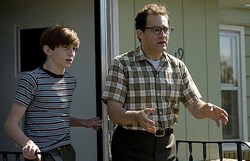
Larry with his son Danny (Aaron Wolff)
Except, Larry senses something purposeful to the senselessness—and so do we. After all, Larry's tribulations all show up at once. Needing answers, Larry consults one rabbi after another, getting only unsatisfactory maxims: You need a new perspective! You must see this as God's will! Asking questions will get you nowhere! And your problems are just not that important.
Here the Coens show their hand—it's not precisely nihilism, but it certainly isn't cheery. Larry's problems (and by extension, ours) might be a product of God's cruel will, or the caprice of some other nasty and detached deity, or the whim of the vindictive fates, but in the end, it really doesn't matter. The questions you ask are not going to be answered. If you think they've been answered, just wait a little while. You'll see. God or fate or somebody's got your number. Whatever else this is, it is not random—so we'd better find the comedy in it.
It's hard to put such a film into a category. It sounds like a very depressing drama, except it's somehow also hilarious. (Those who haven't the stomach for such juxtaposition need not apply.) It begins with a sort of Yiddish pseudo-fable that doesn't have much to do with what follows, except that someone comes to a sudden an untimely end (or do they?), and then Larry's tale of woe plays out.
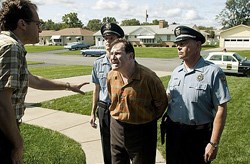
Richard Kind (brown shirt) as Larry's brother Arthur
Set against the backdrop of the Coens' own Jewish upbringing in the Midwest, the film is set in the late sixties, but not in the least dated—it could have happened yesterday, and it could have happened pretty much anywhere. Creatively shot by one of today's most accomplished working cinematographers, Roger Deakins, the film somehow simultaneously feels like a painfully realistic story and a kind of small town yarn. Larry's problems unfold at a very deliberate pace, and as a result, they occasionally plod—who can bear this much ignominy?—but the characters are rich enough to keep us engaged.
The Coens shot in Minnesota and cast mostly actors from the area (as they did with Fargo), all of whom acquit themselves well. Richard Kind (who plays Uncle Arthur) will likely be the only familiar one to moviegoers. Michael Stuhlbarg, on the other hand, a Tony Award winner and celebrated theatre actor, is unfamiliar to cinemagoers, but won't be for long. His hapless Larry is nuanced, comedic, and full of pathos—a joy to watch even as he's sinking into despair.
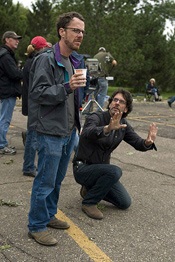
The Coen brothers on the 'Serious' set
I have a hunch that after No Country for Old Men, every movie the Coens make cannot help but be a bit of a disappointment. A Serious Man is no exception. It won't be remembered as a major part of the Coen canon. But it is far more relatable than their recent work, and one cannot watch it without pondering deeply some inherently biblical questions about the meaning of trials and the nature of fate—and without wondering if it's secretly a kind of adaptation of the book of Job, with a trick ending. It takes pieces that the Coens have been playing with for years and puts them together in one very dark, very funny, very human package—and for that, it's a film worth seeing.
Article continues below
Talk About It
Discussion starters
The first rabbi tells Larry that he needs a new perspective—that he should see everything as God's will, but he doesn't need to like it. How does this view of tribulation square with Scripture?
The second rabbi's story seems to imply that we need not ask questions of God, and that too much questioning is fruitless. Is he right? What do the Psalms tell us about questioning God?
Larry proves the "uncertainty principle" to the class and says it proves that you can't ever know what is going on—then tells them that it will be on the midterm. Can we ever know "what is going on"? What does 1 Corinthians 13:9-12 say about this?
When Arthur breaks down, what does he say to Larry? What does this say about the problem of comparing one person's pain to another's?
Do you think God cares about us when we have seemingly senseless troubles, like Larry? What does the book of Job tell us about afflictions?
The Family Corner
For parents to consider
A Serious Man is rated R for language, some sexuality/nudity and brief violence. There is a lot of profanity, mostly from teenagers. Several characters—including teens—smoke pot. Larry sees his attractive female neighbor sunbathing in the nude—and we do, too. One of the male characters was found soliciting a man for sex, and this is alluded to. The violence is very brief: someone is stabbed in the chest with a stake, Larry's head gets slammed against the wall a few times, and a dream sequence involves an unexpected shot in the head. There is also a brief but completely non-graphic sex scene in a dream sequence.
After this week’s UMC votes on LGBTQ issues, African Methodists should join American conservatives in the new Global Methodist denomination.
W. James Antle III
A Serious Man
1 of 4
Michael Stuhlbarg as Larry GopnikLarry with his son Danny (Aaron Wolff)Richard Kind (brown shirt) as Larry's brother ArthurThe Coen brothers on the 'Serious' set
















 While we pray for peace, we need moral clarity about this war.
 Alcoholism among women is rising. Can the church help?
 After this week’s UMC votes on LGBTQ issues, African Methodists should join American conservatives in the new Global Methodist denomination.