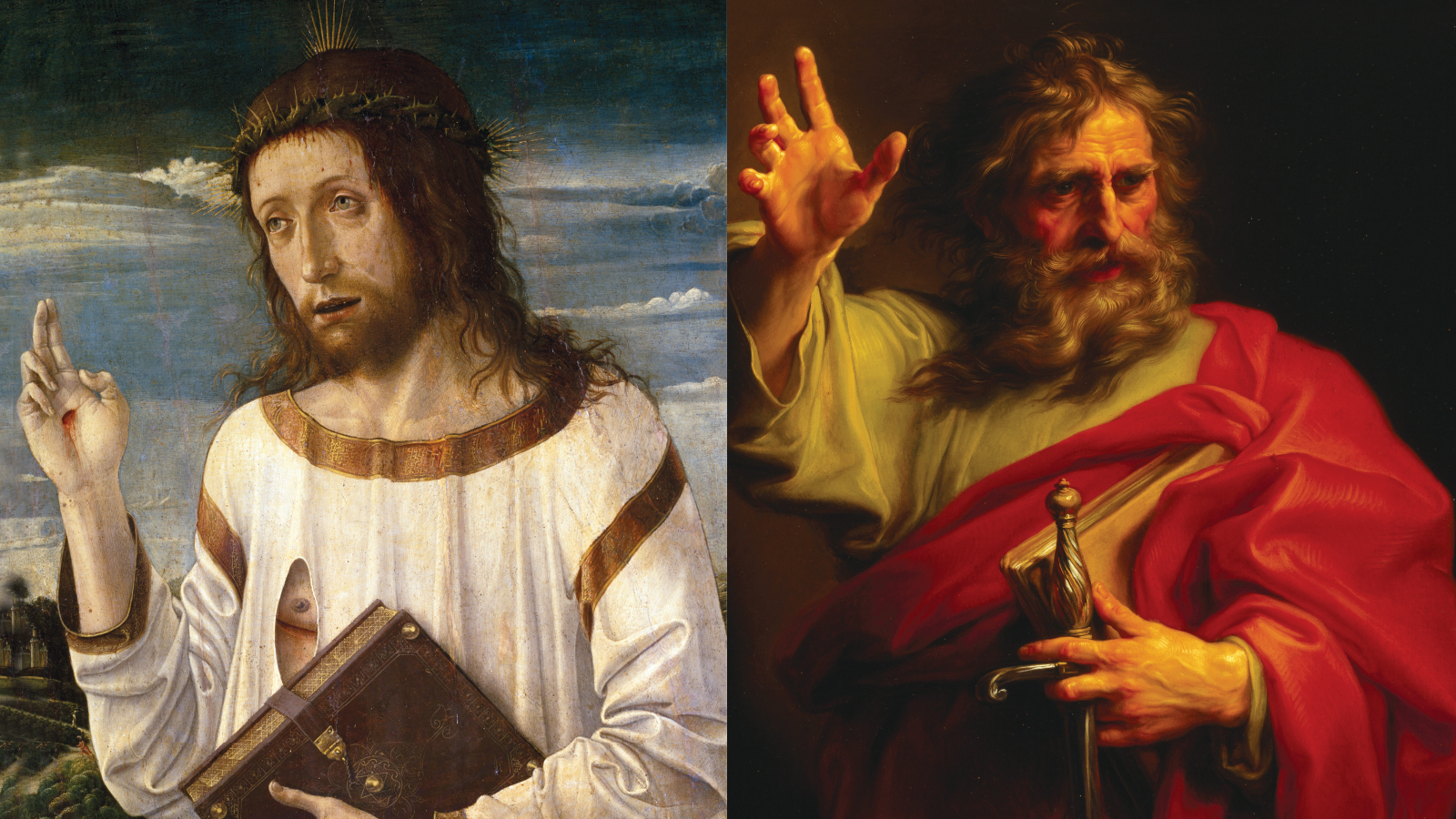

Many biblical scholars and lay Christians have noted that Jesus preached almost exclusively about the kingdom of heaven, while Paul highlighted justification by faith—and not vice versa. Some conclude that they preached two different gospels. Others argue that really they both preached justification; still others say it's all about the kingdom. What gives?
Note: Clicking the "video" links placed in the article will take you to a segment from an interview with Scot McKnight about the implications of this story.
I grew up with, on, through, and in the apostle Paul. His letters were the heart of our Bible. From the time I began paying attention to my pastor's sermons, I can only recall sermons on 1 Corinthians—the whole book verse by verse, week by week—and Ephesians. I don't recall a series on any of the Gospels or on Jesus.
There were two annual exceptions to our Pauline focus. At Christmas, we heard a sermon on one of the narratives about Jesus' birth, and during Holy Week, we got something on Jesus' death and resurrection. We were Pauline Christians and not one bit worried about it. I learned to think and believe and live in a Pauline fashion. Everything was filtered through Paul's theology. Justification was the lens for the gospel, and "life in the Spirit," the lens for Christian living.
Then I went off to Bible college (now Cornerstone University in Grand Rapids, Michigan) and majored in history while taking as many Bible courses as I could. Once again, Paul featured prominently. My senior year, I read the first volume of Ralph Martin's New Testament Foundations series and was taken with the freshness of the Gospels. But nothing overwhelmed me like my first experience in seminary. Sitting in Walter Liefeld's synoptic Gospels course at Trinity Evangelical Divinity School, I was absolutely mesmerized by Jesus, his kingdom vision, and the Gospels. I decided then and there that my life's pursuit would be Jesus and the Gospels.
A few years later, I began doctoral work on the Gospel of Matthew, and a few years after that began teaching as a young professor at Trinity, where I even got to teach Jesus and the Gospels. I spoke so often about Jesus' teachings that one student quipped that I needed to give a lecture called "Jesus' View of Jesus," since I had covered Jesus' view on everything but Jesus!
Something was clearly happening to me. Formerly I had loved Paul and thought with Paul. Then, when I encountered Jesus, as if for the first time, I began learning to think with Jesus. One of my colleagues occasionally suggested I was getting too Jesus-centered and ignoring Paul. I'm not so sure I was ignoring Paul; after all, I was teaching a few of his letters on a regular basis. But I had unlearned how to think in Pauline terms and was thinking only in the terms of Jesus. Everything was kingdom-centered for me.
Evangelicalism is facing a crisis about the relationship of Jesus to Paul, and many today are choosing sides.
And, truth be told, I was so taken with Jesus' kingdom vision that reading Paul created a dilemma every time I opened his letters.
An Evangelical Crisis
My experience is not unusual. Many of us have made a move from Paul to Jesus, and an increasing tension remains among evangelicals about who gets to set the terms: Jesus or Paul? In other words, will we center our gospel teaching and living on "the kingdom" or "justification by faith"?
The choice matters. It can be said without exaggeration that the evangelical movement owes its fundamental strength to the Reformation and the Great Awakenings and revivals of the 18th and 19th centuries; that is, it is a Paul-shaped movement through and through. The early 20th century arrival of the social gospel, which seemed to link "kingdom" with "liberal" and "justice," made the Pauline emphasis within the evangelical movement more pronounced. Furthermore, when some evangelicals recently rediscovered Jesus' kingdom vision, they were frequently warned that they were on the verge of falling for a social gospel.
But something has happened in the past two decades: a subtle but unmistakable shift among many evangelicals from a Pauline-centered theology to a Jesus-shaped kingdom vision. Sources for this shift surely include George Eldon Ladd's The Presence of the Future, the rugged and unrelenting justice voice of Jim Wallis, perhaps most notably in his Call to Conversion, and a growing social conscience among evangelicals. (video) We can argue about factors, but what matters is that a shift has occurred.
Daniel Kirk, a young New Testament scholar at one of Fuller Theological Seminary's extension sites, recently sent me a manuscript for review. The first suggested title was, Jesus Have I Loved, But Paul? That perfectly captures something I have observed in 15 years of teaching college students. Students love the Jesus part of the class, but their eyes seem to glaze over when we move from Jesus to Paul.
It is not exaggerating to say that evangelicalism is facing a crisis about the relationship of Jesus to Paul, and that many today are choosing sides. (video) I meet many young, thinking evangelicals whose "first language" is Jesus and the kingdom. Yet despite the trend, perhaps in reaction to it, many look to Paul and justification by faith as their first language. Those addicted to kingdom language struggle to make Paul fit, while those addicted to Paul's theological terms struggle to make Jesus fit. I know the experience because I, too, struggled to make the Pauline message fit the kingdom vision, and that was after struggling to make Jesus fit into the Pauline message.
Two approaches
Evangelicals have offered two ways to resolve this dilemma—that is, to bring Paul and Jesus into a more perfect harmony. What stands out is that each approach imagines that it is articulating the gospel itself. One approach is to master Jesus' gospel, the kingdom vision, and show how Paul fits. The other approach is to master Paul's gospel, his theology of justification, and show how Jesus fits. Each approach requires some bending of corners and squeezing of sides but, with extra effort and some special explanations, each thinks it can show the unity of the messages of Jesus and Paul and that the gospel of the kingdom and the gospel of justification are one and the same.
Take the Jesus approach. The kingdom of God, if one follows George Ladd's line of thinking (often called "inaugurated eschatology"), is defined as the "dynamic reign of God." It is grounded in texts like Matthew 12:28, where Jesus says that if he casts out demons by the Spirit of God, then the kingdom of God has (presently) come upon them. Or Mark 1:15: the time has been fulfilled, the kingdom of God has drawn near (so near that its presence is now being felt)—therefore repent and believe. It is not hard to fit "justification by faith" into the mold of the dynamic, personal, redemptive presence of God in the work of Jesus Christ. With some careful nuancing, the witness of Romans to justification and the witness of Ephesians to a cosmic redemption in Christ can be drawn into the ambit of the kingdom.
But a few problems always emerge. They have always given me an uneasy conscience about this kind of harmonizing. First, Paul doesn't talk about the kingdom enough to make me think his theology is really kingdom-shaped. His letters include fewer than 15 references to the kingdom. Fitting Paul into a kingdom mold is more by hook than it is by the book. Furthermore, Paul thinks more in terms of soteriology, justification, and ecclesiology than he does kingdom. So, if we are to be fair to Paul, we have to let Paul be Paul.
An even more fatal flaw resides in this approach: kingdom means more than the "dynamic" reign of God at work in Christ. The emphasis on "dynamic" leads me to think that we evangelicals want "kingdom" to refer to the personal experience of conversion, so that it can fit with our evangelical Paul. The roadblock here is insurmountable: kingdom for any and every Jew in the first century had at least four components: a king (Jesus or God), a people (Israel), a territory (the land of Israel), and a law that governed the people (the Torah or law of Moses). My conclusion: You can't begin at kingdom with Jesus and simply cross the path and conclude that Jesus was, after all, talking about justification.
What devastates this approach is that some of the central themes of kingdom for Jesus—which are all found in those crucial passages in Luke, such as the opening sermon in Nazareth (4:16-30)—are not found in Paul. Yes, Paul does care for the poor—of Jerusalem, at least. But caring for the poor and the outcast, and a revolutionary message about possessions—well, they just don't show up enough in Paul to lead one fairly to conclude that Paul was essentially teaching the same thing as Jesus. Kingdom and justification are not the same thing. (video) We have to find a better way to harmonize Jesus and Paul.
So others have started with Paul's understanding of justification and found a way to incorporate Jesus' kingdom vision. A recent attempt by John Piper, one of the leading lights in the revival of Reformed theology, illustrates how this can be done. At one pastor's conference, Piper asked a simple question: Did Jesus preach Paul's gospel? The order—asking if Jesus fits Paul!—might rankle many Bible readers and historians, but such questions about the Bible are not inappropriate.
To answer this question, Piper probed the one and only time the word justified in a Pauline sense appears in the Gospels. Luke 18:14 reads, "I tell you that this man, rather than the other, went home justified before God." Jesus is referring, of course, to the tax collector and not to the Pharisee. We could add Matthew 12:37, and perhaps Luke 10:29 and 16:15, but we can't find much in the Gospels that shows Jesus thinking in terms of "justification by faith." But Piper's skilled exegesis and theological persuasiveness led him to conclude that Jesus did teach justification by faith, perhaps even by double imputation.
Piper isn't alone here. (video) Long ago a German Lutheran, Joachim Jeremias, connected Jesus' term Abba (Aramaic for "father") to Paul's theology of justification to show that this central message of the New Testament was found in both Jesus and Paul.
But what weakens the attempt to make Paul fit into a kingdom vision weakens the attempt to make Jesus fit into Paul's justification paradigm. What makes Paul tick at the level of language just doesn't make Jesus tick. What makes Jesus tick in the kingdom doesn't make Paul tick. We either have to let Jesus be Jesus, who barely talks about justification, and let Paul be Paul, who barely talks about kingdom (video), or we have to find another way.
I think there is another way, one that is fair to both and at the same time explains the inner unity at the level of gospel.
The Gospel Way
The problem with the two approaches—trying to make Paul fit Jesus' kingdom vision, or trying to make Jesus fit Paul's justification vision—comes down to this: each approach reduces the word gospel. For one group, it is equated with the kingdom. For the other, it is a synonym for justification by faith. To be sure, the word gospel encapsulates both kingdom and justification, but gospel operates on a foundation deeper than either. If we can grasp that, the supposed disjunction between Jesus and Paul disappears.
So where do we begin to get a New Testament understanding of "the gospel"? With Paul! Not with Romans 3 or Romans 5, however, but with 1 Corinthians 15:1-8:
Now, brothers, I want to remind you of the gospel I preached to you, which you received and on which you have taken your stand. By this gospel you are saved, if you hold firmly to the word I preached to you. Otherwise, you have believed in vain.
As we can see, here Paul is about to define gospel, and in fact, this is the only text in the New Testament that does so. What he says next is crucial:
For what I received I passed on to you as of first importance: that Christ died for our sins according to the Scriptures, that he was buried, that he was raised on the third day according to the Scriptures, and that he appeared to Peter, and then to the Twelve. After that, he appeared to more than five hundred of the brothers at the same time, most of whom are still living, though some have fallen asleep. Then he appeared to James, then to all the apostles, and last of all he appeared to me also, as to one abnormally born.
We can't find much in the Gospels that shows Jesus thinking in terms of 'justification by faith.'
A number of observations are in order.
First, this is the gospel handed on to Paul (v. 3), which suggests it was the gospel the earliest apostles preached.
Second, the gospel saves people from their sins (v. 2-3).
Third, the essence of the gospel is the story of Jesus (vv. 3-8) as the completion of Israel's story (v. 3). Both the word Christ (Messiah) and the phrase "according to the Scriptures" are central to how the apostles understood the word gospel.
Fourth, there's not a word here about either kingdom or justification! Sure, you can probe "for our sins" until both themes bubble up to the surface, but we should at least let Paul be Paul when it comes to defining the gospel. (video)
Added together, it means this: The gospel is first and foremost about Jesus. Or, to put it theologically, it's about Christology. Behind or underneath both kingdom and justification is the gospel, and the gospel is the saving story of Jesus that completes Israel's story. "To gospel" is to tell a story about Jesus as the Messiah, as the Lord, as the Son of God, as the Savior.
Thus, the question of whether the gospel of Jesus and the gospel of Paul are the same is radically reshaped. The question is not, "Does Paul preach the kingdom?" Nor is the question, "Does Jesus preach justification?"
Or if, like Piper, we ask if Jesus preached Paul's gospel, then we are really asking, "Does Jesus preach Jesus?" Or, "What was Jesus' teaching about Jesus?" Or, "Does he preach himself as the completion of Israel's story?" Or, "Does Jesus preach his own life, death, burial, and resurrection?"
The entire New Testament comes together by answering all these questions. And the answer is Yes, Jesus preached himself as the completion of Israel's story. Jesus preached the gospel (of Paul, of Peter, of John) because Jesus preached himself. Any reading of the Gospels, and any Gospel will do, leads constantly to this question that Jesus himself asked those who saw him and heard him: "Who am I?"
What Jesus Thought of Jesus
Let's start with Jesus' teaching about the kingdom. His inaugural sermon in his hometown synagogue, at Nazareth, is a profoundly and properly egocentric statement about himself. We miss the essence of this passage if we reduce the story to kingdom only. Jesus reads from Isaiah 61:1-2, a passage about end-time kingdom redemption. But what we need to note is that Jesus thinks he is the agent of that redemption, that he is none other than the "anointed" one.
Another key kingdom text is Luke 7:20-23. John the Baptist asks whether or not Jesus is the "one who was to come." Jesus answers by creating a clever and beautiful mosaic from Isaiah (29:18-19; 35:5-6; 61:1). The last line is arresting in its bold claim: "Blessed is the man who does not fall away on account of me" (emphasis mine). In other words, Jesus claims that he fulfills those Scriptures. "The story of Israel," Jesus is saying, "comes to its completion in me." Again, the message of Jesus is thoroughly egocentric.
This last text leads us to a set of Gospel texts that I call the "Who am I? Who are you?" texts. In these passages, Jesus and John the Baptist are in dialogue with one another and with others about who they are. I fear we skip over these passages because we know them too well. But let me suggest we ask a question about these Jesus and John conversations: What kind of people run around asking others who they are? And when they ask such questions, do they assume that the answers are found in the persons and predictions of the Bible? Which of us says to another, "Who do you think I am? Do you think I'm the figure from Isaiah or the Messiah or Elijah or Moses or the Son of Man or the Davidic king?" None of us, and if we did, we'd be assigned to the fringes of society and perhaps institutionalized.
Jesus and John seemed to have carried on a conversation about who they were. And while John doesn't seem always to be certain of who he is, Jesus always is certain about both who John is and who he is.
(Who did others think Jesus was? Matthew 16:14. Who did others think John was? John 1:19-28. Who did John think John was? John 1:22-23. Who did John think Jesus was? Matthew 3:11-12; Luke 7:18-23. Who did Jesus think John was? Mark 9:9-13. Who did Jesus think Jesus was? Luke 7:22-23.)
There is something here that courses through the pages of the Gospels: Jesus and John see themselves as the ones who complete Israel's story, and their story is the saving story. (video) This is exactly what Paul said the gospel was. Jesus may have spoken of kingdom, and Paul may have spoken of justification, but underneath both kingdom and justification is Christology: It is the story about Jesus, who is Messiah and Lord and who brings the kingdom and justifies sinners by faith.
Excuse me for piling on here, but only when we grasp the gospel as the saving story about Jesus that completes Israel's story do we see the profound unity between Jesus and Paul. Both "gospeled" the same gospel because both told the story of Jesus. (video)
For example, what kind of person says this: "Do not think that I have come to abolish the Law or the Prophets; I have not come to abolish them but to fulfill them" (Matt. 5:17)? Jesus overtly declares that the entire Law and Prophets point to him and are fulfilled in him, which is to "gospel" exactly as does Paul, who says it this way: "according to the Scriptures."
What kind of person chooses the symbolic number twelve, which connects to the formation of Israel as a twelve-tribe people and also to the hope for the revival of the ten lost tribes? But there's more: Jesus does not include himself because he perceives himself to be the Lord of the Twelve. Jesus, by appointing twelve, saw history coming to completion and saw himself as Lord of that completion. That is gospeling! And it's the gospel of all the apostles.
What kind of person predicts more than once that he will not only die but also rise, as Jesus does in Mark 9:31?
What kind of person sums up his life as the Son of Man who came to give his life as a ransom for many, but does so in ways that combine Daniel 7's Son of Man vision with Isaiah 42-53's servant image? That is what we find when we combine Mark 10:45 with Mark 14:24.
What kind of person sees himself as the Passover, as Jesus does at the Last Supper? Here Jesus synthesizes profound images, makes sense of his own life through those images, and declares that he himself is the redeeming, forgiving agent for Israel. Again, we are right where Paul was in 1 Corinthians 15, when he said Jesus died "for our sins." This is Paul's gospel in the words and actions of Jesus.
My contention, then, is simple: If we begin with kingdom, we have to twist Paul into shape to fit a kingdom vision. If we begin with justification, we have to twist Jesus into shape to fit justification. But if we begin with gospel, and if we understand gospel as Paul does in 1 Corinthians 15:1-11, then we will find what unifies Jesus and Paul—that both witness to Jesus as the center of God's story. The gospel is the core of the Bible, and the gospel is the story of Jesus. (video) Every time we talk about Jesus, we are gospeling. Telling others about Jesus leads to both the kingdom and justification—but only if we begin with Jesus.
Scot McKnight is the Karl A. Olsson Professor in Religious Studies at North Park University. He is the author of many books, most recently One Life: Jesus Calls, We Follow (Zondervan).
Copyright © 2010 Christianity Today. Click for reprint information.
Related Elsewhere:
Go to ChristianBibleStudies.com for "Jesus vs. Paul," a Bible study based on this article.
CT has posted several short videos of Scot McKnight talking about his cover story.
Scot McKnight also wrote the April 2010 cover story, "The Jesus We'll Never Know."
Other CT articles by Scot McKnight include:
Review: Brian McLaren's 'A New Kind of Christianity' | Brian McLaren's 'new' Christianity is not so much revolutionary as evolutionary. (February 26, 2010)
Five Streams of the Emerging Church | Key elements of the most controversial and misunderstood movement in the church today. (January 19, 2007)
The Mary We Never Knew | Why the mother of Jesus was more revolutionary than we've been led to believe. (November 28, 2006)