Martin Campbell directed a little movie called Casino Royale—perhaps you've heard of it?—and it turned out to be a big enough hit that the powers-that-be gave him a bit of creative wiggle room for his next project, allowing him to break out of the 007 franchise and make the movie he really wanted to make. I say good for Campbell; his Casino was, for my money, easily the most stylish of the Bond movies, but also the one with the most heart.
His well-deserved "vanity project," though, turns out to be no vanity project at all. Edge of Darkness is adapted from an earlier BBC miniseries, which Campbell directed in 1985. Clearly, the material resonates with him. And it's likely to resonate with moviegoers, too; Edge of Darkness is not an art project or an auteur's labor of love so much as it's a flat-out thriller, and it certainly doesn't scrimp on style. As for the heart? Well, it certainly tries—maybe a little too hard, in fact.
Of course, the other big story is that this is Mel Gibson's first starring role since Signs, nearly eight years ago, but it actually turns out to be a fairly low-key comeback for Gibson: He's played roles similar to this, he delivers a performance that is basically a twist on his brooding work in Signs, and there's only one passing reference to his more recent off-camera persona, a metaphor in which he invokes Jesus on the cross. It's solid work, but flashy it ain't.
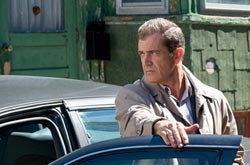
Mel Gibson as Thomas Craven
And actually, that's a good way to describe the movie as a whole—a stylish but low-key film that splits the difference between a throwback thriller and a modern-day noir. Gibson plays Boston detective Thomas Craven, who at the film's beginning is excited to have his grown daughter Emma (Bojana Novakovic) take some time off from work to come stay with her old man. His joy quickly turns to worry, however, when he finds that his daughter is mysteriously ill.
She becomes violently sick while sitting at the dinner table, and it's enough to convince both her and her father to immediately seek a doctor. Thomas doesn't get his answers, though, and Emma doesn't get the help that she needs because, as soon as the front door is opened, Emma is gunned down by a thug with a shotgun.
Bojana Novakovic as Emma Craven
The rest of the film—like its protagonist—is haunted by grief. The movie is punctuated by flashbacks to Thomas with his young daughter, and he even imagines (or hallucinates) that she is still with him, talking to him. The tone is somber; it's dark and very talky, but Campbell brings a different style than what he did with Casino Royale. There aren't a lot of big chase scenes or explosive set pieces; the movie is made up of long stretches of quiet, intimate dialogue, usually punctuated with loud, jarring bursts of violence.
As an effective thriller, it works well: The pacing is right, and the Bernard Herrmann-styled score underscores the material's bombast. But that's where things begin to fall apart: Rather than keep the focus on Craven and his grief, the film's sadness slowly turns to righteous anger. Craven, of course, can't help but investigate the cause of his daughter's death, and while everyone else assumes that the shooter was actually targeting Thomas, he quickly finds that it was Emma herself who was the gunman's object. As he investigates his daughter's mysterious personal and professional life, he finds that her work as a research assistant for a government-sponsored nuclear testing facility has taken her deep into some troubling conspiracies.
Craven on the prowl for his daughter's killer
And … well, I dunno. The deeper the film delves into its layered plot, the more ludicrous and convoluted it becomes. There is plenty of talk about terrorism and Homeland Security, but also an environmental angle, and the whole plot is vague enough that it could just as easily have been a political thriller from the Cold War as it is a product of the War on Terror. All attempts at profundity are silenced by the deafening anger at the movie's core—anger at no one in particular; anger borne from a strong but rootless feeling that the government is just one big conspiracy, that they're all out to get us, that we're pawns in their game and there's nothing we can do about it. (And Gibson has made that movie before.)
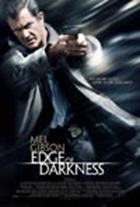
In other words, it's sinister and bleak, but also insubstantial. So what's the payoff? Alas, like so many films in which Gibson has chosen to participate, this one ultimately deteriorates into a revenge flick. (Indeed, the movie poster's tagline reads: "Few Escape Justice. None Escape Vengeance.") Craven's quest comes less about finding out who killed his daughter and more about taking revenge on anyone who he thinks could have played a part. The final few minutes of the film recall nothing so much as The Departed (whose screenwriter, William Monahan, is also credited here): There's a lot of blood and startling gunfire, and very few people are left standing at the film's conclusion.
You won't like me when I'm angry
In other words, the film masks its paranoia in populism, and unfortunately, it just might work: In the theater where I screened the movie, audience members cheered loudly at some of the film's most violent and vengeful moments. That's not my kind of crowd-pleaser, and it's a bit of a disappointment: Edge of Darkness is not without its virtues, and chief among them is its proof that Campbell could direct a really taut, terrific thriller, and that Gibson doesn't necessarily have his best work behind him. Alas, all that promise is unfulfilled here, and Edge of Darkness ends up angry and depressed.
Article continues below
Talk About It
Discussion starters
What form does Craven's grief take? How would you respond if you were in his situation?
Do you think the film romanticizes revenge? Is Craven wrong for doing what he does?
Do you think the film says anything worthwhile about the nature of politics, corporate greed, or our reaction to large-scale wrongdoings?
The Family Corner
For parents to consider
Edge of Darkness is rated R for strong bloody violence and language. The language is restricted to just a couple of brief outbursts, but the violence is often very graphic and bloody, definitely deserving of its strong rating.















 While we pray for peace, we need moral clarity about this war.
 Alcoholism among women is rising. Can the church help?
 After this week’s UMC votes on LGBTQ issues, African Methodists should join American conservatives in the new Global Methodist denomination.