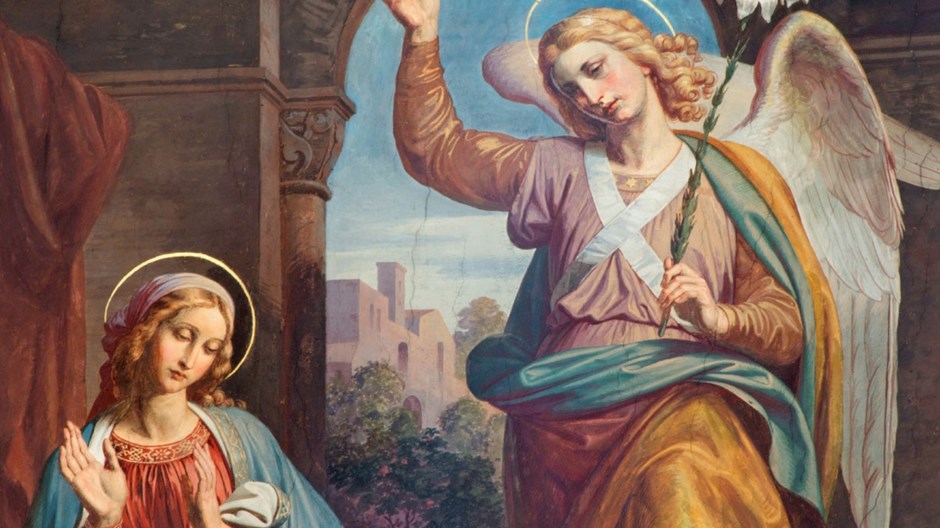
Most evangelical Protestants are today sitting out as Roman Catholics, Eastern Orthodox, and some liturgical Protestants celebrate one of the most significant events in the New Testament: the angel Gabriel's announcement to Mary that she would give birth to Jesus.
One might expect American evangelicals to be among the most enthusiastic celebrants of what is known as the Annunciation. For starters, it focuses on two issues that theologically conservative Protestants have long defended against theological liberals: the historicity of the Virgin Birth, and Christ's unique divinity. In a theological sense, the Annunciation could be of greater significance than Christmas.
"It connects directly to the incarnation, while Christmas (whatever the true date) falls around nine months after the incarnation," says pro-life writer Randy Alcorn. "It is basic Christian doctrine that Christ became flesh at the moment the Holy Spirit overshadowed Mary, at the moment of fertilization. He became human at the exact point all others become human, the point of conception."
And so the Annunciation's implications are intensely political as well as theological. Few days on the Christian calendar, and few passages in Scripture, are so relevant to the abortion debate. For example, Alcorn notes that since Mary "hurried" to see Elizabeth (Luke 1:39) after Gabriel's visit, it's likely that Jesus was not yet fully implanted in Mary's womb when Elizabeth's unborn son, John, "leaped for joy" (1:41-44). That, he suggests, helps to eliminate hairsplitting over when personhood begins.
Some Protestants have attempted to draw out the pro-life implications of the Annunciation. The group Lutherans for Life, for example, offers bulletin inserts, sample sermons, and other resources to make March 25 a catalyst for fighting abortion. But most Protestant churches, if they have an annual service devoted to the unborn, instead commemorate the January 13 anniversary of the Supreme Court's Roe v. Wade decision with Sanctity of Human Life Day.
Part of the reason may be that the Annunciation has not historically been a day for the church to focus on the unborn in general.
"Until modern science made abortion such an easy thing (they had it in the ancient world, of course—hence ancient medical oaths against it—but it was fairly primitive and often dangerous), and also made us far more aware of life in the womb, it wasn't such a major social issue," says Anglican theologian and bishop N.T. Wright. "'Christian' societies knew, from the days of the Roman empire, that abortion and infanticide were basically pagan practices, so the question wasn't raised."
By the time abortion became a major issue, says Dallas Theological Seminary New Testament professor Darrell Bock, "Protestant worship patterns were well established."
It's those Protestant worship patterns—and what they were in large part protesting—that historians, theologians, and pro-life activists agree are at the heart of the biggest reason why even the most pro-life evangelicals don't do much with the Annunciation.
"The Annunciation is not celebrated because it is about Mary and because the Roman Catholics make so much of it. It's that simple," says Scot McKnight, religious studies professor at North Park University. "The strong pro-life people are also often the strongest anti-Catholics, though they'll cooperate with Catholics against abortion." Similarly, he says, not celebrating the Annunciation is a symptom of Protestant aversion to the church calendar. "The only events of any significance in the evangelical church (non)calendar are Christmas and Good Friday/Easter." Even Pentecost is rarely celebrated in most congregations, he notes.
Melinda Delahoyde, president of CareNet, has seen the subject of Mary divide Catholics and evangelicals who are otherwise united on their anti-abortion views. "I think evangelicals shy away from Mary and celebrations of her high place in the faith, and that is an understatement. We do not focus on the process of the conception of Jesus and his unborn months from her perspective for various reasons," she says.
Rather than , she says, the Bible chapter pro-life Protestants most often draw on as their supporting text is . "This makes sense to me as an evangelical. We would focus on God's knowledge, plan and care for the unborn human life as it is laid out in Scripture and not on the announcement of that unborn life through a particular person." The two passages are simply "two different approaches to the same principle supporting unborn life," she said.
Baylor University philosopher Francis Beckwith, author of several books on abortion, sees another important reason Protestants and Catholics do not have the same response to the Annunciation.
"The reason evangelicals probably don't celebrate the unborn Jesus is the same reason they don't celebrate the teenage Jesus: it's not part of his three-year ministry," said Beckwith, who returned to the Roman Catholic faith of his childhood in 2007, while president of the Evangelical Theological Society. "There is, especially in American evangelicalism, a huge emphasis on pragmatic Christianity: saving souls, getting stuff done. Jesus, in his ministry, was getting stuff done. He wasn't just laying there in a womb or a manger. For Catholics and Orthodox, however, the salvation that evangelicals preach more fervently depends on the lowliness of the Christ and his incarnation. Hence, the different emphases."
Article continues below
Even if evangelical Protestants did take the church calendar more seriously, the Annunciation wouldn't overtake Christmas as the dominant celebration of the Incarnation, says Gerald McDermott, professor of religion at Roanoke College.
"While the medievals talked profusely about Christ in the womb, and most notably Thomas Aquinas on the wisdom of Jesus in the womb, the Annunciation typically fell during Lent and so was overshadowed by preparation for the Passion," McDermott said.
That has shaped an emphasis on Christmas over Annunciation even in the Christian traditions that place a high emphasis on Mary and the church calendar, says McKnight, who notes that the two times of preparation in the church calendar are Lent and Advent. In Roman Catholic tradition, the feast of the Annunciation is moved if it falls during Holy Week. (Not so in the Eastern Orthodox tradition, though due to calendar differences, Orthodox Holy Week no longer falls in March.)
There's good reason for Christmas to trump the Annunciation, says Roger Olson, theology professor at Baylor: "The actual day of Jesus' birth (and some subsequent events of unknown chronological relationship to it) is given more attention in the gospels."
Besides, McDermott noted, "The Annunciation marks not the conception but the announcement of a future conception: 'You will conceive' (Luke 1.31). In church tradition the birth of Jesus has always gotten more attention than the conception, just as human birthdays are remembered in most cultures. Incarnation of course began at conception, but is first seen by the world on someone's birthday."
It's of no matter that we don't know when Jesus was actually conceived, says Olson. "We usually don't know the exact date of anyone's conception." That's why we celebrate birthdays. "It was natural, then, for the church to identify a 'birthday' for Jesus (even if we don't know either day)."
Article continues below
Contrary to some occasional rhetoric, says Jon Shields, assistant professor of government at Claremont McKenna, pro-lifers who prioritize birthdays are not being inconsistent. "Most citizens—including millions of pro-choice ones—don't think birth marks our beginning," he says. "Some pro-choice scholars even think persons come to be after birth—yet presumably even Peter Singer celebrates his birthday. I think birthdays are important for another reason: we become fully visible and known at birth. This is true even for the mother who gets to really see and hold her baby for the first time. So, there is a way in which Jesus does enter the world at his birth even though he has been a person for nine months."
In other words, while Elizabeth and Mary shared the joy of Gabriel's news and Mary sang her famous song of praise to the Lord, the Annunciation marks a private moment of obedience and the quiet explaining words of an angel. It was not until Christmas that the heavens burst forth with singing angels and stars in the East.
"The nativity is a public celebration of the person whose life began nine months earlier, at the Annunciation," says Paige Comstock Cunningham, executive director of the Center for Bioethics & Human Dignity. "March 25 is the unsentimental observance of the staggering reality of God joined with man in a human zygote."
Indeed, says Wright, "March 25 is an important day, and that there is quite possibly a lot of food for thought waiting to be served up there," for discussions of the unborn, for Jesus' divinity, and other issues. However, he says, "A word of caution: The four canonical gospels do indeed teach the divinity of Jesus. But they teach it within the context of the coming of God's kingdom on earth as in heaven. The 'divine identity' of Jesus is nothing more nor less than the coming of Israel's God to be king of the world, through his inauguration of the kingdom climaxing in his death and resurrection. Unless we learn this and teach it—and live it—no amount of interesting speculation about the 'person' of Jesus will be anything other than a displacement activity."
Ted Olsen is Christianity Today's managing editor for news & online journalism.













 While we pray for peace, we need moral clarity about this war.
 We’ve got little information on Jesus’ appearance and personality. But that’s the way God designed it.españolFrançais
 The government plans to close its porous border with Myanmar to boost security, separating ethnic groups that straddle the boundary.





