The House of Representatives is working day and night in its effort to cut more than $60 billion from the federal budget. The House is considering a continuing resolution, a bill used to fund the federal government for the remainder of the year. The bill includes deep cuts for environmental agencies, education, and foreign aid (except those related to security). It makes modest reductions for defense, homeland security, and police. These cuts are in line with the spending priorities of most American evangelicals.
The Pew Research Center for People and the Press released a February 10 survey of Americans on their budget priorities, in which they asked them whether they favored increasing, decreasing, or keeping current levels of spending in specific policy areas. Pew provided Christianity Today with a religious breakdown of questions on the budget and spending priorities.
Overall, evangelicals were more likely to favor reductions in federal spending, but like other Americans, they wanted most areas to remain the same or increased.
The top choices among evangelicals for the chopping block are economic assistance to needy people around the world (56 percent), government assistance for the unemployed (40 percent), and environmental protection (38 percent). In each of these categories, evangelicals were more supportive of decreasing spending than are other Americans. In fact, evangelicals were more supportive of funding cuts in every area except military defense, terrorism defense, aid to veterans, and energy.
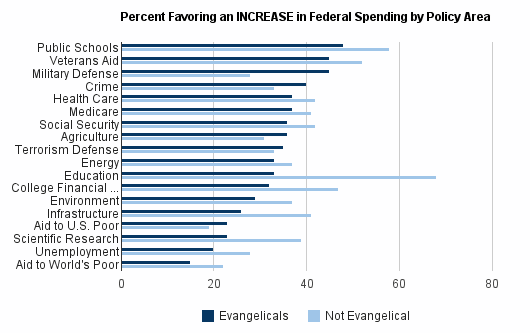
In general, Americans are more in favor of spending increases, not decreases. Evangelicals were more likely to favor an increase in defense spending (45 percent) compared to non-evangelicals (28 percent). The largest gap between the two groups, however, was in areas related to education, an area the House bill targets for some its largest cuts.
When asked about "public schools," evangelicals supported increasing funding (48 percent), but this was 10 points lower than others' support for schools (58 percent). When asked about education funding in general (just "education"), 68 percent of non-evangelicals support increased spending compared to only 35 percent of evangelicals. Gaps appeared in other education areas including college financial aid (47 percent to 15 percent) and scientific research (39 percent to 16 percent).
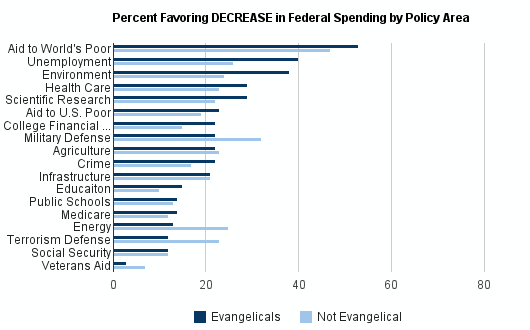
Cutting foreign aid and support for the unemployed while favoring increases in defense and police are not priorities of all evangelicals.
Robert Zachritz, government relations director for World Vision in the U.S., said in a statement that U.S. programs help save lives worldwide. He said eight million children who die each year, lives that could be saved with low-cost aid programs to provide malaria bed nets or child immunizations. "World Vision recognizes the need to make tough decisions addressing the present fiscal crisis, including budget cuts, but these should not fall disproportionately on the poorest of the poor," Zachritz said. "Congress is considering an overall budget reduction of 8.8 percent from the FY 2011 presidential request, with cuts disproportionately made to the most cost-effective humanitarian programs saving children's lives."
Sojourners is lobbying against the House bill, asking people to ask, "What Would Jesus Cut?"
"The moral test of any society is how it treats its poorest and most vulnerable citizens. And that is exactly what the Bible says, over and over again," said Sojourners president Jim Wallis. "Taking the cutting knife to programs that benefit low-income people, while refusing to scrutinize the much larger blank checks we keep giving to defense contractors and corporate executives, is hypocritical and cruel. I'll go even further and say that such a twisted moral calculus for the nation's fiscal policy is simply not fair, and not right. It is not only bad economics, but also bad religion."
Most evangelical activists have remained less vocal over specific funding decisions except to support efforts to defund Planned Parenthood and any other organization that provides abortions. Federal funds cannot be used for abortions, but critics suggest that the money given to Planned Parenthood allows them to shift funds towards providing abortions. A bill sponsored by Rep. Mike Pence (R-Ind.) would eliminate funding to such organizations. This bill is being actively supported by the Southern Baptist Ethics & Religious Liberty Commission, the Family Research Council, the American Family Association, and other pro-life organizations.
Copyright © 2011 Christianity Today. Click for reprint information.
Related Elsewhere:
Christianity Today covers other political developments on the politics blog.







Support Our Work
Subscribe to CT for less than $4.25/month