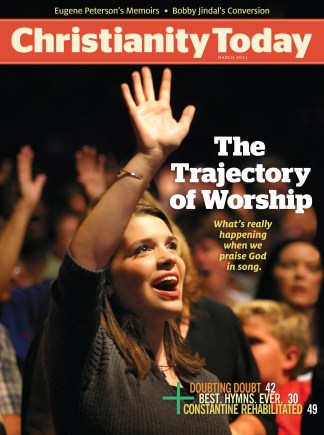
The first time I can remember singing from a hymnal was in 1972. It was the year between high-school graduation and college, the year I got my first full-time job. That year my mother's health began to fail, and my world shifted on its axis as I started to follow Jesus. That was the year I began to attend Glad Tidings, a plain concrete bunker of a church, whose colored windows reminded me more of ashtray glass than cathedrals.
Glad Tidings was a Pentecostal church, but of the reserved variety. Their Azusa Street brethren might whoop and dance. Let other congregations swoon in ecstasy, ravished by the Spirit, or speak in the mysterious languages of men and angels. Not the folks at Glad Tidings. It's not that they didn't believe in such things. They were convinced that God had the power to interrupt the service at any moment. He might send them all into a fit of shouting that lasted for days. Indeed, they prayed for such things to occur. But they never acted as if they actually expected he would.
Most of the time, or so it seemed, God respected their suburban sensibilities and kept a polite distance. But every so often the Spirit would stir the congregation the way the angel stirred the waters of Bethesda, and one or two voices would cry "Glory" or "Amen." They were always the same voices, of course. They never made this declaration at any volume that would disturb our decorum. But it was loud enough for all of us to hear. Just loud enough to let the rest of us know there was glory afoot.
Red Hymnals and Campfire Rounds
Glad Tidings was less self-conscious about singing. Three or four times during the service, the entire congregation reached for the old red hymnals in the pew racks and gave voice to their faith. The dog-eared hymnal pages were illuminated by the penciled scrawls and stick figures of bored children. The stanzas below those hieroglyphics depicted the pilgrim life of Jesus' followers as one of wandering and weariness, tears and tarrying.
We were passing through the valley.
We were camped on the banks of the river.
We were sinking deep in sin.
The hymn writers helped us get our bearings by pointing to the milestones along the way.
We were at Bethel with Jacob.
We were drinking water from the rock with Moses.
We were in the Garden with Jesus.
I wouldn't describe the melodies of those old hymns as pretty. They seemed strange to me, as archaic as the shape-note harmonies of the Sacred Harp, from which many of them were hewn. They exuded a kind of musty charm for me, the way my grandmother's house did with its ancient wood and iron stove. Something about them reminded me of the songs my father and uncles sang after they had drunk too much beer. Songs with titles like "Let Me Call You Sweetheart" and "On the Road to Mandalay." Those hymns rolled along with a rhythm that was so predictable, you didn't need to know the words or the melody to sing them. If you knew one hymn, it seemed, you knew them all. And if you didn't know it, you had only to wait a stanza or two to sing it like you knew it.
The songs we had sung the night before at the Lost Coin Coffee House were different from the hymns we sang in church. The Lost Coin was located in the Sunday school building just across the parking lot from Glad Tidings. At the Lost Coin, we worshiped God with campfire rounds led by a gangly guitar player named Mike who prayed daily for the salvation of Bob Dylan and George Harrison. The songs we sang at the Lost Coin were simpler, based on a handful of chords and a seemingly endless repetition of the chorus. We didn't mind. If anything, their simplicity made them even easier to sing than the old gospel songs. We sang them with enthusiasm. We clapped. We stomped. We sang in antiphonal rounds. We mirrored the meaning of the words with hand gestures. If someone had taken the words of Psalm 119 and fit them to the tune of "Bingo" ("There was a farmer had a dog and Bingo was his name-o"), we would have sung it. All 176 verses.
The songs we sang at the Lost Coin were fun. But fun is not the word I would use to describe the hymns of the church. If the campfire rounds we enjoyed at the coffeehouse taught us that we could lift our voices in worship, those old hymns taught us how to lift our gaze. The God spoken of in those songs was not fun but immortal and invisible. He was so holy we had to say it three times. "Man of Sorrows, what a name," we cried, "Hallelujah! What a Savior!" Those were the kinds of songs that caught in your throat and moved you to tears. The kind that made you stand a little straighter and sing a little louder.
Now, 38 years later, I find that I have reached a stage in life where most of the music I hear in church is "their" music, whoever "they" are. That is to say, I have reached a stage in life where most of the music I hear in church annoys me. I do not mean to be a musical snob. Indeed, I think of myself as an eclectic. I was raised on Bix and Beethoven. I came of age in the era of the Beatles. The buttons on my car radio are set to classical, country, oldies, rock, and even Christian music. I think of myself as someone who has been baptized by immersion in the waters of musical diversity.
Yet somehow when Sunday comes, all my musical sophistication dissolves, and I am reduced to that most primitive test of aesthetic values: "I may not know what art is, but I know what I like." Or, rather, "I may not know what worship is, but I know what it isn't." When the worship leader reminds me that worship "isn't about me," I try to take it to heart. I really do. Nevertheless, more often than not, I walk into church hoping to be a worshiper and leave a curmudgeon. A chastened curmudgeon. A repentant curmudgeon. But a curmudgeon nonetheless.
The root of my problem is one of vertigo, not aesthetics. What I need is not a change of tune so much as a reorientation along worship's true trajectory.
Reversing Field
I have concluded that the root of my problem is one of vertigo, not aesthetics. What I need is not a change of tune so much as a reorientation along worship's true trajectory. Like most churchgoers, I tend to view worship as something that moves from earth to heaven. We think of worship as something that originates with us, our gift to God. Perhaps this is why so many of us are conflicted about it. We consider worship to be an expression of our personal devotion. So when the musical style or some expression gets in the way, we don't feel like it is our worship at all. It is someone else's idea of worship. Perhaps the worship leader's or that of the majority. But not our own.
The biblical portrait of worship moves in the opposite direction. The trajectory of heavenly worship begins with God and descends to earth. This trajectory is reflected in Psalm 150, where praise begins in the heavenly sanctuary and resounds throughout the domain of God. From there it is taken up by those on earth, who praise God with a variety of instruments and dancing, until "everything that has breath" praises the Lord (Ps. 150:6).
We find the same trajectory of worship in Revelation 5. John, who has been caught up to heaven and sees an innumerable multitude of angels and saints surrounding the throne of God, hears the angels declaring the worthiness of the Lamb "to receive power and wealth and wisdom and strength and honor and glory and praise!" Revelation 5:13 continues: "Then I heard every creature in heaven and on earth and under the earth and on the sea, and all that is in them, saying: 'To him who sits on the throne and to the Lamb be praise and honor and glory and power, for ever and ever!' "
In his book Working the Angles, Eugene Peterson makes an observation about prayer that applies to worship in general. "Prayer is answering speech," Peterson writes. "The first word is God's word. Prayer is a human word and is … never the initiating and shaping word simply because we are never first, never primary." Worship is by nature answering speech. Like a musical instrument in which one plucked string causes all the other strings to resonate, earthly worship resonates with the worship of heaven. Worship is not our attempt to project our voices so that they will be heard in heaven. Neither is it a performance executed on the earthly stage for the benefit of a spectator God. It is certainly not something we do primarily for ourselves, as if it were a kind of self-amusement or spiritual entertainment.
In a sermon entitled "Praise, One of the Chief Employments of Heaven," Jonathan Edwards explained, "Let it be considered that the church on earth is the same society with those saints who are praising God in heaven. There is not one church of Christ in heaven and another here upon earth." This means that when the church gathers for worship, it engages in a heavenly activity. The worshiping church does not merely imitate what goes on in heaven. It participates in heaven's worship. Like one who walks into the church sanctuary after the service has started, those who worship on earth move into something that is already in progress. We take up a theme that was begun by others before the throne of God, adding our voices to theirs.
Consequently, the worshiping church is part of a much larger congregation. It is one that includes patriarchs and prophets, saints and angels. No wonder Edwards called worship "the work of heaven" and observed, "If we begin now to exercise ourselves in the work of heaven, it will be the way to have foretastes of the enjoyments of heaven."
A Heavenly Congregation
The psalmist's portrait of worship is noteworthy because it is so specific. One thing is clear from his description in Psalm 150:3-5: It is appropriate to worship God with music. Most believers agree with this. What we often don't agree on is the kind of music and which instruments to employ in this worship. The reasons for our differences are varied and far more complex than we realize. Some of our differences are a function of culture and taste. We grow accustomed to certain instruments and prefer particular styles. I like the music I grew up with. I hate the music my kids listen to. But personal tastes change. My father was a huge fan of jazz, not the "cool jazz" of today but old school jazz: Bix Beiderbecke, Louis Armstrong, and Fats Waller. As a kid, I hated his music. When I became an adult, especially after my father died, I found that I liked it because it reminded me of him. This is not unusual. Personal experiences shape our musical preference. So do society and culture.
But even deeper reasons remain for our reaction to the music we hear in church. In his book Resounding Truth, Duke theologian Jeremy Begbie writes that music not only reflects a social and cultural order, it is also embedded in what he calls a "sonic order." Music " … involves the integrity of the materials that produce sound and of sound waves, the integrities of the human body, and the integrity of time." "When we hear music," Begbie writes, "a whole range of elements are pulled together—in particular, our state of mind and body, memories and associations, social and cultural conventions, and other perceptions that come along with the musical sounds. Together, these greatly affect the meaning the music will have for us."
What does this mean for us as far as worship is concerned? For one thing, it means that we cannot help being profoundly affected by the music we hear. Music affects us on every level: neurological, physiological, aesthetic, and emotional. When someone says to me, "I just can't worship to that music," I believe them. But the psalmist's description of the worship of heaven suggests that the variety of musical styles, the instruments used, and the methods the church employs in its worship should exceed the scope of taste.
Simmering Differences
In light of this, three suggestions arise almost spontaneously. They are not new thoughts by any means, but they bear repeating, given that tensions surrounding worship are always simmering below the surface of congregational life.
When the church gathers for worship, it engages in a heavenly activity. The worshiping church does not merely imitate what goes on in heaven. It participates in heaven's worship.
First, we don't have to please everyone when it comes to worship. Given the variety of styles and tastes, it is not possible to please all people all the time. I am certain that the psalmist's style of music would sound alien to my ears. If that's true, I don't need to be ashamed of the fact that I really do hate some of the music I hear in church, nor be upset that not everyone agrees with my judgment.
Second, the quality of music is not always the most important factor in our worship experience. Clearly some music is better than other music. A Beethoven piano concerto is qualitatively better than "Chopsticks." Part of me wants to believe we should offer God only the best. Yet the worship that moves me most and is the most effective vehicle for helping me to enter God's presence is not always the best music.
Third, it is not our differences in taste but rather our mutual contempt and lack of respect that have caused the most damage in the church. What has hurt us most has been our unwillingness to acknowledge that all of us have sacrificed in some measure when it comes to the church's experience of worship.
Worship is not a private practice. It is the chief work of heaven and the duty of every creature. A day will come when our conflict and mutual discomfort over the church's worship will end. Until then we must muddle through the best we can by reminding ourselves that we are part of a much larger congregation—one populated by patriarchs and prophets, saints and angels, where we are invited to join a chorus that began on the first day of creation. The first notes were sounded by those who surround the throne in heaven. Their theme echoes through the rest of God's domain. All that remains is for us to add our voices to their song.
John Koessler is professor of pastoral studies at Moody Bible Institute and author of the forthcoming Folly, Grace, and Power: The Mysterious Act of Preaching (Zondervan). Part of this article appeared in a PreachingToday.com sermon, "The Hallelujah Chorus."
Copyright © 2011 Christianity Today. Click for reprint information.
Related Elsewhere:
Go to ChristianBibleStudies.com for "The Trajectory of Worship, a Bible study based on this article.
Check back all this week for more articles from March's special issue on worship. Previously posted articles include:
The Hymns That Keep on Going | The 27 worship songs that have made the hymnal cut time and again. (March 7, 2011)
Whatever Happened to Amazing Grace? | Why John Newton's famous hymn failed to win, place, or show. (March 8, 2011)
Pop Goes the Worship | Religion professor T. David Gordon says Muzak has shaped singing in church. (March 9, 2011)
Worship in Black and White | Racial reconciliation happens when we not only sing each other's songs but learn the stories embedded in those songs. (March 10, 2011)
Also, both Christianity Today and Leadership Journal have special online sections on worship.