The life and work of J. Edgar Hoover offers grist for a dozen different movies or more, and Clint Eastwood’s J. Edgar wants to be all of them at once. It’s the sort of staidly respectable, competently directed biopic that gives a bad name to competently directed biopics, and possibly to respectability.
Everything that ought to happen does happen, but seldom with much sense of urgency or revelation. The one question in which the screenplay by Dustin Lance Black (writer of the biopic Milk, about gay-rights activist Harvey Milk) takes a vital interest is whether the perpetual flirtation between Hoover (Leonardo DiCaprio) and his right-hand man Clyde Tolson (The Social Network‘s Armie Hammer) will or won’t spill over into physicality.
Like Richard Attenborough’s reverential Chaplin (starring Robert Downey Jr,), J. Edgar takes a lazy shortcut to summarizing its subject’s life: depicting the great man dictating his memoir, the better to assure his legacy and that of his beloved agency. This device allows Black to put in Hoover’s mouth nuggets apparently drawn from his own notes for the screenplay, such as, “Believe what you will about historians—most write from a present perspective, forgetting context.” And “Let’s leave that to the reader’s imagination. It’s important to preserve a bit of mystery about our hero.” Hoover even goes so far as to caution his scribe that “Even great men can be corrupted”—meaning, of course, other great men.
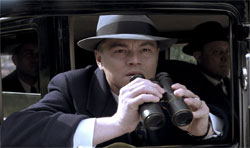 LEONARDO DiCAPRIO as J. Edgar Hoover in Warner Bros. Pictures’ drama “J. EDGAR,” a Warner Bros. Pictures release. ?????????????????????????????????????????????????????????????????????????????????????????????????????????????????
J. Edgar does offer some historical context. A dramatic early depiction of the anarchist bombings of 1919 and the Palmer raids that followed, including a raid on the Russian People’s House in New York that allegedly turned up bomb-making material, reminds us that there was some real basis for the Red scare. A vignette in a movie theater depicting an audience booing a clip of Hoover, then cheering when the projectionist cuts Hoover short and starts a Jimmy Cagney gangster feature, illustrates the folk-hero status that gangland figures enjoyed in those days, and offers some perspective on Hoover’s interest in promoting the figure of the heroic G-man in comic books and movies.
But it’s not enough to show us these things: Hoover has to say things like “They’ve forgotten the bombs, the terror, the raids.” And “Just like the Communist before him, the gangster finally fell from favor; now children dreamed of joining the FBI.” The more he explains to his biographers, the less room there is for the mystery that Hoover himself told us is needed. Toward the end, the film undercuts some of what we’ve seen by revealing that Hoover hasn’t been honest with his biographers, but here too we’re simply told what happened in a way that undermines rather than enhances any mystery.
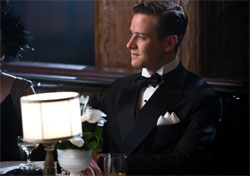 ARMIE HAMMER as Clyde Tolson in Warner Bros. Pictures’ drama “J. EDGAR,” a Warner Bros. Pictures release.
Over the course of its long 137-minute running length, J. Edgar hits all the expected marks. The film makes much of Hoover’s doting but domineering mother Anna Marie (Judi Dench), who tells her son at one point that she’d rather have a dead son than one who is a “daffodil” (daffodils apparently being equivalent in this connection to pansies). The Lindbergh kidnapping gets a prolonged chapter. The Kansas City massacre, the JFK assassination, and Hoover’s vendetta against Martin Luther King Jr. are all present and accounted for. Shirley Temple and Ginger Rodgers put in appearances. Yet the film has little if anything interesting to say about any of this.
We see Hoover the visionary, laboring to bring investigative procedure into the modern era, innovating forensic techniques and tools taken for granted today, such as the FBI’s centralized fingerprint library. Hoover the autocrat, making petty judgments about agents’ fashion sense and firing those who rub him the wrong way. Hoover the loose cannon, for whom due process was optional rather than mandatory, engaging in illegal surveillance if he felt like it, amassing secret files on the personal lives of prominent and not-so-prominent Americans, and stooping to blackmail to get what he wanted.
Yet because almost none of the other characters are fleshed out, the effects of Hoover’s actions on the world have little impact. The social impact of the Lindbergh kidnapping is palpable only in the look on Anna Marie’s face when she stresses how important it is that the baby be brought home. The enormity of Hoover’s shady actions is largely expressed by tut-tutting from the long-suffering Tolson, who comes across as expressing the screenwriter’s voice in the world of the story. It’s Tolson who calls Hoover on the distortions of his memoir, so we know we’re getting the straight dope, there.
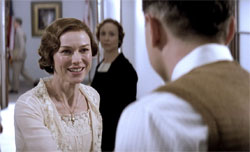 NAOMI WATTS as Helen Gandy in Warner Bros. Pictures’ drama “J. EDGAR,” a Warner Bros. Pictures release. ????????????????????????????????????????????????????????????????????????????????????????????????????????
The filmmakers never get close enough to any people or situations drastically affected by Hoover’s actions, for good or for ill, to feel their pain or their relief. Hoover’s work benefited some lives and ruined many others. What does that mean in human terms? Or, failing that, what are the implications for the future? J. Edgar is too wrapped up in its title character and a very few others—essentially Tolson and Anna Marie—to come to grips with such questions.
Plying a curious accent and acting at various points in differing degrees of aging makeup, DiCaprio is never convincing as a man born at the end of the 19th century, coming of age before the first World War and reaching old age before Leo was born. The problem isn’t the makeup, which is adequate (at least, DiCaprio’s makeup is adequate; Hammer is another story). Leo sometimes looks persuasive as the old Hoover—until he opens his mouth and those childlike tones emerge.
Period fedoras and pinstripes aside, Leo’s own face, as the young Hoover, is intractably that of a boy-man of the latter 20th century—a man who looks younger in his late 30s than Hoover looked in his late 20s. Men back then aged differently than today’s pretty Hollywood heroes. Actors like Matt Damon, Orlando Bloom and Tobey Maguire will look like aging teen idols well into their 50s and beyond. Men like Gregory Peck and Henry Fonda looked like grownups at 25.
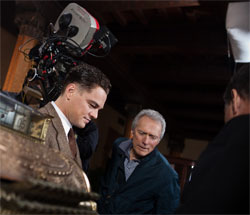 (L-r) LEONARDO DiCAPRIO and director CLINT EASTWOOD during the filming of Warner Bros. Pictures’ drama “J. EDGAR,” a Warner Bros. Pictures release.
In the end, J. Edgar ventures to draw a conclusion: “Love is the greatest force on earth,” Hoover intones, “more enduring than hate.” This is, in fact, true, though it’s a truth the movie hasn’t explored and hasn’t earned. Is Hoover’s love of his mother, or of Clyde Tolson, more enduring than his hate of Dr. King, Eleanor Roosevelt, or other people whose politics he opposed?
That’s not what the movie means, of course. It means that the love of two men is more enduring than the hate that opposes such love—the hate even of a mother who would prefer a dead son to an effeminate one. That’s an awfully glib postscript to wrap up the story of a life as complex, controversial, and consequential as that of J. Edgar Hoover.
Talk About It
Discussion starters- Which character did you find most interesting? With whom, if anyone, did you most sympathize, or most identify? Why?
- Hoover’s secretary (Naomi Watts) turns down an early romantic overture by Hoover, but serves him faithfully all her life, keeping his secrets and protecting him to the end. What do you think her motives are? Does the movie offer any insight?
- Hoover places a high premium on loyalty. How important is loyalty? Are there any limits to loyalty?
- Hoover says “Sometimes you have to bend the rules to keep your country safe.” Is there any truth to this statement? Are there rules that can be “bent” or broken for a greater good? Are there rules that should never be bent or broken?
- What are the potential dangers when people take it upon themselves to bend the rules for a greater good?
The Family Corner
For parents to considerJ. Edgar is rated R for brief strong language, including an F-bomb and a couple of strong obscenities. God’s name is taken in vain at least once. There are references to the indiscretions of prominent Americans, both heterosexual and otherwise, and an audiotape of sexual sounds. Violence includes a terrorist explosion, some gunplay, a brief beating and a fisticuff. There is also a brief image of a baby’s skeletal remains. There is also some drug content: Hoover gets regular injections of an unspecified “pick-me-up” cocktail.