



The men planned to meet in the desolate rainforest of Central Africa, amid towering 150-foot trees and swarms of small butterflies clustered like shark teeth on the seemingly endless red clay road. Their discussion would lead to clean drinking water for hundreds of destitute villages—and the fracturing of a tight-knit missionary community.
Driving east from Berberati, a town of 80,000 where diamonds can be found in nearby streambeds, was Roland Mararv. The former Iron Curtain Bible smuggler had traded the life of a Swedish Baptist missionary for that of a commercial well-driller—a better way, he believed, to help the Central African Republic (CAR) escape the ranks of the world's 10 poorest nations. After 20 years in business, Mararv was seeking a suitable buyer for his drilling company, Sangha Forage.
Having traveled originally west from Bangui, the landlocked nation's capital of 700,000 along the wide Ubangi River, was Jim Hocking. The longtime Grace Brethren missionary had been raised in the CAR and was looking for a way to pursue his empowerment dreams for Central Africans that his mission's emphasis on souls had been constraining.
Their 2003 meeting was a fateful one. What transpired over the next few years provides a window into how complicated it is to build clean wells in remote villages and let donors know exactly where and how wisely their money was spent.
Strong beginning
Mararv had drilled 1,400 wells nationwide and was ready to retire from drilling thanks to a 600-well contract with the German government and a fortunately timed devaluation of the local currency. Hocking was chafing at a mission desk job in the States while his wife recovered from a traumatic experience. (Their family was robbed at gunpoint before the CAR's 2003 civil war, the nation's fourth in 10 years, making it Africa's most lawless country after Somalia.) Yet Hocking still wanted to help his fellow Central Africans, who face an average life expectancy of 50 years and, for most, income of less than $1 per day.
They devised a plan: Mararv would donate his $1 million drilling operation to Hocking, who would use it as the cornerstone of a new charity, Integrated Community Development International (ICDI).
ICDI was birthed at the right place at the right time. It caught a surging wave of evangelical interest in Africa and water aid. Living Water International, with more than 10,000 wells completed in 26 countries, got the ball rolling in 1990 in Kenya. Dozens of smaller Christian ministries have sprung up since. Charity:Water, launched in 2006 by former New York City nightclub promoter Scott Harrison, has arguably taken water aid to a new level of prominence, raising more than $40 million for 4,300 projects in 19 countries.
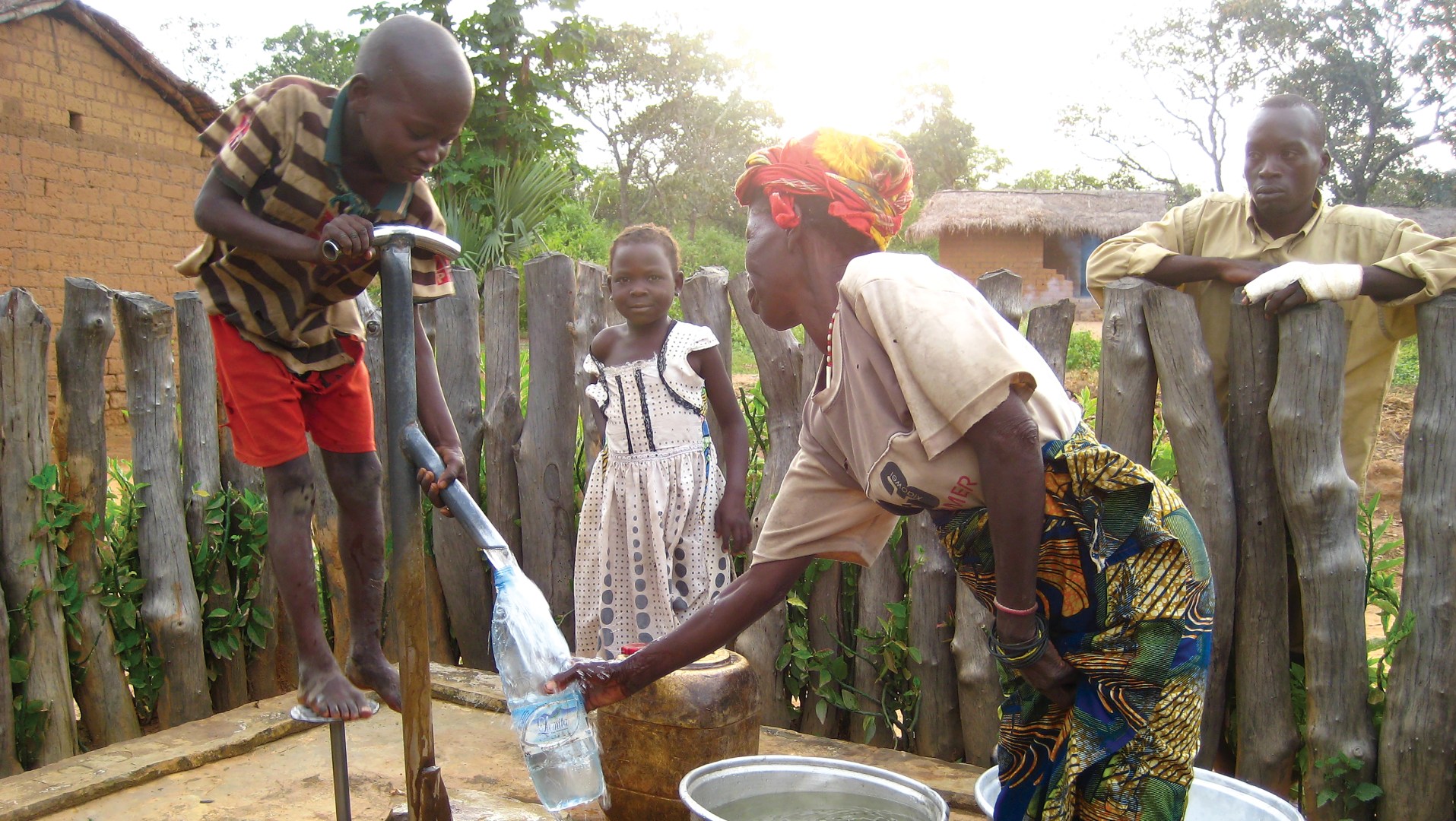
The pitch was compelling: Bring clean drinking water to the African nation once deemed "the world's most silent crisis" by the United Nations. The World Health Organization (WHO) estimates that water-related illnesses kill more African children under age 5 than HIV/AIDS, malaria, and measles combined. Access to clean water reduces water-related deaths by 21 percent, and the hours previously spent either ill or fetching water can now be used by women for economic endeavors and by children for schooling.
Within a few years, ICDI—which also launched orphan care, radio, AIDS education, and agriculture programs—was pulling in more than $2 million in donations from NGOs, churches, and individuals.
In September 2010, Charity:Water chose ICDI as the recipient of its high-profile anniversary campaign. It raised $1.7 million in four months to help provide wells to the Bayaka, an indigenous tribe known as pygmies (adults are less than 5 feet tall). A special edition of ABC News' 20/20 this past December highlighted ICDI as one of six groups improving global health.
Stateside, things were rosy for ICDI. It reported to donors that over 200 new wells had been drilled and another 800-plus maintained. It planned a $4.2 million budget for 2011.
But back in the CAR, a March 2010 lawsuit by ICDI's African representative, a former education minister and governor, was the latest evidence of relational bridges ICDI burned during its rapid growth.
The three missionary couples who first helped Hocking operate ICDI had all left on bad terms. Their missions also severed ties with the organization whose founding purpose was to serve as "an adjunct to existing mission programs" (since changed to "empower Central Africans").
Mararv and his wife, Gunnel, codified concerns in a 100-page report. They alleged that ICDI had engaged in double billings and had lied about well rehabilitations to the tune of more than $1 million.
"I have no theory as to where all the money has gone," said Mararv to Christianity Today after traversing the nation examining many of ICDI's wells. "All I know is that you don't see it here."
Mararv became concerned about his donation after he noticed that wells for Gem Diamond, an international diamond mining company, appeared on a June 2008 donor update as paid for by Living Water. Subsequent research led to questions that, frustrated by ICDI's responses, prompted Mararv to complete his report which was sent to the ICDI board, major donors, and, eventually, CT.
Charges denied
ICDI, which had yet to complete a certified external audit, denied the charges. It countered with a 33-page board report, which led all of its major donors to affirm their support of Hocking. ICDI claims that Mararv not only drew false conclusions based on a "colossal misunderstanding" of incomplete information, but also was retaliating for no longer being allowed to import hunting supplies (for his son's safari business) undeclared on ICDI shipping containers—a practice Mararv says was permitted by ICDI until he began researching his report.
CT examined the reports, and drove 600 miles through some of the world's poorest villages, to understand what happened.
The core charges Mararv leveled at ICDI were claiming project totals that surpassed capabilities or records, as well as double billing: the same wells and rehabs would appear in donor reports for multiple NGOs. ICDI and Living Water say project totals do not match due to different reporting methods, cost-sharing, and typos—thus the mismatches don't represent actual missing dollars exchanged.
Regarding cost-sharing, some groups like Living Water donate less than the full cost of a given well so that recipients have incentive to develop other funding sources. Other times ICDI distributes costs to allow smaller donors to be involved, or to give donors better publicity via higher well counts. Over half of the wells in a 100-well project for the International Partnership for Human Development (IPHD) and a 36-well project for Mercy Corps in 2008 also appear in the donor reports of Charity:Water, Living Water, and Blood:Water Mission. A number of wells commissioned by Catholic missions appear on American NGO donor lists as well.
Mararv contests whether those wells needed to be cost-shared, given that he did the same work for roughly the same price, which included 25 percent markup for business taxes and 25 percent for profit margin—markups that a nonprofit wouldn't have. Jonathan Wiles of Living Water explains that ICDI projects may cost twice as much as Sangha Forage projects did because nonprofits have many other expenses that influence the bottom line, such as long-term training on sanitation and HIV/AIDS.
Regarding Gem Diamond, the company paid ICDI to drill two wells on its gated Likaya compound in southwestern CAR and another well for a neighboring village. But ICDI says the 2007 wells were twice as deep as normal, approximately 150 meters, and that two attempts resulted in dry holes. So it asked Living Water to cover the extra costs.
Quoted well prices are based on an average depth of 60 meters. So, with ICDI claiming a 65-meter average for 2007, Mararv says that it shouldn't have needed to bring in Living Water. Hocking counters that his reserves were so low that he couldn't wait out the year to see if he later recouped the costs.
Poor communication
Cost-sharing makes sense in principle, but implementation can be tricky. The ICDI board report claims that cost-sharing was built into NGO contracts. But Mercy Corps and Catholic mission leaders expressed surprise that their wells were also claimed by American NGOs.
This, in turn, leads to other confusions. For example, IPHD's 2008 funds were enough to rehab 40 to 50 wells but were spread across a 100-well rehab project in northern Ouham. Other donors, including Living Water and Charity:Water, made up the remainder. None of the donor reports share credit.
"I can't control what they tell their donors," said Hocking. "Nobody technically gets 100 percent credit."
Failing to share credit is "unforgiveable but very common," said Chris McGahey, a 28-year water management expert now with Tetra Tech ARD. "Too many organizations are bad record keepers. Love 'em to death, but by far their priority is to put the thing in the ground."
Other charges from Mararv include the following:
- Premature rehabbing: The Vergnet and India manually operated pumps prevalent in the CAR are designed for rigorous use. But Hocking says even a regularly maintained pump can break within 6 to 12 months from overuse by villages swollen with refugees. However, ICDI has imposed a two-year limit on rehabs and, in the wake of Mararv's report, said it has identified 10 wells rehabbed before the previous one-year limit and has made them right with donors.
- False reporting: Mararv says that ICDI reported that wells tested clean when they never were tested. Nearly all of ICDI's rehab reports through 2008 state that no disinfection was needed, claiming that samples taken to a government laboratory tested clean. But lab records exist for only half of the 2005 and 2008 wells, and not at all for 2006 and 2007. In addition, the government at that time tested mainly for aesthetics (odor and hardness), not potability—that is, for fecal coliform, arsenic, fluoride, and nitrates—as recommended by the WHO. Hocking says the lab never reported that any ICDI wells needed treatment. Living Water says it strongly encouraged ICDI to chlorinate every well but doesn't have a formal policy requiring it. Today ICDI tests every well in-house.
- Other double charging: Mararv alleges that ICDI charged both the U.S. embassy and an Italian foundation, Un Raggio Di Luce, for the construction of a fence and roof. Josh Danforth was the missionary running ICDI's orphan and agriculture programs from 2006 to 2008. He left ICDI in April 2008 and submitted a report alleging that ICDI had sent the same receipts to both the foundation and the embassy. He also alleged that ICDI had inflated the costs incurred and diverted materials intended for the project to its radio station in Boali.
The embassy declined comment. The foundation's Silvia Vienni remains unsatisfied with ICDI's documentation of her donations. Hocking says of the early years, "I robbed Peter to pay Paul many times, and then [always] paid Peter back later."
Overselling
The most puzzling practice involves ICDI's maintenance program, an expansion of a system Mararv devised to keep pumps working longer. Villages paid a small monthly fee ($8) and received regular maintenance visits, which reduced or even eliminated the need for major repairs.
Hocking has grown the program to 900 villages, up from 350 when Mararv handed it over, but only half of those villages pay regularly (Mararv had the same results). But the villages' payment histories show that many of the rehabs in ICDI's early years were of villages making steady payments, with donors paying $1,000 to $1,500 to cover the cost. This suggests to Mararv that either regular maintenance visits had not been made as promised (leading to deteriorating wells), or that maintenance visits were being "charged" to donors at rehab rates.
Along these lines, former staff have accused ICDI of using such donations to subsidize other ministries that were harder to raise funds for. "Why is well drilling being treated like a cash cow … ?" wrote Berberati garage chief Ron Ziegelbaur in a grievance e-mail before he was dismissed in January 2007. Hocking says Ziegelbaur was an "incredible mechanic" but was dismissed for not keeping up with assigned tasks.
Hocking explains the payment pattern: "[Villages] are selected based on what they're putting into it. Some people that need [a rehab] may not get it because they want it handed to them. … [Others] get a rehab because they're investing in [their well], and we think it will last a long time."
Mararv says that participating villages never needed $1,000 worth of repairs from Sangha Forage. Plus, his rehabs included a soufflage, or flushing out, for which ICDI charges $5,000 separately.
Hocking says ICDI operates under different definitions from Sangha Forage, and that wells qualified for rehabs if they weren't pumping water when the maintenance team arrived, regardless of the cost of the repair. Yet Living Water, in a heated reprimand to Hocking in October 2007, wrote, "We do not expect routine maintenance for the cost of a rehab." When such expectations began is unclear, as neither group clearly distinguished the difference between maintenance and rehabs in the early years of the partnership.
Hocking disputes Mararv's claims of the preventative nature of maintenance, saying that even paying villages can lose a functioning pump within 6 to 12 months due to overuse.
All that being said, the claim of ICDI—that it provides 450,000 Africans in 900 villages with a "constant supply" of clean water—seems oversold.
"Could you couch it as fraud? Maybe, but it's a stretch," says McGahey. "More like goodhearted people who are not thinking it through."
Hocking has "no doubts" that his Central African field staff "pulled the wool over my eyes" at times, but defends the program. "It is nearly impossible to really verify what happened here," he says.
Living Water says the program successfully instills ownership. "In other countries, locals say, 'Here are the mzungu [foreigners] to look at their well,'" said president Mike Mantel. "In CAR they say, 'What are you doing visiting our well? You have to ask before using it.'"
Methods endorsed
ICDI acknowledges that it made mistakes as it grew, and has sought to correct them while professionalizing its staff and reporting. Living Water says it chose to extend grace as it invested in ICDI's potential.
"Understand that in a new startup, you have a lot of issues to address all at one time," said Bruce Whitmire, the then–Living Water vice president overseeing ICDI. "I am a lot easier on a guy getting started than on a guy who's been doing it for a while, because there's a learning curve."
Mararv acknowledged in his report that his claims were based on incomplete information and that he was seeking answers. Still, Mararv wants a confession and apology: "I feel betrayed by a person I thought was a saint and a good friend."
His concerns have reinforced the misgivings of many in the CAR's small missionary community. In addition, David Zokoe, ICDI's in-country representative, believes he was forcibly retired in February 2010 because of his interest in Mararv's report. ICDI says Zokoe was let go because he was in his 70s and no longer meeting objectives, but was offered a generous pension.
Zokoe has taken ICDI to court in the CAR over his dismissal and Mararv's claims. "I will withdraw the court case if Jim confesses his error," he says. A brokered attempt at reconciliation by the CAR's prime minister failed. Hocking says that Zokoe refused his apology; Zokoe says the apology was insincere because Hocking would not specify what wrongs needed forgiveness.
Bangui tabloids have made much of the dispute between ICDI and Zokoe. "I think it is very bad for us as Christians in this country because people are looking to us as a model," says Nupanga Weanzana. He is president and dean of Bangui Evangelical School of Theology, located by a massive new stadium along an oddly broad road that used to be the runway of the Bangui airport. "We are 50 years past the time when we needed a man from the West to control everything. That is the big problem with ICDI: leadership."
Hocking acknowledges that ICDI has made mistakes. "Most of those mistakes came from working quickly and learning while we worked," he says. "However, we have always tried to make our errors right when they are presented to us."
Regarding disaffected former employees, Hocking says, "Yes, a lot of [former staff] felt like I moved too fast and grew too fast. … They had a different idea, and that idea clashed with my vision, and at that point we had to separate ways. And that's—you know, that's missions. That's business. That's life.
… Why would I slow down and quit helping people when God continues to bless and give me the opportunity to help more people?"
The Mararv report has spurred ICDI to make changes. ICDI had already started professionalizing its staff, beginning with a full-time CFO in 2007. Record-keeping is now improved, contracts and costs are clearer, and ICDI will soon complete its first external audit.
"The birth pains that ICDI has been blessed with—now we are a better organization because of it," says board chairman Doug Brennan. "This trial even helped us find some errors. … There will be errors until we go to heaven. If we find an error, we correct it."
"I wish NGOs could be self-critical enough to learn something from a business model," says McGahey. "Doing good and running a good financial operation are not mutually exclusive."
The Zokoe lawsuit is ongoing. The friendships between Hocking and his fellow CAR missionaries are still strained. Both sides say they want reconciliation. But that may prove harder than providing the poorest villages in the world with a cup of clean water.
Jeremy Weber is Christianity Today's news editor.
Copyright © 2011 Christianity Today. Click for reprint information.
Related Elsewhere:
More information about ICDI, Living Water International, and Charity: Water can be found at their respective websites.
Previous Christianity Today coverage of organizations providing wells in Africa includes:
Clean Water, Clean Blood | Jars of Clay is well on the way to bringing fresh water to 1,000 African communities. (November 13, 2009)
Songs of Justice, Missions of Mercy | Why Christian musicians are embarking on a different kind of world tour. (November 13, 2009)