On Friday, the Brazilian supreme court sentenced former president Jair Bolsonaro to more than 27 years in prison for plotting an attempted coup after losing the 2022 election. The landmark ruling marks the first time the country has tried and convicted a person for trying to overthrow an elected government.
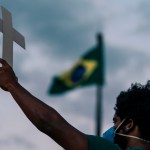
For days ahead of the verdict, Bolsonaro’s evangelical supporters took to the streets in demonstrations and held vigil praying outside of the politician’s condo in Brasília.
The court found Bolsonaro guilty of leading a group of high-ranking officials involved in a January 8, 2028 uprising and plotting the assassinations of his political opponents. Calling the election rigged and declaring incoming president Luiz Inácio Lula da Silva illegitimate, protestors occupied and vandalized congressional headquarters, the supreme court building, and Planalto Palace, which contains the president’s offices.
Bolsonaro denies the charges, claiming that he was not even in Brazil on January 8—he boarded a Brazilian Air Force plane bound for Orlando, Florida, on December 30, 2022, two days before the handover, and remained there until March 30, 2023. He told the court that those who took to the streets calling for a military coup were crazy.
related


Evangelicals participated in the riots, with at least four pastors among the 1,400 people arrested, and they continued to back him as he and others faced charges for their involvement.
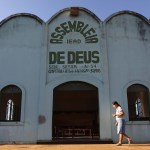
Pastor Silas Malafaia, leader of Vitória em Cristo, part of the Brazilian Assemblies of God, organized street demonstrations and advocated for amnesty for all arrested protesters. Last month, he was targeted by police and charged with obstruction of justice.
Malafaia, in turn, has called for the arrest of Supreme Court Justice Alexandre de Moraes, who is in charge of the Supreme Court’s investigation of Bolsonaro.
“This almost indiscriminate support that evangelicals gave to Bolsonarism is one of the clearest fingerprints of the coup movement,” said political scientist Carla Ribeiro Sales, who belongs to a Baptist church in Recife. “I confess that I am ashamed—not of the gospel, but of this mess we have gotten ourselves into.”
Clashes over Bolsonaro have polarized Brazilian churches, echoing America’s splits around President Donald Trump.
“It’s terrible to see people hurt, families divided, churches sick because of this polarization,” said Cynthia Muniz, pastor of Igreja Anglicana Porto in São Paulo. “There were entire families who left churches because they thought their leader should take a stand in favor of one candidate or another.”
Brazil elected Bolsonaro in 2019, backed by 69 percent of the country’s evangelical minority, but that support slipped. He lost reelection in 2022 by a margin of 2.1 million voters, or 1.8 percent of the electorate.
“Bolsonaro certainly would have no relevance at all if it weren’t for evangelicals,” said theologian Jacira Monteiro.
Some evangelical leaders hope the former president’s conviction might spur a reckoning among evangelicals. Theologian Valdir Steuernagel points to the challenge for the church to recover the ministry of reconciliation, as described in 2 Corinthians 5.
“We have been so captured by political polarization that we have lost the ability to listen to the Scriptures, which call us to encounter, not to distance ourselves,” he told CT. “Our calling is to reconcile.”
It won’t be an easy task. Some Brazilian evangelicals remain loyal to Bolsonaro and have joined public demonstrations, such as the demonstration held on September 7th (Brazil’s Independence Day) in São Paulo. The protesters called for amnesty for all those accused of a coup d’état, including Bolsonaro.
One of the most strident spokespersons is Malafaia. “The constitution, the laws, and the justice system were thrown into the trash by those who should be the greatest example of upholding the law: the Supreme Court,” he said in a video released after the conviction.
related


Ed René Kivitz, pastor at Igreja Batista da Água Branca in São Paulo, said that churches have three challenges: to defend democracy and the secular state, to promote peace and reconciliation among all people, and to multiply signs of justice and solidarity.
“We need to prevent the hijacking of the thinking of evangelical communities by political ideologies, whether on the right or the left,” he said.
Bolsonaro’s trial, though criticized by the former president’s supporters, has been seen as exemplary in its aim to curb anti-democratic initiatives in Western nations.
“Our concern as pastors is not to allow this to happen again,” said Muniz, who also emphasizes the superiority of biblical ethics over ideologies and the polarization that arises from them.
She uses Jesus’ words to Pontius Pilate in John 18:36 as a reference for addressing political polarization: “My kingdom is not of this world.”
For Muniz, the kingdom has a real impact on the world, bringing justice, goodness, and hope. “God cannot be reduced or co-opted by political parties or figures,” she said.
The former president remains under house arrest, now convicted of coup d’état, violent abolition of the rule of law, armed criminal organization, aggravated damage to public property, and deterioration of a listed building.
He and his former aides may be in prison soon—Brazilian law allows them to stay free while they appeal the sentence. The supreme court is expected to rule on all appeals by the end of the year.