In America, we like our presidents a certain way: tall, telegenic, and quick-witted. They should be adept at shaking hands; smart, but not too smart; wealthy, but not too wealthy. He probably is "too smart," but Paul Ryan, the latest figure to enter the maelstrom, fits the criteria.
Our expectations for said President are similarly straightforward: we want them to be good at everything and to appeal to everyone. They should unite the country, balance the budget, and generally do what's needed to save the free world.
Many Americans would add another job requirement, a more spiritual one in nature. The President, many voters believe, should be a pastor to the people, a pan-Protestant minister-at-large to the church of America. He gives succinct but powerful eulogies that offer hope while steering clear of doctrinal niceties. He speaks words of vaguely spiritual character in economically uncertain times. He ties the American future to a nondescript trajectory of moral ascent. Still, the President is not exactly a pastor. He might come close, but political-spiritual leadership is a game of inches.
So, let's amend our idea of President, citing Abraham Lincoln as we do so: If America is, in the eyes of many, an "almost chosen" land, the President is an "almost pastor."
Some would undoubtedly scoff at the idea of President as "almost pastor." Perhaps, though, it carries some merit. I prefer to locate the pastorate in the local church per 1 Timothy 3:5: There, Paul directs Timothy to raise up elders or overseers or bishops that lead their families well, for if they don't spiritually care for their families, "how will he care for God's church?" In other words, the elder or pastor is a local church office.
The Bible makes it clear that the church and the state are distinct entities, and so must be the officers or leaders of each institution, a view derived from Jesus' words on taxation. As recorded by Matthew, the Pharisees sought to paint Jesus as a Caesar-hating radical, yet another first-century insurrectionist who declared Roman rule—and therefore civil government—illegitimate. Christinstructed those listening to honor the state by paying taxes even as they honored the Lord through acceptable worship: "Render to Caesar the things that are Caesar's, and to God the things that are God's" (Matt. 22:21).
In this declaration, we see how Jesus viewed the state and the church: they were each established authorities, and yet, they were distinct entities. Caesar was not to rule the things of God, fortunate for the people of God on many levels. If you think your least favorite American President was bad, try Nero on for size.
World-shaping theorists such as Augustine and Aquinas each argued in their own way for rulers that would honor God's church but not rule it. Echoing Romans 13, Augustine urged Christians, the members of the City of God, to obey the state, but the great theologian prescribed no bishopric for the ruler of the City of Man. Aquinas believed that the government in its best sense could stimulate virtue, but the brilliant "Dumb Ox" limited the authority of the state much as Augustine had.
Luminary theologians of the Reformation like Luther and Calvin largely upheld this distinction, though neither saw as much discontinuity between the two spheres as did the Anabaptists, who championed a thoroughgoing separation of the institutions.
The American founders worked off a body of ideas through the great thinkers of the Enlightenment: figures like Hobbes, Locke, and Rousseau. Adams, Madison, Hamilton, Jefferson and other shapers of the American polis created the doctrine of "separation of church and state," which did not outline an exclusion of religion from public life, as is commonly alleged today. The American President, very much unlike the country from which this nation was birthed, would not be the head of the church.
Formal theology, philosophy, and history applied to politics might be fine on their own terms, but what about the actual life of the nation? Wouldn't we want a national pastor of sorts? The conduct and character of America's leader exercises a direct effect on the country, whether for good or for ill.
It is a blessing, a gift of God, when a President knows Christ as Savior and acts on that faith in discernible and tangible ways. The stalwart leadership of President George W. Bush after the 9/11 attacks comforted and galvanized many of different backgrounds. Jimmy Carter'swork as a Sunday school teacher in a humble Georgia church has encouraged many to take teaching the Bible and learning from teaching seriously.
On the other hand, it will spell trouble for America if the President is downright hostile to religion. The President is able to singlehandedly lend strength to the country as Franklin Delano Roosevelt did in his "Fireside Chats," or to selfishly sap its moral vitality, as John F. Kennedy and Bill Clinton did through brazen adultery.
Article continues below
American Christians who are engaged in the life of this country likely desire an evangelical candidate who not only loves the Lord but who also governs wisely and justly. But living in a fallen world—and an increasingly diverse and secular nation—means that believers will not always find a candidate who shares their worldview. If nature is red in tooth and claw, politics are red in tariff and clause.
Engagement in the nation's public life often means dealing with less-than-ideal choices, circumstances, and candidates. Christians bemoan this reality, but it is part of life in a fallen world. Pursuing our good and the good of our neighbor—publicly practicing Christ's command in Mark 12:31—means that we must often make difficult choices and go with the best possible candidate given a biblical worldview.
On the other hand, evangelicals might support religious candidates from a range of traditions with whom they have major doctrinal disagreements. When this is the case, believers should recommit themselves to the City of Man even as they find their essential identity and their undying hope in the City of God. We want a virtuous head for our country, but we do not want an Orwellian "Dear Leader," a political figure to whom we attach spiritual significance and from whom we expect messianic deliverance. The only one who deserves such adoration is not physically here yet—but when he comes, term limits won't apply.
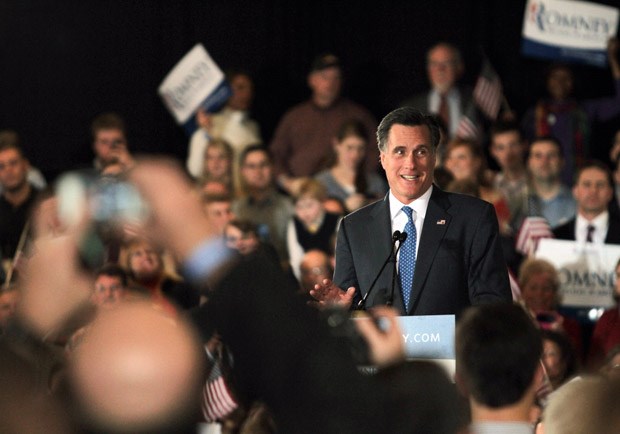
What of the upcoming election, which features a Mormon candidate for the presidency? However charitable and even constructive in certain ways, recent Mormon-Christian dialogues have not necessarily assuaged the doctrinal concerns of many evangelicals. The President, however, is not a pastor. As recent books like Could I Vote for a Mormon as President? argue, it is conscionable to support and vote for a Mormon.
Evangelicals might divide over which candidate to support. Yet, even Christians who are impressed by Romney know it may mean a major cultural boost for Mormonism. It would be foolish to ignore this idea—though we should also note that the much-discussed presidency of Kennedy, for example, did not singlehandedly revitalize Catholicism.
America is a unique country, one that has accomplished tremendous good in its relatively short life. The "almost pastor," the President of this nation, seemingly an "almost chosen" land, has the opportunity to extend this legacy or to quash it. Christians have a chance to play a role in this great matter, even as we remember that our disappointment in even the best of leaders is only temporary. Soon, a figure will rule the world who gives us far more than telegenic looks and searing oratory.
Article continues below
Owen Strachan is assistant professor of Christian theology and church history at Boyce College. Author of essays in The Atlantic and First Things , he has worked for the White House in the U.S. Department of State and for the Commissioner of the Maine Department of Labor. Previously he wrote on Obama's faith.












 While we pray for peace, we need moral clarity about this war.
 We’ve got little information on Jesus’ appearance and personality. But that’s the way God designed it.españolFrançais
 Beyoncé’s right. Whether listening to Cowboy Carter or reading theology, diversity is a good thing.





