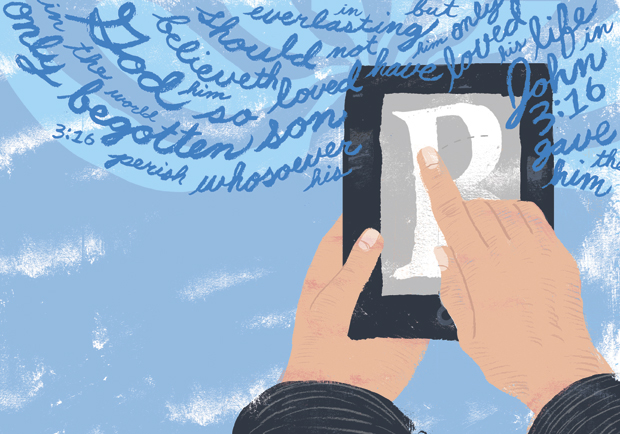

In the 15th century, Johannes Gutenberg and Martin Luther both wanted to get Scripture into the hands of the masses. Centuries later, in a new millennium with technologies far exceeding any they could have imagined, their vision has been fulfilled at a stunning pace.
Not only do billions around the world now have access to the Bible online, and not only are many of them actually reading it, they’re also actively engaging with the Word of God—and with one another in far flung virtual communities across the planet.
With these trends, the vocabulary of Bible dissemination is changing. For centuries, the buzzword was distribution, with a focus on quantity delivered. The new buzzword is engagement. Lamar Vest, president and CEO of the American Bible Society (ABS), says we’re witnessing “a revival of Bible engagement. For too long we have judged our effectiveness by the number of Bibles distributed. We are determined to no longer judge our effectiveness by tonnage but by impact.”
Vest’s comments came at a conference in Orlando, Florida, held late last year by the Forum of Bible Agencies and largely catalyzed by ABS and its new engagement initiative, Uncover the Word. The event drew representatives from over 125 organizations, including Willow Creek Association, Renovaré, the Salvation Army, Christianity Today, and Scripture Union, plus many denominations. Participants were urged to “leave behind their logos and egos” and join a “movement” for Scripture engagement.
Presenters included Bobby Gruenewald, founder of YouVersion.com, with over 50 million us ers; Mark Brown, creator of the Bible page on Facebook, with over 8.5 million “friends”; Jim Mellado, president of Willow Creek Association; Rick Warren, pastor of Saddleback Church; Chris Webb, president of Renovaré; and Sam Rodriguez, president of the National Hispanic Christian Leadership Conference.
“The Bible has long stood as the centerpiece for the moral ethos in this country,” Rodriguez said in his opening address. “We have lost that. This movement will reaffirm biblical orthodoxy among us. It will be a prophetic, truth-telling movement. We will reengage the culture with this story.”
New research from ABS and the Barna Group—called State of the Bible 2011—was also pre sented. Results showed that 45 percent of Americans say God regularly speaks to them through the Bible, but 50 percent say the book is hard to understand. “Some see that 50 percent statistic as a problem,” said Mark Forshaw, executive director of ABS’s Global Scripture Impact, “but we are choosing to view it as an opportunity.”
The study also showed that while 86 percent cite the Bible as “a sacred book,” only 20 percent are engaging it in their personal lives. Joel Hunter, pastor of Northland Church in Orlando, cited a widespread “de-emphasis on the Bible. Unfortunately, we are biblically ignorant. We go to the Bible when we need something, but we are not married to it.”
Are the marvels of modern technology—the information superhighway on steroids—changing that?
The New Roman Roads
The ancient Roman roads spanned more than 250,000 miles. The Romans started building these continent-connecting arteries in 500 B.C., enabling both their empire to grow and the gospel to advance rapidly.
Today’s Roman roads are the Internet, the smartphone, the tablet, and social media, ready and waiting for innumerable journeys of faith and witness. While the ancient roads connected hundreds of towns and cities, the new ones connect millions of homes and individuals. New York Times columnist Tom Friedman recently wrote, “The world has gone from connected to hyperconnected.”
There are an estimated 400 million smartphones (iPhones, Androids, Blackberries, and so on) across the globe. Brown estimates that number will rise to 1 billion within a few years, because “more and more people are doing everything on their smartphones.” Last year, for the first time, sales of smartphones and tablets surpassed those of laptop and desktop computers. Daily time spent on apps now exceeds time spent online on laptops and desktops.
These new technologies bring unprecedented access and analytical tools. The question is no longer, “How many Bibles do you own?” but, “How accessible is the Bible to you in various for-mats?” My bookshelf may hold three copies, but my smartphone can hold 300 versions.
The way people read and respond to Scripture is going through an epochal transformation, in both form and function. Innovative communication media are creating unprecedented pathways for a new generation of Bible innovators—and even more traditional, “old-school” publishers and organizations are coming around.
Nearing its 200th anniversary, ABS is making an effort to shake off potential organizational aging and drift. (Even the word society reflects an earlier era.) Founded in 1816, ABS began with a twofold mission: to advance the Word of God, and to end slavery. The society’s first president, Elias Boudinot, had served in the Continental Congress; Francis Scott Key was ABS’s vice president from 1818 until his death in 1843.
It’s a rich history at ABS, and now they’re aiming to make more history through Uncover the Word. It’s the type of work Paul described as a “supporting ligament” (Eph. 4:16)—connecting people with gifts to people with needs. They are especially focusing on bringing churches, leaders, and innovators together to promote scriptural engagement through collaborative efforts. Yesterday’s “societies” are becoming today’s networks.
Traveling the New Highways
Because these new roads are ready for travel, a vast host of pilgrims will be needed. But what principles can we learn from the vanguards of online Bible engagement? Here are a few nuggets gleaned from conversations with some of today’s most seasoned travelers:
Initiative. In the digital age, the most effective travelers are not the timid. Instead, a few lone souls and a few small nimble teams have tried their hands at Bible engagement online and are proving most successful. More aggressive learn-as-you-go approaches are trumping calculated study-first strategies. Those who start simply, and simply start, rule the new roads.
Responsiveness. The pulse of online Bible engagement is rapid response and connections. While Brown’s Facebook page may not have more users than other sites, it frequently draws more interactivity. That means that more people are typing, responding, liking, sharing, forwarding, and clicking on this page than any other. Remembering that there is a soul on the other end, and responding promptly, are vital to online engagement.
Frequency. In the app-development world, conventional wisdom says, “Think big, start small, fail fast; learn rapidly.” To try repeatedly is vital in engaging people with Scripture online. The digital environment welcomes raw attempts and quickly forgives trial-and-error efforts that are promptly corrected and adapted with improvements.
Saturation. The forwarding and referring capacities of digital Bible engagement means the potential for reaching people has little to do with a traveler’s budget and more to do with vision. Things can quickly go viral. Effective travel on the new roads involves a constant awareness of reaching broadly—that a small impact on one soul has the potential of reaching thousands more in a short span of time.
Stones and Phones
The Bible conference in Orlando concluded in prayer with each participant holding a small stone in one hand and a smartphone in the other. Conference attendees were reminded that the Word of God first engraved upon stone tablets at Mount Sinai could now be communicated on the faces of a billion mobile phones and computer tablets.
Technology has changed the game. Printed Bibles have to be duplicated, bound, packaged, shipped, displayed, sold, taken somewhere, and then opened and read. Digital Bibles, however, begin as electronic bytes on a server and can become a thousand or a million copies on the faces of smartphones in mere seconds.
While the message of Scripture has not changed, the delivery of it has. Gruenewald says, “We understand that Bible translators might have given 30 years of their lives to what now takes us 30 seconds to download.”
Luther regarded Gutenberg’s invention as more than a new science, something truly glorious. He called the printing press “God’s highest … act of grace, whereby the business of the gospel is driven forward.” Luther had recognized a new “road.” What might he have said about the iPad or the Android phone? And just how would Luther and his colleagues have harnessed and traveled these new roads for the kingdom? How will we?
Robert C. Crosby is professor of practical theology at Southeastern University, a columnist at Patheos.com, and author of several books, including More Than a Savior: When Jesus Calls You Friend (Multnomah). His next book, The Teaming Church: Ministry in the Age of Collaboration (Abingdon Press), releases in October.
Copyright © 2012 Christianity Today. Click for reprint information.
Related Elsewhere:
Christianity Today also covers “The New Engagers.”
Previous CT articles on social media in ministry include:
How to Think about Social Networking in Churches | What do we do with virtual fellowship? (December 20, 2011)
Twitter Reaches Out to Christian Leaders at Catalyst’s ‘Be Present’ Conference | The company wants to verify prominent pastors as the religious leaders navigate social media challenges. (October 7, 2011)
Christianizing the Social Network | Tim Challies looks at emerging technology through a theological lens. (May 17, 2011)
Religious Self-Profiling | Identifying one’s faith on online social networks proves challenging for some. (January 14, 2010)
Does Twitter Do Us Any Good? | How the movement of the Trinity can help us decide. (June 4, 2009)