The house lights go down. Spinning, multicolored lights sweep the auditorium. A rock band launches into a rousing opening song. "Ignore everyone else, this time is just about you and Jesus," proclaims the lead singer. The music changes to a slow dance tune, and the people sing about falling in love with Jesus. A guitarist sporting skinny jeans and a soul patch closes the worship set with a prayer, beginning, "Hey God …" The spotlight then falls on the speaker, who tells entertaining stories, cracks a few jokes, and assures everyone that "God is not mad at you. He loves you unconditionally."
After worship, some members of the church sign up for the next mission trip, while others decide to join a small group where they can receive support on their faith journey. If you ask the people here why they go to church or what they value about their faith, they'll say something like, "Having faith helps me deal with my problems."
Fifty or sixty years ago, these now-commonplace elements of American church life were regularly found in youth groups but rarely in worship services and adult activities. What happened? Beginning in the 1930s and '40s, Christian teenagers and youth leaders staged a quiet revolution in American church life that led to what can properly be called the juvenilization of American Christianity. Juvenilization is the process by which the religious beliefs, practices, and developmental characteristics of adolescents become accepted as appropriate for adults. It began with the praiseworthy goal of adapting the faith to appeal to the young, which in fact revitalized American Christianity. But it has sometimes ended with both youth and adults embracing immature versions of the faith. In any case, white evangelicals led the way.
Saving the World
Juvenilization happened when no one was looking. In the first stage, Christian youth leaders created youth-friendly versions of the faith in a desperate attempt to save the world. Some hoped to reform their churches by influencing the next generation. Others expected any questionable innovations to stay comfortably quarantined in youth rallies and church basements. Both groups were less concerned about long-term consequences than about immediate appeals to youth.
In the second stage, a new American adulthood emerged that looked a lot like the old adolescence. Fewer and fewer people outgrew the adolescent Christian spiritualities they had learned in youth groups; instead, churches began to cater to them.
Between 1930 and 1950, Americans got blasted by the Great Depression, World War II, and the cold war. Youth pastors, politicians, and parents all wondered if America and its "way of life" would survive. In the public mind, young people held the key to national survival. After all, millions of young people were unemployed, and Hitler and Stalin were riding to power on the backs of easily manipulated youth. Torrey Johnson, the first president of Youth for Christ (YFC), spoke for many when he said, "If we have another lost generation … America is sunk." In a world of impending doom, who could argue against doing whatever it took to Christianize and mobilize the young saviors of the world?
The 1940s also saw the birth of the "teenager." Unlike the more diverse youth of previous eras, teenagers all went to high school and participated in a national youth culture increasingly dominated by the same music, movies, products, and cultural beliefs. Although it may seem that the teenagers of the 21st century bear little resemblance to those of the 1950s, crucial similarities remain in the structure of adolescent life and its relationship to the church. And one of the most important traits is the aversion to growing up.
When asked to sum up what was most important to her and her friends, one mid-1940s teenage girl said, "We just want to live our own lives. We're not in a hurry to grow up and get all serious and morbid like older people." Of course, girls who just want to have fun make poor saviors of the world. But except for a few Roman Catholic youth and their leaders whose voices were largely ignored, Christians turned a blind eye to early warning signs that youth culture frivolity might swamp Christian activism.
Failed Attempts
Each branch of American Christianity responded differently to the growing pressure to juvenilize. Mainline Protestants, such as those who ran the Methodist Youth Department, assumed that young people were natural political activists. They successfully mobilized an influential minority of young people to fight for racial integration and other progressive political causes.
One mid-1940s teenage girl said, 'We just want to live our own lives. We're not in a hurry to grow up and get all serious and morbid like older people.' Of course, girls who just want to have fun make poor saviors of the world.
But their attempts to adapt to youth culture proved clumsy. In 1959, a national convocation that tried to use Beat culture and existentialism to shake up the supposedly apathetic teenagers of the "silent generation" backfired and led to the resignation of the conference organizer. More often, youth committees and "rhythmic games," the Methodist answer to dancing, competed poorly against other youth culture entertainments.
Article continues below
African American Baptists taught young people to speak, act, and dress like adults and to use their Christian maturity to shame segregationists. This strategy succeeded beyond everyone's wildest dreams in the sit-in movement of the early 1960s. But in the pressure cooker of the movement, the religious fervor that initially motivated many young activists turned into a zeal for destroying anything that seemed to get in their way, including the very black churches that had nurtured their activism. Meanwhile, African American churches had not developed much expertise in creating youth-friendly environments that could sustain teenage loyalty in the face of the upheavals of the 1960s and '70s.
Pre-Vatican II Roman Catholics grew up in what journalist Garry Wills later described as "a ghetto, undeniably. But not a bad ghetto to grow up in." Their families, neighborhoods, schools, and youth clubs were all saturated with Catholic identity markers. Drilled in memorization of the Baltimore Catechism, they knew the facts of their faith better than subsequent generations. But when they voiced tough theological questions, they often felt rebuffed. And they struggled under intense adult pressure toward sexual purity without being provided a fully satisfying rationale.
What seemed at the time like an unassailable, effective approach to youth socialization turned out to be quite fragile. When the institutions of the Catholic ghetto began to shake and Americans simultaneously decided that religion should be an optional, personalized activity, Roman Catholics were unable to adapt. They had not learned how to create the emotionally satisfying, entertaining youth environments that would be needed to sustain religious interest among the young in post-1960s America.
Evangelical Success
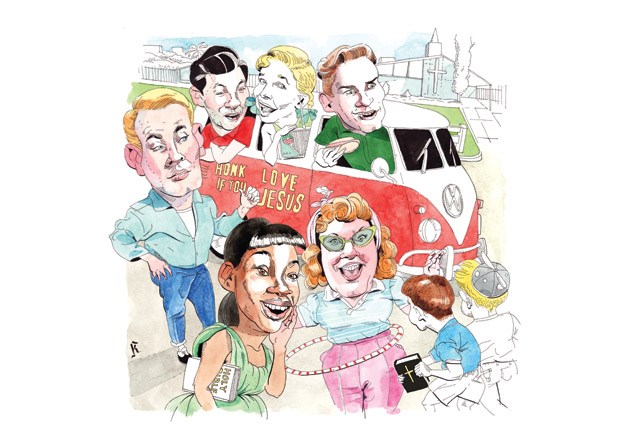
In contrast to other Christian youth leaders who ignored, suppressed, or adapted clumsily to youth culture, white evangelicals—like those who founded Young Life and YFC—embraced it. They created a youth-friendly version of old-time religion that they justified in part by insisting they had no intention of tampering with what happened in church. With a dream of beating "the world" at its own game, they started weekly Saturday night youth rallies held in auditoriums and featuring live radio broadcasts, upbeat music that mimicked the crooner and big-band styles of the day, brief testimonies by recent converts, and short, fervent sermons tied to current events. Stadium events like the May 1945 Victory Rally in Chicago drew thousands to spectacles of patriotism and piety and won respect even in the secular press.
Article continues below
Since the fate of the world depended upon winning as many youthful converts as quickly as possible, preachers at YFC rallies didn't worry about ways they might be subtly altering the gospel message. Billy Graham, who got his start as an evangelist on the YFC rally circuit, claimed that "the young people around the world today who are having the best time are the young people who know Jesus Christ." Jim Rayburn, founder of Young Life, agreed: Accepting Christ as Savior did not mean giving up pleasure and wearing a long face. As he put it, "It's a sin to bore a kid."
At the same time, the new breed of evangelical youth leaders stressed that following Christ included absolute obedience to his commandments and separation from "the world." This seemingly contradictory combination of fun and moral strictness actually worked quite well at capturing teenage loyalty in a competitive religious and entertainment marketplace. Mainline Protestant youth leaders often complained that YFC rallies were stealing young people away from more worthy, social gospel-oriented youth programs.
In addition to rallies that borrowed heavily from teen entertainment, evangelical youth leaders established Christian clubs that fit neatly into the emerging social world of the public high school. The goal was for teenagers to "stand up for Jesus" as pure witnesses in the pagan stronghold of the public schools. As YFC national club director Jack Hamilton told teenagers, "You know, gang, they can take the Bible as a book out of school, but you can put it back in by the life you live!"
Bible club members carried their Bibles to school and wore distinctive pins, sweaters, and jackets—group identifiers that closely resembled those of other high school clubs, cliques, and gangs. They had their own yearbooks and substituted a senior banquet for the senior prom. Although they did not drink, dance, or go to movies, YFC Bible clubbers of the 1950s appropriated many elements of white, middle-class youth culture with full approval of their adult mentors.
One local chapter even developed a Christian hot-rod club called the Boltin' Bishops. The combination of adherence to old standards of right and wrong and the drive for evangelistic success allowed this Christian youth culture to develop relatively unhindered. And since adults assumed that young people would eventually grow out of these pop-culture forms of Christianity, few worried about long-term effects on the church.
Article continues below
A Youth Theology of the Body
But how could Christian youth and their leaders tell the difference be tween worldly compromise and beating the world at its own game? Because they had few clearly articulated theological criteria for deciding which adaptations to youth culture were morally acceptable, YFC leaders instinctively turned to the purity of youthful bodies as the key distinguishing mark that separated cultural victory from worldly contamination. This unconscious focus on bodily purity was humorously illustrated at a 1953 rally in Lansing, Michigan.
Early in the meeting, the rally was interrupted by Bible club member Norm Hinton, who staggered down the aisle holding his stomach and feigning illness. Four young men in the audience jumped up to help, carrying Hinton to a cot on the platform. Local YFC director Billy Walker immediately prescribed an operation. Lacking proper anesthetics, Walker removed one of Hinton's shoes and placed it over the patient's nose and mouth. Using a knife and saw as make-believe instruments, the "doctor" extracted dice, cards, cigarettes, tickets to the movies and a dance, comic books, and an empty bottle of whiskey. He replaced these with a picture of Jesus, a Bible, Christian tracts, a Christian novel, tickets to the Bible club and roller-skating party, and a copy of Youth for Christ magazine. After the successful operation, the patient got up "really alive, and gave a terrific testimony!" This skit provided a pantomime of the working theology of culture operative in YFC and other evangelical youth movements of the day.
The ultimate way for a teenage girl to prove her bodily purity and confirm her powerful Christian witness seemed to be to get elected prom queen and then refuse to dance. The editors of Youth for Christ magazine eagerly reported several instances in which this happened during the 1950s. Such stories confirmed that Christians could be popular, have fun, and save the world at the same time, but only if they preserved their pure "witness." This youthful spirituality held a powerful appeal because it reassured teenagers that their renunciation of youth-culture pleasures was contributing directly to the all-important Christian mission of saving souls. In contrast, Roman Catholic teenagers heard just as many urgent messages about sexual purity, but did not catch a vision for how their personal abstinence could save the world. As a result, the enforced sexual morality of the Catholic ghetto did not fare as well in post-1960s America as did the voluntary, mission-inspired evangelical version.
Article continues below
It also helped that adults provided white evangelical teenagers with replacements for most of the youth-culture pleasures they renounced. In those rare cases where no equivalent could be found, they simply redefined life with Jesus to be just like whatever teenagers had to give up, only better.
One anonymous YFC teenager wrote of her disillusionment with Elvis Presley: "The fact of the matter is, I've found something else that has given me more of a thrill than a hundred Presleys ever could! It's a new friendship with the most wonderful Person I've ever met, a Man who has given me happiness and thrills and something worth living for."
Evangelical teenagers were coming to describe the Christian life as falling in love with Jesus and experiencing the "thrills" and "happiness" of a romantic relationship with him. Perhaps because they believed so strongly in a personal relationship with Jesus as the center of Christianity, they didn't question what might be lost when that relationship was equated with an erotic, emotional attraction to a teen idol.
All Adolescents Now
Despite its obvious weaknesses, this juvenilized Christianity proved highly adaptive to cultural changes. It fared equally well in the buttoned-down 1950s and the psychedelic 1960s. Long before the 1960s counterculture alerted everyone in America to the "Generation Gap," white evangelicals were already highly skilled at adapting their message and methods to young people. The pioneers of YFC and Young Life paved the way for evangelicals to accept long hair, Christian rock, small groups, or any other cultural adaptations that might be needed to capture the attention of later generations. Some of the growth of conservative churches over the subsequent decades would come from this expertise in recruiting and retaining young people.
The final step in the process was the transformation of American adulthood itself. Older cultural conceptions of adulthood encouraged responsibility, self-denial, and service to others. In the first half of the 20th century, most people clearly entered adulthood in their teens or early 20s by virtue of getting married, getting a job, and having children. More recently, the passage to adulthood has been delayed and rendered more subjective for most middle-class Americans.
Article continues below
In what sociologist James Cote calls the new "psychological adulthood," the individual's "needs and wants" expand and his or her "obligations and attachments" contract. The seven deadly sins have been redefined: "pride has become self esteem … lust has become sexuality … envy is now channeled into initiative and incentive … sloth has become leisure."
Of course, many adults still value virtue and deplore vice. But they also increasingly view life as an unending journey of self-development. And the contemporary landscape through which they journey has many paths that can end in self-centeredness or even narcissism.
In short, at least some traits that should be included in Christian maturity have been decoupled from adulthood in post-1960s America, and this change has encouraged juvenilization. Indeed, it is likely that the juvenilization of American Christianity and the emergence of the new immature adulthood have mutually reinforced one another. We're all adolescents now.
Juvenilization Triumphant
Because of juvenilization, American Christianity is doing much better than it should be. Despite numerous cultural, legal, and institutional changes that should have led to religious decline, American churches remain about as full as they were 50 years ago, and most Americans continue to believe in a God who bears considerable resemblance to the Christian God. Why?
Because of juvenilization, American Christianity is doing much better than it should be. Youth ministries have contributed to this sur prising outcome by making the Christian life more emotionally satisfying.
In 1924, after a thorough study of Muncie, Indiana, sociologists Robert and Helen Lynd concluded that even there in the heartland, Christianity had begun an inevitable decline. A key indicator was that young people seemed less religious than their parents. In 1978, the Lynds' Middletown surveys were repeated, revealing that the predicted decline in religion had never materialized. Both youth and adults had more positive views of the church and Christianity in 1978 than their predecessors did in 1924. The top reason people gave for going to church had changed from "habit" to "enjoyment."
Youth ministries and juvenilization contributed to this surprising outcome by making the Christian life more emotionally satisfying. Passion was in, duty was out. This kind of individualized, emotional connection to God sustained religious interest in a changing society in which custom, tradition, and social pressure would no longer motivate people to care about faith or attend church.
Article continues below
Not surprisingly, in the process of adapting to the new immature adulthood, churches started looking a lot like youth groups. Contemporary churches appeal to thousands of Americans by providing an informal, entertaining, fast-paced worship experience set to upbeat music. Everything done in these churches to reach "unchurched" people was already being done in the YFC rallies of the 1950s. And this parallel is not coincidental.
How many evangelical pastors have started their careers as youth pastors over the past 40 years? To take one highly influential example, Bill Hybels first experimented with his seeker-friendly model and church market research while serving as a youth pastor in the 1970s. The white evangelical churches that are growing the fastest in America are the ones that look most like the successful youth ministries of the 1950s and '60s.
Even the emerging church movement, which among other things is a reaction against this white, middle-class, suburban version of Christianity, is itself a product of juvenilization. Concerns that evangelical churches were alienating postmodern young people pushed many emerging church pioneers to explore new ways to be the church. Tony Jones argues that the egalitarianism and relational ministry practiced in evangelical youth groups shaped the emerging church movement.
Although white evangelicals have been the most aggressive juvenilizers, other branches of American Christianity are not far behind. Some of the most fervent young Catholics are combining traditionalist faith and youth culture styles. In her book The New Faithful: Why Young Adults Are Embracing Christian Orthodoxy, Colleen Carroll Campbell writes of these young Catholics:
They sing evangelical songs. They tell their conversion stories and facilitate the conversion of others. They stress the importance of a "personal relationship with Christ." They wear T-shirts with messages like "Eucharistic Adoration: Do It 24/7" and "Top 10 Reasons to Be Catholic."
When asked what they get out of their rock band-energized youth liturgies, Catholic teenagers report that they like the "intense experience" that serves as a "stress reliever" and they "love the music." Some African American church leaders are experimenting with hip-hop worship in order to reach young people who are alienated from traditional black churches. The history of white evangelical youth movements suggests that over time these innovations will filter into adult church life. And that is not all bad. "That's the way we've always done it" is not a compelling theological argument.
Article continues below
Unintended Consequences
Still, churches new to juvenilization would do well to consider its unintended consequences. Juvenilization tends to create a self-centered, emotionally driven, and intellectually empty faith.In their landmark National Study of Youth and Religion, Christian Smith and his team of researchers found that the majority of American teenagers, even those who are highly involved in church activities, are inarticulate about religious matters. They seldom used words like faith, salvation, sin, or even Jesus to describe their beliefs. Instead, they return again and again to the language of personal fulfillment to describe why God and Christianity are important to them. The phrase "feel happy" appeared over 2,000 times in 267 interviews.
Today many Americans of all ages not only accept a Christianized version of adolescent narcissism, they often celebrate it as authentic spirituality. God, faith, and the church all exist to help me with my problems.
Smith and his research team labeled this pattern of religious beliefs Moralistic Therapeutic Deism. Teenagers learn these beliefs from the adults in their lives. It is the American cultural religion. Teenagers are "moralistic" in that they believe that God wants us to be good, and that the main purpose of religion is to help people be good. But since it is possible to be good without being religious, religion is an optional tool that can be chosen by those who find it helpful. American Christianity is "therapeutic" in that we believe that God and religion are valuable because they help us feel better about our problems. Finally, American teenagers show their "deism" in that they believe in a God who remains in the background of their lives—always watching over them, ready to help them, but not at the center of their lives.
Given the history of youth ministry and juvenilization, this pattern of religious beliefs should come as no surprise. As early as the 1950s, youth ministry was low on content and high on emotional fulfillment. The best youth ministries did provide individualized spiritual formation and even intense discipleship. But even otherwise exemplary youth ministries could unintentionally send the message that the church or even God exists to help me on my journey of self-development. Most youth ministries since the 1960s have followed the club model pioneered by Young Life and YFC. Songs, games, skits, and other youth-culture entertainments are followed by talks or discussions that feature simple truths packaged with humor, stories, and personal testimonies. As they listen to years of simplified messages that emphasize an emotional relationship with Jesus over intellectual content, teenagers learn that a well-articulated belief system is unimportant and might even become an obstacle to authentic faith. This feel-good faith works because it appeals to teenage desires for fun and belonging. It casts a wide net by dumbing down Christianity to the lowest common denominator of adolescent cognitive development and religious motivation.
Article continues below
Today many Americans of all ages not only accept a Christianized version of adolescent narcissism, they often celebrate it as authentic spirituality. God, faith, and the church all exist to help me with my problems. Religious institutions are bad; only my personal relationship with Jesus matters. If we believe that a mature faith involves more than good feelings, vague beliefs, and living however we want, we must conclude that juvenilization has revitalized American Christianity at the cost of leaving many individuals mired in spiritual immaturity.
Taming Juvenilization
As the line between adolescence and adulthood continues to blur, eliminating youth ministries would only weaken religious formation of youth without doing much to counter spiritual immaturity among adults. And instead of naively thinking we can eliminate juvenilization, we should instead work to tame it by helping local congregations build an intergenerational way of life that fosters spiritual maturity.
Pastors and youth leaders can begin by teaching what the Bible says about spiritual maturity, with a special emphasis on those elements that are neglected by juvenilized Christians. Church leaders also need to ask hard questions about the music they sing, the curriculum materials they use, and the ways they structure activities.
We need to ditch the false belief that cultural forms are neutral. Every enculturation of Christianity highlights some elements of the faith and obscures others. We must be vigilant and creatively compensate for what gets lost in translation when we use the language of youth culture. For example, if we sing songs that highlight the emotional consolations of the faith, what can we do to help young people also embrace the sufferings that come with following Jesus?
Article continues below
I believe one key is to renew our commitment to the church as an intergenerational family, in which each person has a unique role in helping the others toward our shared goal of maturity in Christ (Titus 2:1-15; Eph. 5:21-6:4; Col. 3:18-4:1; 1 John 2:12-14). Adults need children and adolescents to draw out their committed love and provide concrete opportunities to care for others. Adolescents help adults reconnect with the passion of a life devoted to Christ, what he called the first love of the Christians at Ephesus (Rev. 2:4). Young people need adults in their lives who are modeling a vibrant spiritual maturity. One reason no one wants to grow up in America is that many adults don't make their life stage look very attractive.
Teenagers can legitimately follow Christ in adolescent ways, including participating in age-appropriate youth ministries. But those ministries must also help youth catch a vision for growing up spiritually. Churches full of people who are building each other up toward spiritual maturity are not only the best antidote to the juvenilization of American Christianity, but also a powerful countercultural witness in a juvenilized society.
Thomas E. Bergler is professor of ministry and missions at Huntington University, where he has taught youth ministry for 12 years. He is the author of The Juvenilization of American Christianity (Eerdmans, 2012), from which this article is adapted. He serves as senior associate editor for the Journal of Youth Ministry.
Next week, non-subscribers will be able to read responses to Bergler's article by John Ortberg, David Kinnaman, and David Zahl. Subscribers can read them now.
Miracles in Mozambique: How Mama Heidi Reaches the Abandoned | There are credible reports that Heidi Baker heals the deaf and raises the dead. One thing is for sure:She loves the poor like no other in this forgotten corner of the planet. (May 11, 2012)
The New School Choice Agenda | Why Christians in Richmond, Virginia, and elsewhere are choosing to send their children to struggling public schools. (April 9, 2012)
The Best Ways to Fight Poverty—Really | The government is by far the best institution to raise the poor's standard of living. The church does something more important for them. (February 10, 2012)
Have something to add about this? See something we missed? Share your feedback here.















 While we pray for peace, we need moral clarity about this war.
 How Jesus rescued a New Age psychic from spiritual darkness.
 Ethan Hawke has made a movie as scandalous as one of the writer’s short stories.