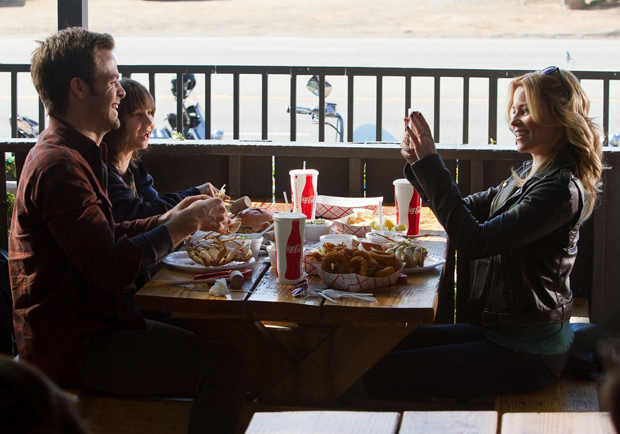
People Like Us is a movie about some pretty lousy circumstances that ultimately produce something of real beauty and value. The movie begins with a death—that much we learned from the trailer. The man who dies leaves what seems, at first, to be a rotten legacy, a family that remembers him only for his abandoning them, and for the perpetual heartaches and loneliness he caused them all. As the full story comes into view, however, we see that even from the man’s failings, there arise some signs of what we can only call grace.
In some ways, the movie proves its own point. As a film, it is not exactly gracefully (or graciously) made. It’s blessed with a decent story and some fine actors, but the filmmakers never trust in those elements to carry the weight of the movie; there are plenty of instances where the thing all but sinks into sentimentality and over-explanation. In spite of its flawed delivery, however, the story can’t help but bear witness to important truths—namely, that beauty really can come from ugly things.

The man who dies is a rock-and-roll producer named Jerry Harper, and it becomes clear early on that he cared more about the music than he did his family. He left behind a son, Sam (Chris Pine, Star Trek), who hasn’t come to visit in years, who feels like he was never good enough for his old man, who believes Jerry did everything possible to force his son out of his life. And then there’s the grieving widow, Lillian (Michelle Pfieffer), exhausted from years of trying to hold her fraying family together, and humiliated that her own son didn’t show up for his father’s funeral.
It’s a family in tatters, but Sam makes a discovery that seems at first like it might drive them all even further apart. A week before his passing, Jerry arranged for all of his money to go to a woman and little boy who Sam’s never heard of before. Was this woman Jerry’s mistress, or his daughter by another woman? Regardless, Sam is even more tortured and confused than he was before.
The woman is Frankie (Elizabeth Banks), and as it turns out, her own family life is something less than exemplary: The first time we meet her, she is being summoned to the school principal’s office, her 11-year-old son Josh having just attempted to blow up the swimming pool with homemade explosives. Sam makes contact with her, but doesn’t tell her who he really is.
And so it becomes the kind of movie where one character knows something the other one doesn’t—and we share his knowledge, waiting through every scene and wondering if this will be the moment when he chooses to tell her, or indeed, if he ever will tell her at all.

The best moments of the film have nothing to do with this secret knowledge, or with this tension, but simply with the relationship between these two leads. Pine and Banks have remarkable chemistry together—and she, in particular, delivers a stellar performance, exuding strength and vulnerability while showing us what a tough life this woman lives without ever allowing us to think her pathetic, or anything less than a bright and funny woman who’s simply doing the best she can.
Banks and Pine are so excellent together that one rather wishes they were in a solid romantic comedy—a direction this movie never really moves in, which is probably for the best. Watching these two characters (and the boy Josh, for that matter) connect with one another and genuinely help to support one another, despite Sam’s secret, is the true joy of this movie—and, for many, it will be reason enough to recommend it.
Sadly, the movie that might have been—a winsomely low-key, true-to-life tale of family drama and redemption—is here presented as a crowd-pleasing, Hollywood tearjerker, counter-programming to the summer season’s superhero movies and raunchy comedies. There’s nothing necessarily wrong with being a tearjerker, perhaps—and many of this movie’s emotions are earned, especially when it’s just Banks and Pine onscreen—but the film tends to lay it on pretty thick.

You might blame it on the fact that this is the directorial debut of Alex Kurtzman, a screenwriter who’s previously worked on Star Trek, Cowboys & Aliens, and some of the Transformers movies. Perhaps he’s used to a reliance on shock and awe to drive his point across. Whatever, this is the kind of movie where there are so many trinkets and rituals—all of them loaded with sentimental value to the characters, but numbing to the audience—that we quickly lose count.
For example, Sam mentions the “six rules” of life that his father once shared with him, and, in a crucial emotional moment, he shares them with Josh—but when you hear these “rules,” you can’t help but be disappointed by how totally anticlimactic they are. Then, as if the film needs another sentimental artifact to focus on, it introduces a worn reel of film, which changes everything for its characters, which Sam simply must share with Frankie in yet another tear-filled scene, gently melodramatic music playing in the background, and so on.
Its sitcom-ready plot devices and tendency to over-explain (the opening scene is a montage of Sam telling us what his job is, as opposed to the film simply showing us what he does for a living) suggest that there’s simply not much confidence in the story, or perhaps not in the people telling it—a real shame, given how superb many of the actors are. Still, there really is a fine story in here—and when all we’re left with is that story and the two leads, People Like Us transcends its clichés to become reasonably memorable.
Talk About It
Discussion starters- God is invoked a few times, sometimes in the form of a coarse mention of his name, during a moment of crisis. Do you think any of the characters are “searching”? Are there any scenes in which that search is vocalized?
- What need does Sam fill for Frankie? For Josh? What, if anything, does Frankie offer to Sam?
- Do you think the movie simply demonizes Jerry—or does it allow him any moment or suggestion of redemption?
The Family Corner
For parents to considerPeople Like Us is rated PG-13 for language, drug use, and sexuality. The language here is fairly intense for a PG-13 movie, with numerous four-letter words and frequent misuses of the Lord’s name. There’s one f-word as well. The drug use involves the use of medical marijuana, and is played for laughs. The sexuality is limited to a single scene depicting an ill-advised late-night tryst; the scene lasts for no more than a second or so.
Photos © DreamWorks
© 2012 Christianity Today. All rights reserved. Click for reprint information.