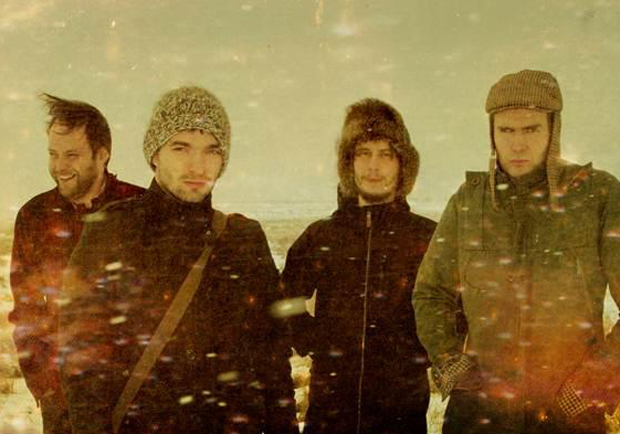
If you’re a Christian in America, you’ve likely heard of Sigur Rós. You might even know a superfan who will go on and on about the sheer beauty of this band’s music. Though the members of Sigur Rós do not claim to be Christians, you may even hear the word “worship” pop up in a discussion with fellow believers.
This phenomenon is a bit baffling given that Sigur Rós is from Iceland, and its outspokenly gay bandleader Jón Þór Birgisson (Jónsi for short) sings in his native tongue. Well, usually. Sometimes he doesn’t use language at all. Jónsi also sings in a form of gibberish that’s been dubbed “Hopelandic.” Nevertheless, search YouTube and you’ll find a mashup of the Sigur Rós song “Inní Mér Syngur Vitleysingur” and Matt Redman’s “Blessed Be Your Name” from Bill Hybels’s Willow Creek Community Church. I can’t say I’m a fan of this attempt, but the point is, once Sigur Rós has made it into a Willow Creek worship service, the band and its perceived worshipful qualities cannot be ignored.
Sigur Rós—named after Jónsi’s little sister and directly translated “victory rose”—plays a version of post-rock, a subgenre that also encompasses bands such as Explosions in the Sky and Mogwai. Post-rock usually eschews a typical verse-chorus-verse structure and plays liberally with dynamics, glacially progressing from whispery to thunderous several times within a song. When vocals are used at all, it’s less about lyrics and more about the texture and melody the voice adds to the overall mix.
On previous releases and new album Valtari, which releases today, Sigur Rós employs these tactics (and others) with a level of skill unmatched by its contemporaries and predecessors. If the band’s previous studio album, 2008’s Með suð í eyrum við spilum endalaust, was more “pop,” Valtari is the opposite, focusing more on atmosphere and ambience than distinct songs. One of the standout tracks, “Dauðalogn,” sounds like what you hope would happen if Gregorian chanters, a boys’ choir, an ancient pipe organ, and the London Philharmonic created a band to accompany a magnificent yet somewhat androgynous soloist who sings in what could be the language of angels.
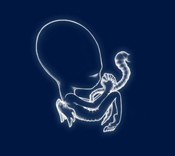
That angelic quality is part of the “worshipful” package. No one makes Icelandic or gibberish sound more heavenly than Sigur Rós, and the band has cultivated a mysterious, otherworldly image to go along with the music. To wit: The cover of Sigur Rós’s breakout album, Ágætis byrjun, looks like the glowing ultrasound of an alien baby, complete with wings; Jónsi often performs in ornate outfits with colorful scarves and feathers and usually plays his reverb-laden guitar with a bow. On Inni, the band’s black-and-white live documentary and accompanying live album, Sigur Rós is cast in bright white light amid the shadows, and the band has also been known to perform behind a white, gauzy sheet. All that to say, when my subconscious couples the gorgeous music with that mental backdrop of images, it’s not too far of a leap to imagine Sigur Rós as a band of angels praising God in an unknown tongue.
Having a singer is an important aspect, too. While I’m certainly a fan of Explosions in the Sky and do find elements of their guitar-based, instrumental post-rock worshipful, it doesn’t communicate in quite the same way Sigur Rós can. It’s not hard to import your own meaning onto any slab of instrumental music, but there’s something significant about hearing and singing along to actual lyrics, even if it’s technically just syllabic nonsense. Sometimes we don’t have the words we want to say or pray or sing, but we want to say or pray or sing something.
I would argue, though, that there’s a big difference between “worship music” and “worshipful music,” i.e. music that’s fit for a Sabbath worship service versus music that evokes worshipful emotions when we listen to it. If we go by theologian John Frame’s definition of worship as “the work of acknowledging the greatness of our covenant Lord,” then when a worship leader leads the congregation in song, the leader and the congregants should know what they’re singing. Gibberish aside, when translating Sigur Rós’s Icelandic lyrics, you’d be hard-pressed to find an appropriate use for the majority of them in a worship service context (e.g. “Barbwire stapled in my bleeding mouth / Locked in a cage / Naked animals beat me”).
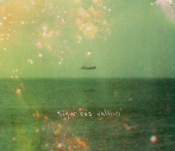
Plus, any attempts I’ve heard that blend Sigur Rós with other Christian worship music—such as the misguided Willow Creek attempt referenced above—end up sterilizing the arrangement. The beauty and powerful, emotive qualities get lost in translation. Sigur Rós is a band very few musicians should attempt to cover or alter. Jónsi’s voice, in particular, is inimitable. On Valtari‘s “Ekki múkk” (listen), his pristine falsetto floats gently but with purpose amid the piano, strings, and various homemade noises. It’s those tranquil moments, which can last 30 seconds or five minutes, that spur reflection and contemplation before the band erupts into a limb-shaking wall of sound that can be celebratory or aggressive (or both), but always cathartic. The roller coaster of deeply felt and communicated emotions is like a musical tour of the Psalms, where you’re just as likely to find a frustrated psalmist pleading angrily for justice as you are to find a peaceful psalmist, content in his Maker’s goodness and sovereignty.
There’s not one simple explanation for why many Christians find the music of Sigur Rós worshipful. But perhaps the take-home here is that all good things come from God, and Sigur Rós makes music that’s stunningly beautiful. God can reveal something about himself in a Sigur Rós crescendo as much as a cascading waterfall, and the Spirit can quietly work in the heart of a believer during the crackling tranquility of “Ekki múkk” as much as the pops and hisses of a campfire on a crisp night. There’s no reason to believe God can’t lavish his common grace on a band in such a way that believers are built up in their faith when they hear it.
That’s the underlying reason for why the music of Sigur Rós can be worshipful. Not because of Jónsi and his gorgeous falsetto and bowed guitar. Not because of our vacillations of ecstasy and meditation as we listen. It’s not solely us and it’s not solely them. It’s God working through both.
Copyright © 2012 Christianity Today. Click for reprint information.