How long can a franchise lie fallow before it belongs to the past, and a sequel no longer persuades us that it's cut from the same cloth as earlier material? At what point does the urgency of "What happens next?" fade into the idle curiosity of "Where are they now?" The first of these questions is the natural subject of a sequel; the second though, is the territory of "sequels."
There is clearly a question of time, not just quality in this distinction. None of the Rocky or Raiders sequels are in the same league as the originals, but the two latter-day "sequels" are in a different category from the earlier ones. With such "sequels" we rightfully expect less. They are more like reunions than continuations. This influences me to go easier on such films.
Men in Black II came five years after the original (clearly within the sequel statute of limitations) which only made its ineptitude a worse disappointment. Now, a decade later, we have Men in Black 3. The very choice of an Arabic numeral 3, not a Roman numeral III, is a subtle disconnect that suggests the film as a "sequel," not a sequel. Ten years seems to be long enough.
Will Smith as Agent J
Alas, ten minutes is long enough to establish that "where they are now" is not a very interesting place. Happily, the movie soon changes the question to "Where were they then?" and takes a turn for the better. With that said, it doesn't approach the witty and energetic original, and though it's better than the lousy MIB II, that's setting the bar low. Take it or leave it.
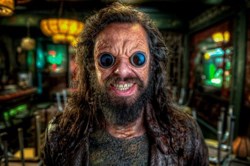
MIB 3 opens with a prison break involving a gratuitous bit of jiggle and giggle, some leering prison guards, a high body count and a formidable outlaw-biker type alien villain. Boris the Animal (Jemaine Clement of the comedy duo Flight of the Conchords) is an intimidating villain presence. Between Rick Baker's makeup and strong visual and sound effects, he's certainly icky and inhuman enough—but aren't these movies supposed to be, you know, funny?
Doesn't anyone involved remember what a scream Vincent D'Onofrio was as Edgar the bug? Though Boris gets a couple of nice moments (notably a scene in which he plays dual versions of himself), his performance is mostly wasted potential.
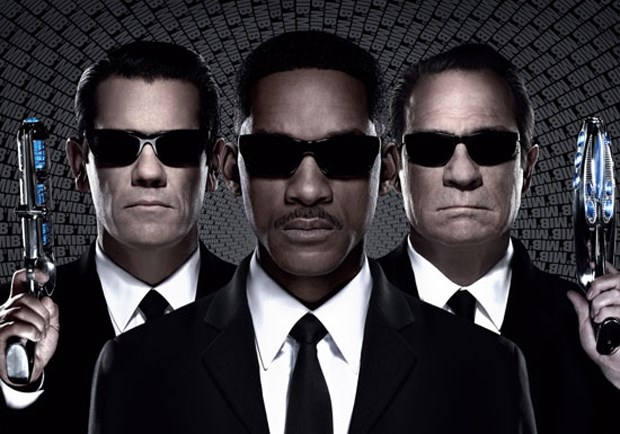
Then we catch up with the Men in Black, still keeping the world safe from aliens and the knowledge thereof. There's no joy here anymore: Agents J and K lack chemistry; their relationship consists of K (Tommy Lee Jones) being gloomily stoic and J (Will Smith) ragging on him about his gloomy stoicism and wondering what happened to make him that way. It's a plot point, of sorts, but that doesn't make it entertaining.
A funeral for absent MIB honcho Zed (played in previous installments by the troubled Rip Torn) offers an opportunity for a whimsical alien rendition of "Amazing Grace" and an unfunny, taciturn "eulogy" by K. There's a gooey scene in a Chinese restaurant with lots of liquidated aliens, and plodding gags about which celebrities du jour are not of this world.
As in the last sequel, the MIB lack the covert finesse of the original film, and use their memory-wiping neuralyzers way too casually—though this does offer a couple of the movie's better jokes as J tries to make the world a better place while covering up close encounters. Still, before the first act is over it's clear the whole routine is exhausted.
Just when one is about to give up, though, the movie catches a second wind. Boris goes back in time, and K vanishes from history, with disastrous consequences for the Earth. To set things right, J must travel back to 1969 and prevent Boris from murdering K in the past.
Without a doubt the movie's best special effect is Josh Brolin as young K. He's bang-on as a young Tommy Lee Jones, and seems to be having all the fun that Jones isn't. Of course, as he keeps reminding us, whatever happened to make old K bitter hasn't happened to him yet. By the time we find out what it is, I'm not sure it makes any sense.
Josh Brolin as Young Agent K
Agent J in 1969 is a fish out of water, which brings Smith back to life. The MIB of the period don't know him, their technology is four decades out of date, and he and K aren't sure how much they can trust each other. There's an amusing scene with a pair of cops pulling J over for driving while black, and when J and K run into an iconic artist eccentric at a "happening" (the second such "happening" this month, after Dark Shadows), the revelation of who he "really" is unexpectedly novel.
Jemaine Clement as Boris the Animal
It's all acceptably diverting, and not actively unpleasant like the 2002 sequel. There are no grand twists or revelations comparable to the truth about the "galaxy" in the original. What the film could most use, I think, is a wide-eyed uninitiate like Linda Fiorentino in the original or Rosario Dawson in the sequel—but one from 1969, which would offer a fresh twist on the outsider's experience of the MIB's nutty world.
Instead, J and K wind up with a hyper-initiate tagalong, an alien named Griffin (Michael Stuhlbarg) who can see the future—in fact, too many futures, so that he's never quite sure which timeline he's actually in. He's as entertaining as anything in the flick, but doesn't provide that extra kick the movie needs to really work.
Article continues below
Ultimately, if I don't quite recommend MIB 3—and I don't quite—it may come down to this: In its zeal to fill in some back story on its heroes, especially K, the film's revisionism erases the one thing about K's back story that mattered in the original: K's entire career in the MIB was overshadowed by a long-denied love for a woman he had left behind—a woman he sometimes furtively surveilled in idle moments, and with whom he reunited at the end of the film.
I resented the way that MIB II ripped K away from his happy ending for the sake of a mediocre sequel. I don't like it any better that MIB 3 has K mooning over a WIB named O (Alice Eve in 1969, wasted Emma Thompson in the present day)—a half-baked romantic interest that goes nowhere and does nothing. Instead of adding to the original, this detracts from it.
All in all, I suppose I'd rather see the MIB go out on this note than MIB II. But in a universe replete with shoddy "sequels" that may not happen either.
Talk About It
Discussion starters
Griffin talks repeatedly about his "favorite moment in human history." If you had to pick a favorite moment in history, what would it be? Why?
A number of characters warn J about "asking questions he doesn't want to know the answers to"—and of course the whole premise of the series is that there are things the public is better not knowing. Are there things we are better off not knowing? Conversely, just because we might rather not know something, does that mean it would be better if we didn't know it? Can you think of any examples of things that people ought to know even if they would rather not?
J has unresolved feelings about his absent father, and remarks "A boy needs a father." How does this idea play out in the film?
Why was K bitter in the beginning of the film? Has he changed by the end? Why?
The Family Corner
For parents to consider
Like its predecessors, Men in Black 3 features gruesome creature effects, grisly violence and brief suggestive content. Numbers of aliens are blasted into goo, and icky special effects portray what I take to be a symbiotic relationship between the alien antagonist and a crab-like creature that lives in an orifice in the palms of his hands, and spits murderous spines on demand, killing lots of people. Sexual content is limited to the opening scene, which features cheesecake shots of a young woman in a provocative leather outfit and some prison guards leering over her. The names of God and Jesus are taken in vain a number of times, and there's some cursing and crass language.














 While we pray for peace, we need moral clarity about this war.
 As my doubts about his teachings grew, so did a secret fascination with Jesus.
 Beyoncé’s right. Whether listening to Cowboy Carter or reading theology, diversity is a good thing.