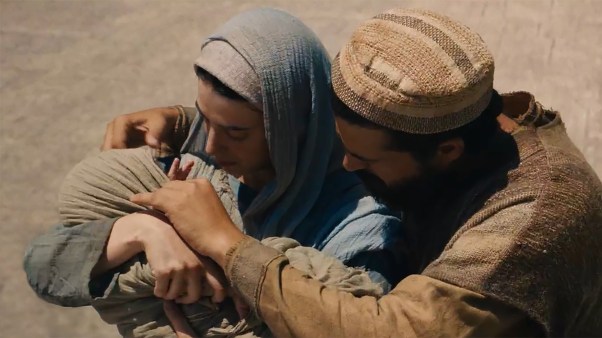
There's a memorable dinner scene in Life of Pi that attempts to springboard the main theme forward but ironically paralyzes it. After the young Pi becomes the poster child of "coexist" and simultaneously embraces the religions of Hinduism, Catholicism, and Islam, his father confronts him during a meal. The serious businessman says, "Believing in everything is the same as believing in nothing." He tells his son to use reason and common sense, but in doing so, he's painted as the bad guy—as if the rest of the film will prove him wrong. But it turns out he's right after all: With a little thought and reason, it's easy to see the holes in Pi's thinking, and that this film, at its core, is nothing more than a big and beautiful spiritual mess.
Adapted from the Yann Martel's popular 2001 fantasy adventure novel by screenwriter David Magee, director Ang Lee's new film traces the journey of its title character from India, across the Pacific Ocean, to Canada. Told in flashbacks from the perspective of the adult Pi (Irrfan Khan) to a struggling author (Rafe Spall) who hopes to be inspired and "believe in God," the story consists of three acts. The first, set in India, focuses on Pi's childhood living at a zoo run by his parents. Here, he develops a love for a girl at school, for the world's many animals, and for various religions, declaring that "faith is a house with many rooms." Lee captures the many creatures with stunning detail and a unique sense of humor, but this thread moves clumsily and feels stale and didactic rather than inspiring.
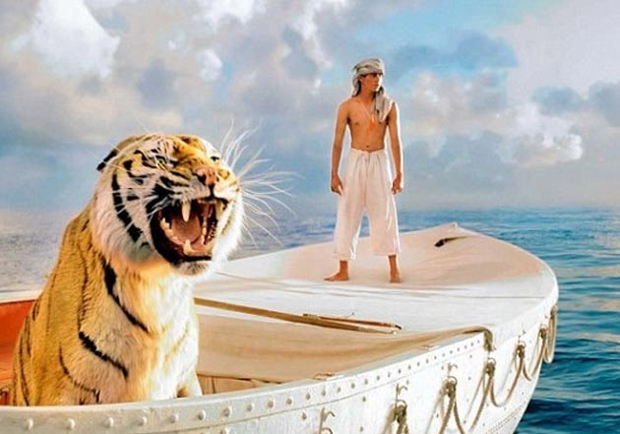
The second act makes up for it, though, when Pi's family decides to leave India for Canada. While crossing the Pacific, a fierce storm sinks their ship; Pi (Suraj Sharma in a breakout performance) and a few zoo animals are the only survivors. On a small boat in the middle of the ocean with a tiger, zebra, orangutan, and hyena, Pi finds himself on a quest to survive, in a battle of man vs. nature—or man against his maker, as he puts it—and an unforgettable adventure ensues. Filled with action, comedy, and moments of spiritual transcendence—like during a storm when Pi cries out to God, "What else do you want from me? I've surrendered everything!"—it's a riveting journey, and Lee the artist makes a visual spectacle of it.
Working with cinematographer Claudio Miranda and a talented visual effects team, Lee creates a masterful 3D experience better than even James Cameron's Avatar. Where Cameron's remarkable visual effects were flashy and gimmicky, Lee's are more substantive. He seems less concerned with making an impression and more concerned with using the medium to put together meaningful, symbolic images. This approach plays out most vividly out on the ocean, specifically a night scene where a bloom of jellyfish surrounds Pi and the tiger, dubbed "Richard Parker." The images form a visual ecstasy, lighting up the dark waters while also pointing to a greater light despite Pi's dire situation.
As such images attest, Pi's adventure makes for a powerful theodicy in his search for meaning in the midst of suffering. Pi discovers that God was present in his journey, providing for him every step of the way—with the help of the tiger and later a magical island. Pi learns that even his pain had meaning and purpose. Unfortunately, Life of Pi ultimately nulls this truth, especially in the film's conclusion.
In the third act, Pi offers an alternative perspective to his skeptical listener, who admits that it's a lot to take in. Pi tells a second, similar story that communicates the same ending—yet this version is void of God, the animals, and the other fantastical details. He then asks the writer which story he prefers. Lee tries to evoke an epiphany moment but merely repeats the pluralistic theology that makes his film problematic. This theology, rooted in philosopher Jacques Derrida's theory that "there is nothing outside the text," dismisses the concept of ultimate reality, concluding that all we have are subjective interpretations. While this thinking might be redeemed if understood that not every interpretation is created equally, Life of Pi places all religions on even terms, as if these faiths don't contradict one another and make exclusive claims. Such political correctness essentially diminishes the spiritual gravitas of the film, inadvertently insulting the very religions it celebrates and squandering faith into a meaningless, faith-for-the-sake-of-faith matter.
In a recent conversation with Chicago Sun-Times critic Roger Ebert, Lee described his own spirituality like this: "I believe the thing we call faith or God is our emotional attachment to the unknown. I'm Chinese; I believe in the Taoist Buddha. We don't talk about a deity, which is very much like this book; we're not talking about religion but God in the abstract sense, something to overpower you."
In Life of Pi, God and religion are also abstract, making the film the quintessence of a postmodern artifact, one that proves about as conflicted as its message. Lee's grandiose images, in all their splendor and glory, certainly reflect the Creator, but the meaning behind them represents something altogether different—and unfortunately, in the end, it's all smoke and mirrors. There are grains of truth, but woven amidst a lie.
Talk About It
- Life of Pi indicates that all religions lead to God. What is problematic about this pluralistic approach to faith? Does the view work logically? Spiritually?
- Why must Christians believe that Jesus is the only path to God? Why is this belief essential to the Christian faith?
- How should Christians treat those of other religions? Have Christians always done a good job at this?
- Pi learns that his suffering wasn't in vain. How should we view our personal suffering? How does it relate to verses like Romans 8:28-30?
- How might a Christian use a film like Li of Pi to lead a non-Christian friend into a conversation about Jesus and the gospel?
The Family Corner
Life of Pi is rated PG for emotional thematic content throughout, and some scary action sequences and peril. Teaching his young son a lesson, Pi's father forces him to watch a tiger kill a goat, but we only hear the noise and see the tiger dragging the dead animal away. The film implies that many people die, including Pi's family, when a ship sinks. On several occasions, Pi almost dies while fighting to survive out on the ocean. Though not graphic, we see some of the zoo animals kill one another. The central theme of the story is religious plurality; the story insists that all religions are equal and right and, thus, lead to God.