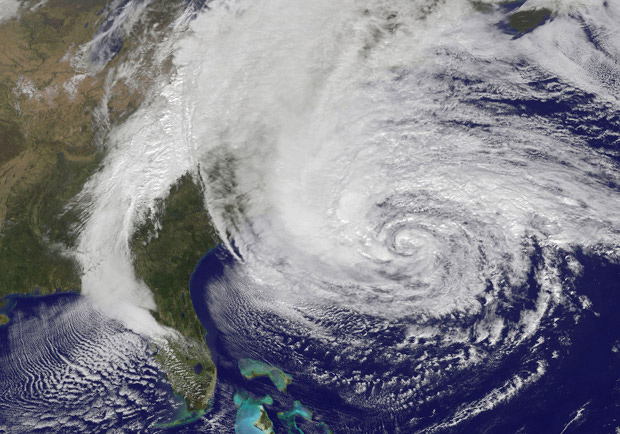
As usual, great weather events bring out the Christian crazies, like those proclaiming that Hurricane Sandy is God's judgment ("God sent the whirlwind. Thank God for righteous judgment," said one) against (pick one) homosexuals, pornography, materialism, secularism, Darwinism, and so on and so forth. But I'm not linking to these statements because, well, you've got better things to do with your time than read sub-Christian, one might even say nonchristian, theology.
Granted when storms do appear in the Old Testament, they are often seen as God's act of judgment, to prod repentance. The classic case is when Egypt was bombarded with hail and lightning so Pharoah would know God was in charge. Pharoah indeed was temporarily scared into faith, but as soon as the storm ceased,"the heart of Pharaoh was hardened, and he did not let the people of Israel go" (Ex. 9:35).
Then again, a storm at sea convinces Jonah he has been disobedient (Jonah 2), and when God speaks out of a tornado (Job 38-41), Job repents in dust and ashes for his insolence (Job 42:6).
Starting with Jesus, though, a different calculus is at work in the Bible, as we might expect. Whereas in Exodus, the storm itself is said to show the sovereign power of God, in the Gospel of Mark, it is Jesus stilling of the storm that demonstrates, as the disciples put it, here is one whom even the wind and seas obey (Mark 4:41). In the midst of the storm, we do not find Jesus claiming it is the judgment of God against the sin of Israel. Nor does Paul revert to that way of thinking when he finds himself in a storm on sea. Instead, he says no one need be afraid, because God will rescue one and all (Act 27:22).
An even more startling contrast is found at the end of the New Testament. That is when we're invited into the holy of holies to get a glimpse of the nature of God: "Then God's temple in heaven was opened, and the ark of his covenant was seen within his temple. There were flashes of lightning, rumblings, peals of thunder, an earthquake, and heavy hail" (Rev. 11:19).
In contrast to the word to Ezekiel, God is very much present in this storm. All those "natural" weather patterns from which we are anxious to distance God ("He allows them to happen but doesn't cause them," "He brings good out of these evil natural disasters," and so forth) become metaphors for the power and holiness of God.
With the coming of Jesus, then, everything is transformed, including how we understand natural calamaties. That which was formerly a sign of God's judgment, intended to punish or prod repentance, is now the occasion to demonstrate God's power and holiness. That which was seen as merely destructive is now a symbol of eternal life.
The difference between the old way of thinking (Old Testament) and the new way of thinking (New Testament) is this: Fear not—that which seems horrible, destructive, and pointless is embraced by the holiness of God and redeemed by the storm of the Cross.
The temptation, of course, is to condemn the crazies with equal and opposite self-righteousness. I'm thinking that Jesus might respond to them as he did to the disciples in the midst of the storm, when they failed to recognize the new thing happening among them: "Why are you so afraid? Have you still no faith?"
Mark Galli is editor of Christianity Today