If you ever get invited to a wedding on a Friday night in Morocco, the invitation will say the ceremony starts “the evening of Saturday.” North Africans consider each day to begin the evening before nightfall—just the way Genesis describes each day of the world’s first week: “And there was evening, and there was morning. . . .”
This small connection between Scripture and one of Africa’s myriad cultures appears at the beginning of the Africa Study Bible (ASB), set to launch in February 2017. The first English-language study Bible written by African scholars for an African context, it’s also attracting Western readers.
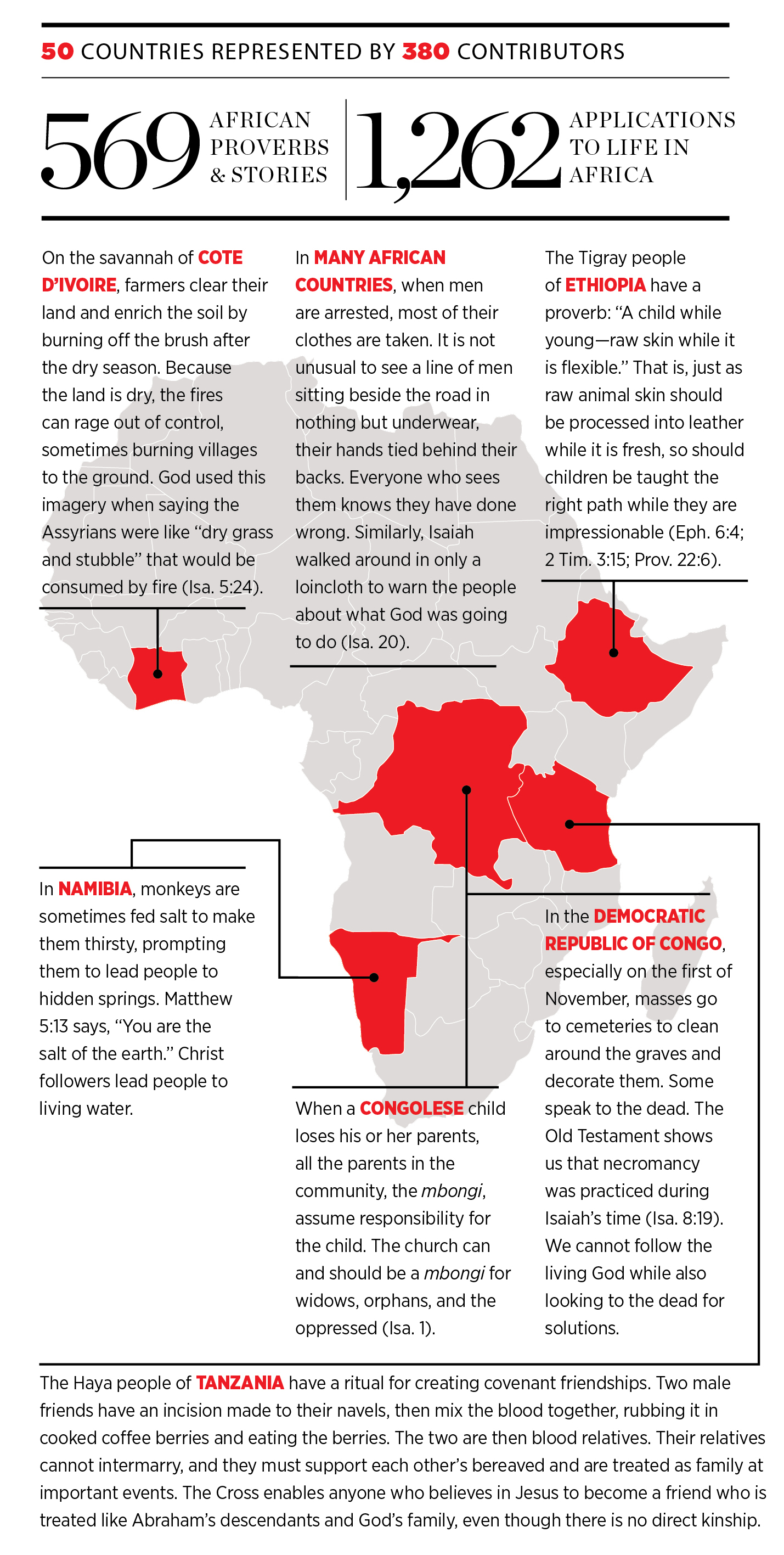
Using the New Living Translation, the ASB includes explanations of unfamiliar words, African proverbs, and ways to apply Scripture to life in Africa.
“A lot of the analogies and cultural phrases in American study Bibles don’t relate fully to many of the issues a lot of Africans are going through—like civil war, polygamy, and the worship of idols,” said Natalie Cameron, spokesperson at Oasis International, which helped to develop the ASB. Conversely, some Bible stories resonate especially well, such as those of the Israelite tribes, given that many Africans are deeply connected to their own tribes.
Just as Westerners generally spend more time in the New Testament, African Christians can over-relate to the Old Testament, said Priscilla Adoyo, a lecturer at Africa International University who worked on the ASB.
“Sacrifices, blessings and curses, family and other relational practices, drought and famine are all familiar ground to the African,” she said. “Unfortunately, some have embraced the Old Testament teachings and picked and chosen what is relevant to their situation from the New.”
The ASB seeks to explain both, but its commentary is heavier in the Old Testament, just as the notes in Western study Bibles are heavier in the New, Adoyo said. “The New Testament is a little foreign, with all the doctrinal issues and disciplines that were needed by the early church. Most of those issues have been articulated clearly in Western study Bibles, and we do not need to re-invent the wheel.”

Africa is ready for its own take on the Bible, she said. “Christians in Africa today have been more exposed to biblical theology and received more balanced teachings, as opposed to what was presented to us by the early missionaries,” she said. “We now understand the value of many of our cultural practices that were denounced by the missionary, while at the same time recognizing the importance of the New Testament teaching regarding the kingdom of God.”
The ASB, which follows in the footsteps of the pastor-focused African Bible Commentary, is intended to disciple those in the pews.
The ASB may also find a Western market. American readers have told Oasis president Matthew Elliott that they have found early samples interesting. “The culture of the Bible has more similarities to African cultures than to ours, so sometimes Africans understand things naturally that we do not,” Elliott said. “We will all benefit from African wisdom and insights into God’s Word.”