The relentless clickety-clack of a typewriter never sounded so ominous, or mournful, as it does in Atonement, Joe Wright's heartbreaking adaptation of the acclaimed novel by Ian McEwan. The film is full of people typing—a girl writing plays, a man composing apologies, a woman spelling out her guilt in the hope that all can be forgiven—to the point where the pounding of the keys is woven into the very score, making Dario Marianelli's music sound even more urgent than it already does.
The story begins in 1935, with 13-year-old Briony Tallis (Saoirse Ronan) at home on her family's estate and writing a play for her cousins to perform. They don't take direction well, though, and when they abandon her, she wanders to the window and witnesses a mysterious encounter between her adult sister Cecilia (Keira Knightley) and Robbie Turner (James McAvoy), the son of the family's housekeeper.
Keira Knightley as Cecilia Tallis
This encounter, and the fact that Briony sees it but doesn't know how to understand it, sets in motion a series of events that ultimately leads to Briony accusing Robbie of a crime—and the accusation ruins not only his life, but Cecilia's, too, because she loves him and is the only one in her family who believes in his innocence.
The film then leaps ahead to 1940. Robbie is a soldier stranded in France during the disastrous retreat at Dunkirk, while Cecilia and a grown-up Briony (Romola Garai) serve as nurses in London. The two sisters do not associate with each other, though Briony, who now knows that she did something wrong, spends her nights typing out her version of what happened—a version that may or may not set things right.
A number of critics have complained that the wartime sequences don't live up to the promise of the film's first act, but having seen the film twice, my own response is somewhat different. If anything, the first act seems clever but somewhat contrived, like a necessary series of events without which the rest of the movie simply could not happen, but the real emotional pay-off comes in the later scenes. And for what it's worth, on second viewing, the later scenes became even more emotional.
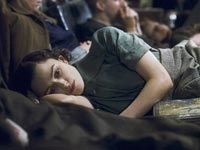
James McAvoy as Robbie Turner
The first act is still quite impressive, though, and much of the credit goes to Ronan's performance as the young Briony, the intelligent but naï ve girl whose great error may be due as much to childish spite as it is to childish innocence.
Some of the credit also goes to the film's unusual structure. The mysterious, indeed scandalous, encounters between Cecilia and Robbie that Briony witnesses are first shown to us from Briony's point of view. They are then shown again, from Cecilia and Robbie's point of view, and what looked threatening to the child turns out to be quite different as far as the grown-ups are concerned. The contrast between these perspectives also prepares us for later moments in the film, when incidents we thought we understood are revealed to be even more complicated than we knew.
Another striking thing about this film is the way it emphasizes the role that both chance and choice play in determining our fates. Young Briony, for example, is drawn to a window because she hears a bee buzzing against it—and if it were not for that bee, she would not have witnessed the first of the puzzling incidents.
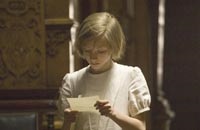
Saoirse Ronan as a young Briony Tallis
The film also probes the fuzzy line between fact and fancy in the way we remember things, and for that matter in the way we sometimes live in the present. Briony's imagination may be partly to blame for the accusation she makes. And Robbie, more than once, thinks back to certain pivotal moments in his own life and wishes they could be undone. During a moment of delusional illness in France, he also imagines that his mother (Brenda Blethyn) has come to soothe and take care of him.
And just as the individual characters wrestle with these issues, so too does the larger society. When a nurse reports that the government is calling the evacuations at Dunkirk a "strategic withdrawal," Briony, ever the wordsmith, replies that this is just a "euphemism for retreat"; compare that to current debates over so-called "exit strategies." And while the British newsreels show the evacuation in the most positive light possible, the film includes a long tracking shot in which Robbie walks down the beach at Dunkirk and witnesses the most chaotic, despairing, reckless behavior possible; compare that to current debates over troop behavior overseas.
A little light does pierce the darkness, though. Roughly halfway through the tracking shot, the camera comes to a gazebo where several troops have gathered to sing a hymn; we circle them and then, just as we leave, we hear them sing the words "the still small voice of God." Moments later, as the tracking shot comes to an end some distance away, the camera turns back to the gazebo, and those words are once again just barely audible on the soundtrack. In the midst of the chaos and despair of war, the film dwells on this note of hoped-for grace—a note that may be echoed in a later scene, where Briony goes about her business while Debussy's Claire de Lune plays over the soundtrack, in stark contrast to the film's usually frenetic score.
Article continues below
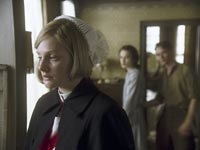
Romola Garai as the older Briony
It is difficult to say much more without giving away important plot points. But suffice it to say that the film, written by Christopher Hampton (Dangerous Liaisons) and directed by Joe Wright (Pride & Prejudice), is full of images and bits of dialogue that echo one another in interesting ways; immersion in water is a recurring motif, and an upper-class man's glib reference to the "war wound" he got while fighting off a child—just a nick on his cheek, really—stands in stark contrast to the actual war wound that the lower-class Robbie has when we catch up with him in France.
The film also raises important questions about the relationship between honesty and kindness, between truth and grace, between memory and wishful thinking, and it ends on a surprisingly powerful note that asks whether there can ever be true mercy without, well, truth. Can one find redemption in a lie, if it is told with kindness?
In thinking about this film, my mind often goes back to Snow Falling on Cedars. Both films move back and forth in time, both films feature young lovers interrupted in a moment of passion, and both films amplify questions of personal, social and even cosmic injustice by dragging their characters into the Second World War.
But where Snow Falling on Cedarswas about bearing your scars and letting go of the past, Atonement seems to be about people who cannot let go of the past, and are indeed haunted by the past and their knowledge that it can never be undone. Briony, in particular, is searching for grace and forgiveness, and the fact that she can't quite find it makes Atonementone of the more devastating films in recent memory.
Talk About It
Discussion starters
Have you done things that you deeply regretted and wished you could undo, especially because of how they affected other people? How have you dealt with it? Is it easier to deal with if the error was committed while you were a child?
When Robbie meets Cecilia in London, he says he doesn't know if they can have a relationship based on "a few moments" that took place a few years before. How would you deal with this situation? Does his dilemma tell us anything about sexual relationships and how they should be approached?
What does the film indicate about class prejudices? Would everyone have believed Briony's accusation if Robbie had not come from the servant class? Have class differences affected your own attitude towards other people? Have you ever tried to fit in with other groups of people the way Robbie does (note his accent)? How?
Article continues below
What does the film say about the relationship between truth and mercy? How do you think God embodies both of these things?
Why is it important that Briony not reveal her first name to the soldiers that she comforts? Why does she reveal it to a wounded soldier just before he dies? How does this tie into the movie's themes of forgiveness, hope, truth, and mercy?
The Family Corner
For parents to consider
Atonement is rated R for disturbing war images (a field of dead children, horses being shot, a man checks the wound in his chest), language (most of it f-words used by the soldiers in Dunkirk, though another, arguably worse four-letter word is seen in tight close-up as it is spelled out on a typewriter), and some sexuality (a man and woman are about to have sex against a bookshelf, but their clothes stay on; a woman dives into the water in her underwear and is somewhat exposed afterwards; a sexual predator's rear end is briefly illuminated by a flashlight in the middle of the night)













 While we pray for peace, we need moral clarity about this war.
 Alcoholism among women is rising. Can the church help?
 The Dallas Mavericks were intended to be the first Christian team in the NBA.