It's hard to begin a review of a Wes Anderson film without using the word "auteur." From his debut film Bottle Rocket (1996) onward, Anderson has established a style that is clearly his own: tracking and slow-motion shots, montages, classic rock songs (often played over the montages or slow-motion shots), wry humor, immaculate production design, the Futura Bold font—and so on. He also returns to many of the same themes, like family dysfunction and identity crises. If an auteur is defined as a director "whose complete control over all aspects of a production gives the end result a recognizable feel," Anderson fits the label as well as anyone.
Anderson's newest film, Fantastic Mr. Fox, is an adaptation of a children's book by the oft-adapted Roald Dahl (Charlie and the Chocolate Factory, James and the Giant Peach, Matilda). Fantastic Mr. Fox represents Anderson's first attempt at an animated film—more specifically, stop-action animation, with real-life models painstakingly photographed one frame at a time. My biggest question going into this film was how Anderson's distinctive style would translate from live action to this new medium.
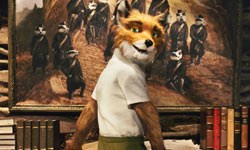
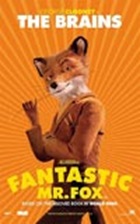
Mr. Fox, as voiced by George Clooney
When asked by the Chicago Sun-Times about using stop-motion, Anderson said, "With stop-motion over other forms of animation, I think you can sense that somebody's moving these physical objects and making them seem alive. You can somehow sense the hands being put on these things, and there's a charm to that, I think." This awareness of "the hands" is especially true in Fantastic Mr. Fox, because the character models wear real fur. As the animators re-position the models between frames, the bristles in the models' fur get pushed around, creating in the final product an effect known as "invisible wind."
If, then, you think about stop-motion as a form that calls attention to itself and the creators behind it, then it seems a perfect fit for a director whose films do the same. And it is. Anderson's eye for detail lends charm and life to the miniature sets of tree houses and farms, and his trademark camera pans let us feast on every hand-crafted morsel. Similarly, the geometric precision he is known for in his set design and camera angles gives Fantastic Mr. Fox an appropriate storybook feel. Notably missing, though, are Anderson's slow-motion shots; one can imagine some frenzied animator begging Anderson not to spend three months of production time on a painstaking ten seconds of slow motion.
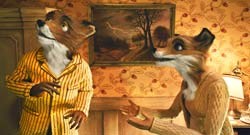
The story of Fantastic Mr. Fox uses Roald Dahl's original barebones plot for the core action and elaborates on it. Mr. Fox (voiced by George Clooney) is a fox, of course, and a one-time farm thief who, for the sake of his family, has settled down to the less dangerous—but also less thrilling and less lucrative—job of a newspaper columnist. Eventually, though, the old itch to steal drives him to the farms of Boggis, Bunce, and Bean, three very mean men. Mr. Fox's relapse ignites a war that places not only his family but also his whole community in jeopardy.
The voice casting is pitch perfect for Mr. Fox, a character who is poised, confident, charismatic, and a little vain. Two-time "Sexiest Man Alive" honoree Clooney is up for it. Opposite him is Meryl Streep as Mrs. Fox, and Streep delivers the intelligent verve needed for a character who isn't completely fooled by Mr. Fox's charisma or feats of derring-do. Also present are a number of Anderson cast regulars, like Bill Murray as the serious and not-so-popular Badger, Jason Schwartzman as Ash, Mr. Fox's insecure son, and Owen Wilson as the P.E. coach.
Anderson is sometimes criticized for writing characters whose absurdities make them too cartoonish, but in an animated film with talking animals, he gets a little more leeway. In fact, the little quirks he gives each character—Mr. Fox's "trademark" whistle, which is borrowed from Hawkeye Pierce in the film MASH, or Kylie the possum's cross-eyed zone-outs—add an extra layer of individuality that helps to distinguish characters portrayed by miniature models instead of human actors. Anderson also has some clever fun with the anthropomorphism of his characters, turning it into its own kind of running joke. One instant Mr. Fox and Badger are bickering back and forth like two middle-aged men—"The cuss you are!"—and the next they are snarling at each other incoherently and flailing their claws.
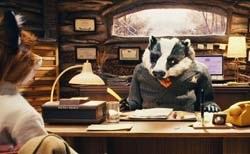
Bill Murray provides the voice of Badger
Anderson's typically wry humor colors much of the dialogue. Says Mrs. Fox, when she suspects that Mr. Fox is back to his thieving ways, "If what I think is happening is happening—it better not be." It's fun, especially coming from these animated characters, but it also makes the film funnier for adults than for kids. At the same time, Anderson does lean more on visual jokes in this film, like the aforementioned cross-eyed Kylie, and these translate well to any age.
Anderson's films often bounce between absurd comedy and poignant catharsis, and Fantastic Mr. Fox is no different. Its brisk pacing keeps the catharsis from weighing down the comedy. He rests for only a moment, a single beat, on little Ash as the tears jump into his eyes, and then we're off.
Article continues below
In fact, though, Fantastic Mr. Fox doesn't hit the same depths of poignancy as some of Anderson's earlier efforts —The Royal Tenenbaums, in particular. The overriding mood is too light-hearted and zany. At one point, Mr. Fox has an encounter that is something like the sublime underwater vision of the jaguar shark in The Life Aquatic, but, as if Anderson (or co-writer Noah Baumbach) couldn't keep a straight face, Mr. Fox's mythical moment is broken by an absurd, and very funny, gesture. It feels as though Anderson relaxed a little to re-tell a children's story, but in a way it's actually refreshing. It makes me more inclined to forgive the one aspect of the animation that bothered me—the frenzied, fast-forward sequences, which look just a little ludicrous, and certainly much too out of control for Anderson.
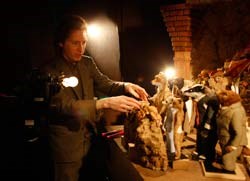
Director Wes Anderson on the set
The themes are familiar for fans of Anderson. Identity crisis, for instance, is a big one: Mr. Fox wants to be a wild animal, and Ash wants to be an athlete. Resolution only comes for everyone when each member of the animal community embraces their own identity and role. If I am allowed to stretch a bit, the scene has echoes of Adam naming animals in the Garden, only substitute a talking fox and scientific Latin names for the father of the human race and the most ancient of human speech.
A related theme is the responsibility that comes with leadership. Mr. Fox has a charisma and decisiveness that no other animal can match (which Badger makes painfully obvious). When he uses these qualities for his own selfish ends, he ends up hurting his family and friends. But when he chooses instead to empower each of them and unite them around a goal, the whole animal community is saved. And when they are saved, the ugly, smelly, mean farmers Boggis, Bunce, and Bean are left waiting in vain for vengeance. So far as I'm told, they are still waiting.
Talk About It
Discussion starters
Is there an identity you wish you could fulfill but don't seem able to?
How do we distinguish between healthy desires and idolatrous desires?
What are some ways in which you might manipulate people around you for your good instead of their good or the glory of God?
Did Mr. Fox face up to all of his character's flaws and repent of them?
The Family Corner
For parents to consider
Fantastic Mr. Fox is rated PG for action, smoking, and slang humor. There are scenes of animated violence, including guns and a knife fight, but the only graphic instance, which is admittedly surprising and sudden, is a close-up on the throat of a character that has been cut and mortally wounded. Also, one character smokes, and a running gag substitutes the word "cuss" for any instance in which a character might have used more offensive language.













 While we pray for peace, we need moral clarity about this war.
 We’ve got little information on Jesus’ appearance and personality. But that’s the way God designed it.españolFrançais
 The plan would organize UMC churches in four global regions, with each given more leeway around same-sex marriage and other theological issues.