 Streeter Lecka / Getty
Update (Feb. 1): Barna just announced that two-thirds of Americans think pro athletes have more influence on society than pastors.
––-
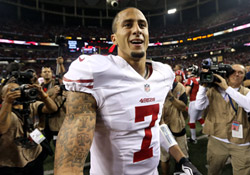
The NFL bans Bible verses on players' eyeblack or uniforms, but Super Bowl-bound San Francisco 49ers quarterback Colin Kaepernick wears his favorite verses on his arms–permanently.
Kaepernick, whose successful season has launched him into the national spotlight, made headlines last November when one Sporting News columnist criticized the quarterback's arm tattoos, likening the player to "inmates at California's state prison."
The commentary sparked response from other bloggers who came to Kaepernick's defense. But Kaepernick's adoptive parents also went straight to the media in support of their son's tattoos, pointing out that he "chose Bible verses and had them inscribed on his biceps."
"'Colin's a fairly religious kid, but he's not in your face about it,'" his father told USA Today."'It's more about him and what he believes.'"
In 2001, the Nevada Sagebrush reported that "Kaepernick's parents raised him in a Christian household, even taking time away from youth football practices to attend Confirmation classes." Kaepernick told the University of Nevada student newspaper that religion is "'a foundation to build your life off of.'"
So, when he chose to tattoo his upper body, he chose Bible verses. According to Sports Illustrated, the psalms tattooed on Kaepernick's arms are all about his competitive instinct. The verses include Psalm 27:3, which says, "Though an army besiege me, my heart will not fear; though war break out against me, even then I will be confident." On the other arm is Psalm 18:39, which reads, "You armed me with strength for battle; you humbled my adversaries before me."
Kaepernick also explained his tattoos to sports reporter and former NFL quarterback Kurt Warner: "My first tattoo was a scroll on my right arm, Psalm 18:39…It's just my way of showing everybody that this is what I believe in."
But Kaepernick obviously is not the only religious NFL player likely hoping God gives him the win in Sunday's game. Baltimore Ravens' veteran linebacker Ray Lewis has been vocal about his Christian faith, even making the cover of Sports Illustrated in 2006 for an article entitled "The Gospel According to Ray Lewis: God's Linebacker." More recently, Lewis was caught dropping to his knees in prayer on the sidelines following the Ravens' double overtime victory over the Denver Broncos earlier this month.
Not surprisingly, Lewis also has tattoos, although they aren't Bible verses and have not sparked nearly the same controversy as Kaepernick's. Rather, Lewis first became well-known over a decade ago, when his role in a January 2000 fight resulted in an indictment on murder and aggravated-assault charges.
Since then, Lewis "has not only rehabilitated his image but become an iconic figure for his dominating play and leadership," according to USA Today.
But CBS Sports says Ray Lewis doesn't believe God will pick a Superbowl winner.
"'What I do believe is that if you give him true credit to say, 'Whatever your will is, so be it,'" Lewis said. "'The bottom line is you never lose when your mind-set is, 'Whatever his will is, so be it.'"
And a majority of Americans actually agree with Lewis. New research from the Public Religion Research Institute shows that "a majority (53%) [of survey respondents] believe that God rewards athletes who have faith with good health and success." Just under 3 in 10 say that "God plays a role in determining which team wins a sporting event."
CT has previously reported on the Super Bowl, including Super Bowl evangelism, faith-based Super Bowl parties, and a cover story on why America loves football. CT also previously interviewed quarterback Tim Tebow about his faith.