
Two years ago there appeared a book that deserves more attention than it has hitherto received. This is the work of Antanas Maceina issued under the title, Das Geheimnis der Bosheit (The Secret of Evil). In this volume Maceina deals with the antichrist with reference to the Russian writer Solowjew’s tales attempting to account for evil in the world. Because he rejected an eternal dualism between good and evil, he was confronted with the question of the problem of evil in the world, and attempted therefore to supply an answer in his book on the antichrist.
The secret of evil is an expression that goes back to 2 Thessalonians 2, where Paul, in connection with the man of sin, speaks of the hiddenness of iniquity. The expression is used frequently to indicate the strange, mysterious character of evil. Maceina wishes to follow the trail of evil in history. He is gripped especially by the thought that the realm of the antichrist is the world of caricature. This realm wears the mask of the Church—and as one proceeds to follow this through, one goes from one thing to another. In this fashion the antichrist is described as the man of ethics, of morality, of decency and well doing, in short, as philanthropist. Naturally there lies in all of this an element of truth: there is a masquerade. But one must be careful of overstatement, as for instance when Maceina identifies the antichrist as the imitation of the new Jerusalem. According to the biblical message, the example of philanthropy does not fit very well, at least not in the case of believers (who of course also are people). But we acknowledge that there always lies in the antichrist something of the substitute, the disguise, of imitation, of caricature, even in the range of the wonders of the antichrist.
Now there is in this book one element that deserves our special attention. When Maceina speaks of the great falling away, he regards this falling away also as a purifying factor in the life of the Church of Jesus Christ, because in its smaller numbers it continues to strive throughout this trial. And in this connection he warns us against the human tendency to attach too much importance to the matter of numbers, to quantity, for the very reason that it is exactly the power of numbers that is the trademark of the realm of the antichrist. The Kingdom of God pays no attention to quantity, but to quality, and one must therefore protect himself from the temptation of numbers. And he expresses himself in such fashion that he makes clear that quantity is the false disguise of value.
He can, therefore, quite naturally point to all kinds of scriptural passages wherein there is warning against the overevaluation of numbers. These warnings are indeed many, and we think back on the census of David, and the band of Gideon in which there were “too many,” and it is exactly in comparison with these that we read in the Gospels about the “legion” of the power of darkness! Therefore Maceina points us to the dangerous cult or fad of numbers. But it is necessary to point out with emphasis that the Gospel also speaks of the value of “the many”. One can say that the preaching of the Gospel to all people is thus directed to the many. It certainly is not in vain that in the Revelation of John mention is made of the great throng which no one can number and which is gathered from all people and nations and tongues. That is an outlook that rests in the broadness and universality of the Gospel for the entire world. The Gospel seeks out the uttermost parts of the earth and that is exactly the perspective of Pentecost. Also in the many resides the blessing of the Gospel. And when one too quickly and too conveniently brings the great falling away in connection with the purification of the Church, which now in its small numbers can still press through in its striving over against massive forces, then one is certainly embarked upon a romantic path.
True, the Gospel gives us no opportunity to seek after numbers, but it does point us toward the riches of numbers for the Lord. We must not sing hymns of praise for individuals. That can only fall short of the doing justice to the great call of the Church to seek, with the harnessing of all possible power, the many in an uprooted world. Do we not read that Christ has given his life for many? Surely the power of God can in the Church’s times of need bring individuals (the persecuted) under God’s special protection, and one must never fear when numbers grow smaller, and we should never come under the suggestive spell of “legion.” Great numbers are no guarantee of value or truth. However, we must not, in juxtaposition to legion, glorify the few, as if there is an essential value in the few that we should desire small numbers. Much more should we look forward to the time when they shall come from all sides, as in the prophecy of Zechariah, where we read, “Thus saith the Lord of hosts; In those days it shall come to pass, that ten men shall take hold out of all languages of the nations, even shall take hold of the skirt of him that is the Jew, saying, We will go with you: for we have heard that God is with you.”
The throng which no one can number.… In the middle of this turmoiled world in which we live, we should not become confused about the value of numbers and the many. We cannot let the matter of the total be decisive, and where two or three are gathered in the name of the Lord, there he will be in the midst of them. But our prayer goes forth also to the many. For even though the power of darkness may have estranged the many and used the total to make an impression, we may never forget that the total remains God’s property. The many have their place in the apocalyptic vision. And upon the many focuses our calling, our expectation and our fervent prayers.
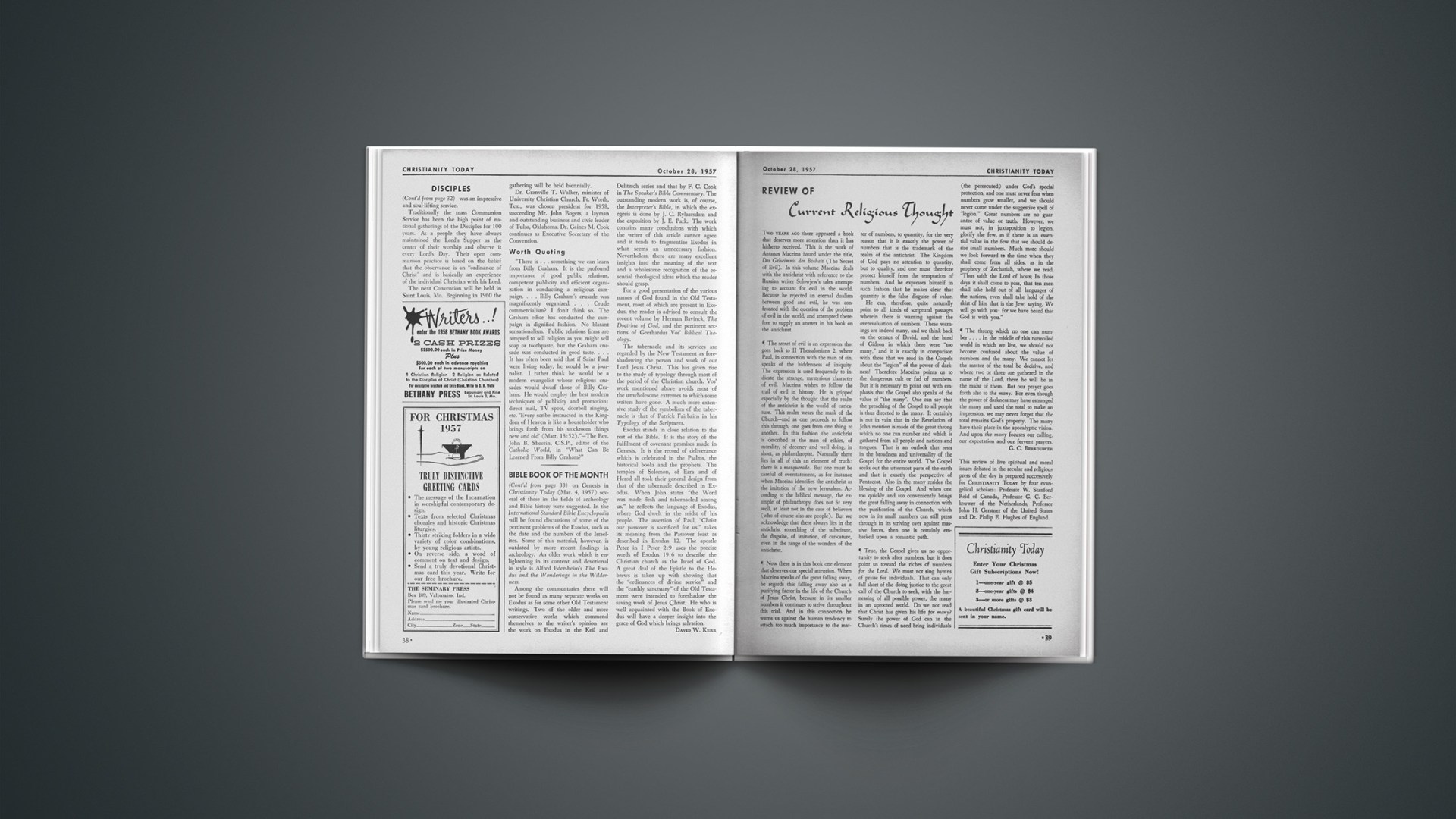
This review of live spiritual and moral issues debated in the secular and religious press of the day is prepared successively for CHRISTIANITY TODAY by four evangelical scholars: Professor W. Stanford Reid of Canada, Professor G. C. Berkouwer of the Netherlands, Professor John H. Gerstner of the United States and Dr. Philip E. Hughes of England.