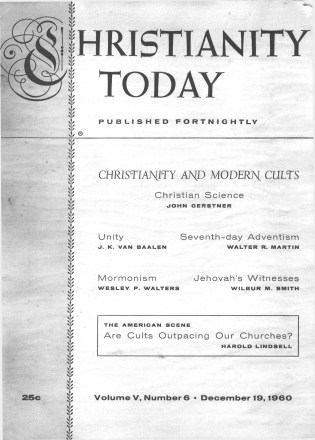
Since the current controversy over the classification of Seventh-day Adventists (denomination or cult?) was first initiated in 1956, one interesting factor in the conflict has gone largely unnoticed. The Adventists apparently have been faced by growing internal tension and division as a result of the publication of their definitive volume, Questions on Doctrine, and of Walter Martin’s new book, The Truth About Seventh-day Adventism.
The rumblings, first beneath the surface, can now be heard audibly in not a few quarters. The fact that there has been a marked change or redefinition of certain facets of Seventh-day Adventist theology, was pointed out by The Gathering Call, published by ex-Seventh-day Adventists. An article entitled “Moving the Landmarks” considers the Adventists’ volume, Questions on Doctrine, and articles published in Eternity magazine by Donald Grey Barnhouse and Walter R. Martin. The editors of the Call point out that some of the old Adventist landmarks have been moved, notably the alleged inerrancy of Ellen White, the vicarious nature of the scapegoat translation of Leviticus 16, and the literal interpretation of the Heavenly Sanctuary doctrine. According to The Gathering Call, historic adventism stands repudiated in these areas, a charge supplemented by other interesting considerations. A. L. Hudson, former elder in a large Adventist church in Oregon, in company with retired yet powerful Adventist leader Dr. M. L. Andreasen, has spearheaded a move to have those responsible for the publication of Questions on Doctrine censured for “misrepresenting the historic position” of the Adventist church. From as far away as Australia and New Zealand letters have reached us concerning the small but apparently vocal segment of Adventism that still wants to brand Sunday keepers with “the mark of the beast,” teach a literalistic sanctuary and scapegoat transaction, and hold Ellen White in esteem as an infallible “prophetess.” Dr. Andreasen at one time was professor of theology at the Adventists’ seminary in Washington, D. C.
Leaders of the Seventh-day Adventist denomination have, however, discounted this faction as unrepresentative of the views of the major constituency of the Church. This affirmation is apparently underscored by the fact that the book, Questions on Doctrine, authorized by the General Conference as the denominational position, has had the widest circulation and general approval of the denomination of any volume of recent years. But the fact remains that there is a segment of Seventh-day Adventists vocal and apparently powerful enough to reverse some of the trends originally undertaken in good faith by the leadership of the denomination in 1956.
It is significant to note that The Signs of the Times and These Times, major Adventist publications, have identified themselves for the first time as publications of the Seventh-day Adventist Church, only to have the identification rescinded and withdrawn from the masthead. Certain publications which allegedly did not represent the position of the denomination are still widely circulated despite the assurance of the leadership of the Seventh-day Adventist denomination that “plans were already operative” to dispense with such inconsistencies in Adventist publishing houses. (Adventist spokesmen assert that, in a sense, each of their publishing houses is autonomous, having its own board of control, and that the reasons for masthead changes lie with the editors.)
Another interesting fact is the Adventist denomination’s attitude toward Mr. Martin’s book, which leaders endorsed as accurately representing their views. Martin’s book was to be stocked by Adventist publishing houses according to commitments made by top Adventist officials. Authorization to place his book on sale was not forthcoming, however, despite the fact that two non-critical non-Adventist publications were accepted for distribution. (Adventist spokesmen point out that their book and Bible houses are set up as retail outlets for their own publishing houses, and only occasionally is the sale of outside books authorized. “Martin’s book sets forth our views accurately,” said one leader, “but that’s only half the story. It also attempts to expose as fallacious the most distinctive of these views. Why should a religious body promote books that seek to refute these teachings?”)
The cleft in Seventh-day Adventism seems, however, to be deeper than appears on the surface. Some Seventh-day Adventist officials seem not to welcome any investigation of their views due to their divergence from what the church maintains as its true position.
One thing, however, is certain. Certain elements in the theology of Seventh-day Adventism are in flux; some of the old landmarks have apparently been moved; and some old errors have been or are being rectified. Perhaps the Adventist denomination would be wiser to admit these faults publicly. By so doing they would probably escape the growing conviction in some circles that they cannot control irresponsible, unrepresentative elements within the church, and are content to remain silent where decisive action would settle the issue. Such action would promote stronger ties of fellowship and respect for the integrity of Adventism among Christians of other denominations.