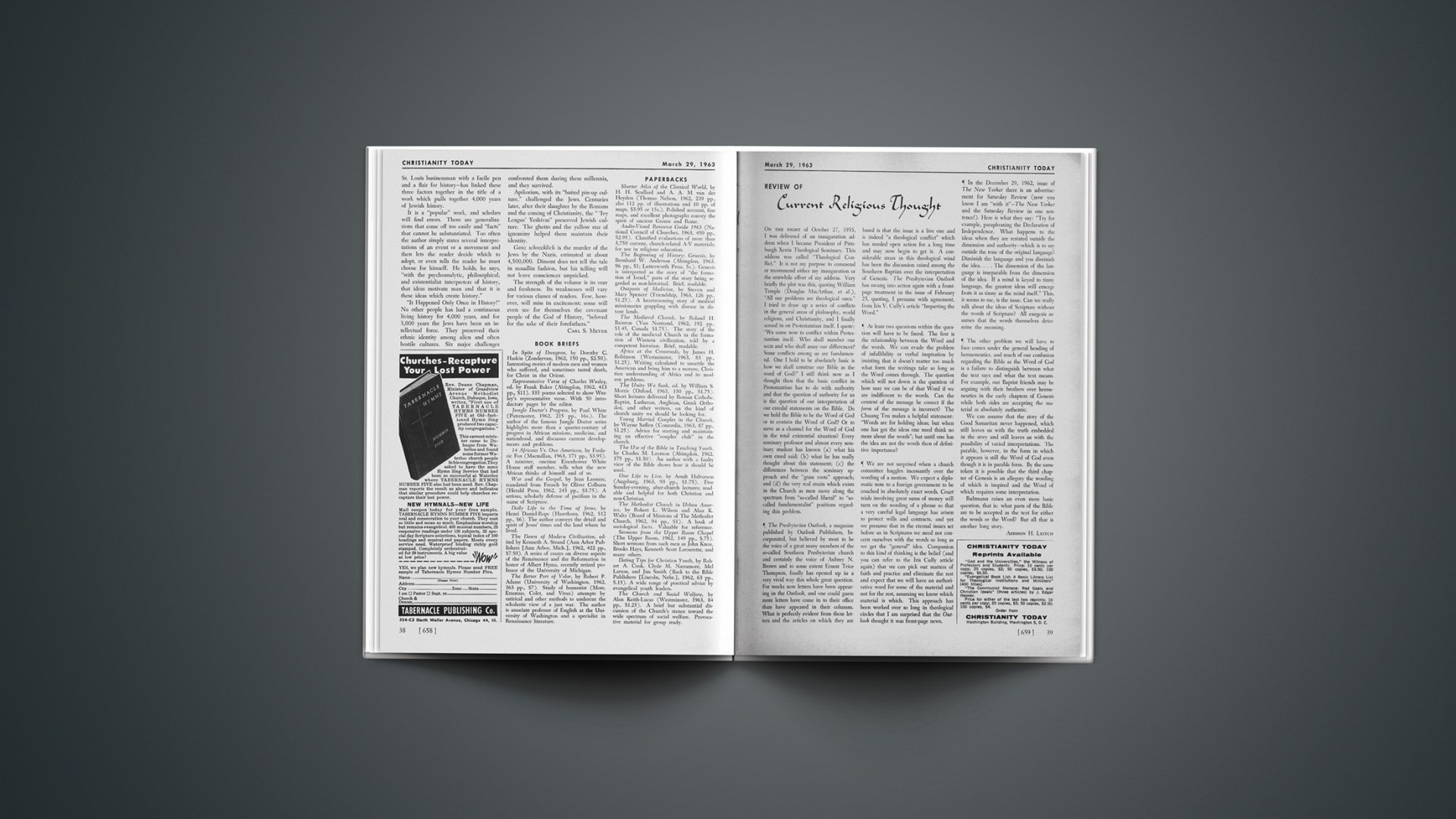

On the night of October 27, 1955, I was delivered of an inauguration address when I became President of Pittsburgh Xenia Theological Seminary. This address was called “Theological Conflict.” It is not my purpose to commend or recommend either my inauguration or the erstwhile effort of my address. Very briefly the plot was this, quoting William Temple (Douglas MacArthur, et al.), “All our problems are theological ones.” I tried to draw up a series of conflicts in the general areas of philosophy, world religions, and Christianity, and I finally zeroed in on Protestantism itself. I quote: “We come now to conflict within Protestantism itself. Who shall number our sects and who shall assay our differences? Some conflicts among us are fundamental. One I hold to be absolutely basic is how we shall construe our Bible as the word of God?” I still think now as I thought then that the basic conflict in Protestantism has to do with authority and that the question of authority for us is the question of our interpretation of our creedal statements on the Bible. Do we hold the Bible to be the Word of God or to contain the Word of God? Or to serve as a channel for the Word of God in the total existential situation? Every seminary professor and almost every seminary student has known (a) what his own creed said; (b) what he has really thought about this statement; (c) the differences between the seminary approach and the “grass roots” approach; and (d) the very real strain which exists in the Church as men move along the spectrum from “so-called liberal” to “so-called fundamentalist” positions regarding this problem.
The Presbyterian Outlook, a magazine published by Outlook Publishers, Incorporated, but believed by most to be the voice of a great many members of the so-called Southern Presbyterian church and certainly the voice of Aubrey N. Brown and to some extent Ernest Trice Thompson, finally has opened up in a very vivid way this whole great question. For weeks now letters have been appearing in the Outlook, and one could guess more letters have come in to their office than have appeared in their columns. What is perfectly evident from these letters and the articles on which they are based is that the issue is a live one and is indeed “a theological conflict” which has needed open action for a long time and may now begin to get it. A considerable straw in this theological wind has been the discussion raised among the Southern Baptists over the interpretation of Genesis. The Presbyterian Outlook has swung into action again with a front-page treatment in the issue of February 25, quoting, I presume with agreement, from Iris V. Cully’s article “Imparting the Word.”
At least two questions within the question will have to be faced. The first is the relationship between the Word and the words. We can evade the problem of infallibility or verbal inspiration by insisting that it doesn’t matter too much what form the writings take so long as the Word comes through. The question which will not down is the question of how sure we can be of that Word if we are indifferent to the words. Can the content of the message be correct if the form of the message is incorrect? The Chuang Tzu makes a helpful statement: “Words are for holding ideas; but when one has got the ideas one need think no more about the words”; but until one has the idea are not the words then of definitive importance?
We are not surprised when a church committee haggles incessantly over the wording of a motion. We expect a diplomatic note to a foreign government to be couched in absolutely exact words. Court trials involving great sums of money will turn on the wording of a phrase so that a very careful legal language has arisen to protect wills and contracts, and yet we presume that in the eternal issues set before us in Scriptures we need not concern ourselves with the words so long as we get the “general” idea. Companion to this kind of thinking is the belief (and you can refer to the Iris Cully article again) that we can pick out matters of faith and practice and eliminate the rest and expect that we will have an authoritative word for some of the material and not for the rest, assuming we know which material is which. This approach has been worked over so long in theological circles that I am surprised that the Outlook thought it was front-page news.
In the December 29, 1962, issue of The New Yorker there is an advertisement for Saturday Review (now you know I am “with it”—The New Yorker and the Saturday Review in one sentence!). Here is what they say: “Try for example, paraphrasing the Declaration of Independence. What happens to the ideas when they are restated outside the dimension and authority—which is to say outside the tone of the original language? Diminish the language and you diminish the idea.… The dimension of the language is inseparable from the dimension of the idea. If a mind is keyed to tinny language, the greatest ideas will emerge from it as tinny as the mind itself.” This, it seems to me, is the issue. Can we really talk about the ideas of Scripture without the words of Scripture? All exegesis assumes that the words themselves determine the meaning.
The other problem we will have to face comes under the general heading of hermeneutics, and much of our confusion regarding the Bible as the Word of God is a failure to distinguish between what the text says and what the text means. For example, our Baptist friends may be arguing with their brothers over hermeneutics in the early chapters of Genesis while both sides are accepting the material as absolutely authentic.
We can assume that the story of the Good Samaritan never happened, which still leaves us with the truth embedded in the story and still leaves us with the possibility of varied interpretations. The parable, however, in the form in which it appears is still the Word of God even though it is in parable form. By the same token it is possible that the third chapter of Genesis is an allegory the wording of which is inspired and the Word of which requires some interpretation.
Bultmann raises an even more basic question, that is: what parts of the Bible are to be accepted as the text for either the words or the Word? But all that is another long story.