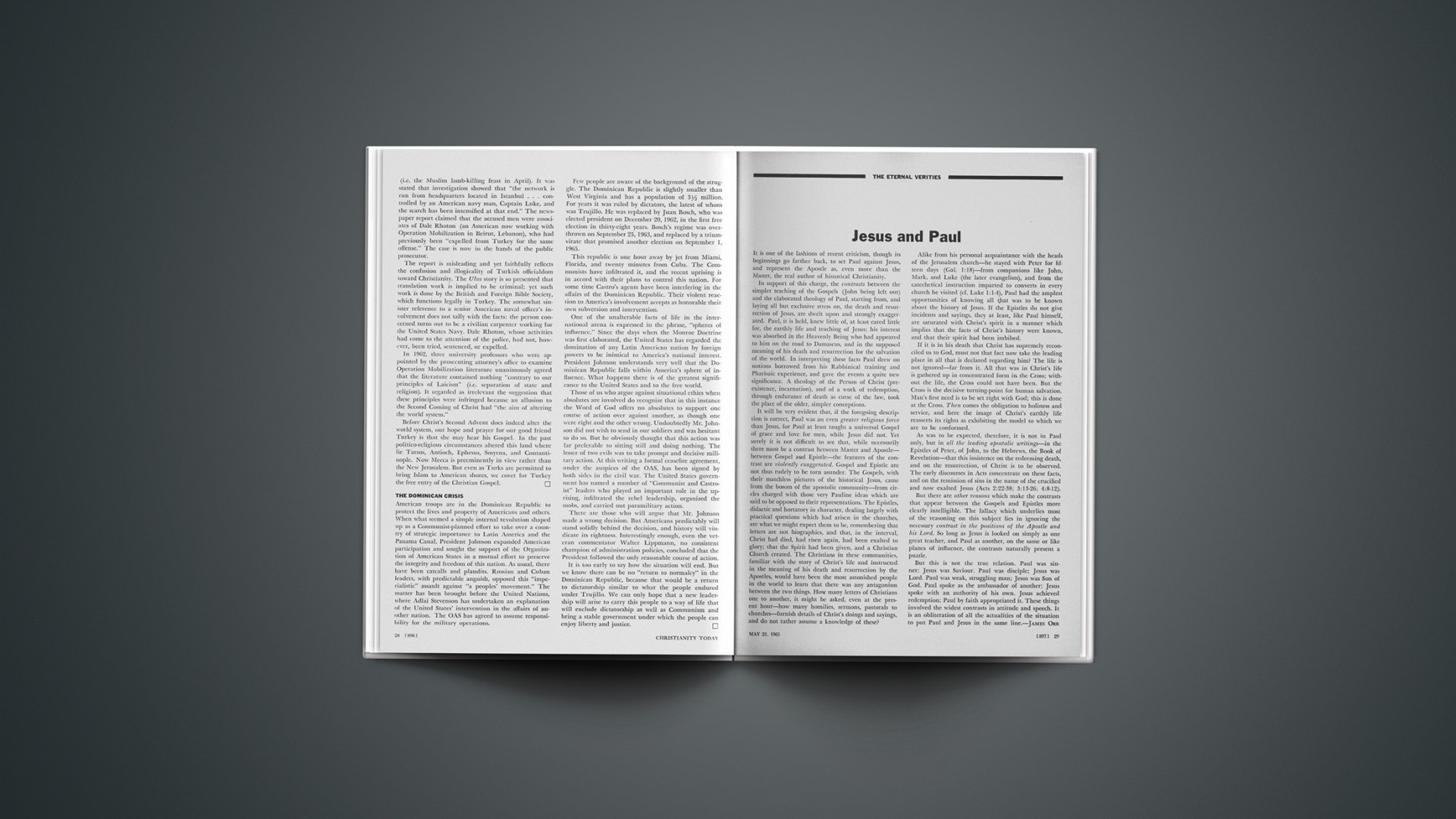

It is one of the fashions of recent criticism, though its beginnings go farther back, to set Paul against Jesus, and represent the Apostle as, even more than the Master, the real author of historical Christianity.
In support of this charge, the contrasts between the simpler teaching of the Gospels (John being left out) and the elaborated theology of Paul, starting from, and laying all but exclusive stress on, the death and resurrection of Jesus, are dwelt upon and strongly exaggerated. Paul, it is held, knew little of, at least cared little for, the earthly life and teaching of Jesus; his interest was absorbed in the Heavenly Being who had appeared to him on the road to Damascus, and in the supposed meaning of his death and resurrection for the salvation of the world. In interpreting these facts Paul drew on notions borrowed from his Rabbinical training and Pharisaic experience, and gave the events a quite new significance. A theology of the Person of Christ (preexistence, incarnation), and of a work of redemption, through endurance of death as curse of the law, took the place of the older, simpler conceptions.
It will be very evident that, if the foregoing description is correct, Paul was an even greater religious force than Jesus, for Paul at least taught a universal Gospel of grace and love for men, while Jesus did not. Yet surely it is not difficult to see that, while necessarily there must be a contrast between Master and Apostle—between Gospel and Epistle—the features of the contrast are violently exaggerated. Gospel and Epistle are not thus rudely to be torn asunder. The Gospels, with their matchless pictures of the historical Jesus, came from the bosom of the apostolic community—from circles charged with those very Pauline ideas which are said to be opposed to their representations. The Epistles, didactic and hortatory in character, dealing largely with practical questions which had arisen in the churches, are what we might expect them to be, remembering that letters are not biographies, and that, in the interval, Christ had died, had risen again, had been exalted to glory; that the Spirit had been given, and a Christian Church created. The Christians in these communities, familiar with the story of Christ’s life and instructed in the meaning of his death and resurrection by the Apostles, would have been the most astonished people in the world to learn that there was any antagonism between the two things. How many letters of Christians one to another, it might be asked, even at the present hour—how many homilies, sermons, pastorals to churches—furnish details of Christ’s doings and sayings, and do not rather assume a knowledge of these?
Alike from his personal acquaintance with the heads of the Jerusalem church—he stayed with Peter for fifteen days (Gal. 1:18)—from companions like John, Mark, and Luke (the later evangelists), and from the catechetical instruction imparted to converts in every church he visited (cf. Luke 1:1–4), Paul had the amplest opportunities of knowing all that was to be known about the history of Jesus. If the Epistles do not give incidents and sayings, they at least, like Paul himself, are saturated with Christ’s spirit in a manner which implies that the facts of Christ’s history were known, and that their spirit had been imbibed.
If it is in his death that Christ has supremely reconciled us to God, must not that fact now take the leading place in all that is declared regarding him? The life is not ignored—far from it. All that was in Christ’s life is gathered up in concentrated form in the Cross; without the life, the Cross could not have been. But the Cross is the decisive turning-point for human salvation. Man’s first need is to be set right with God; this is done at the Cross. Then comes the obligation to holiness and service, and here the image of Christ’s earthly life reasserts its rights as exhibiting the model to which we are to be conformed.
As was to be expected, therefore, it is not in Paul only, but in all the leading apostolic writings—in the Epistles of Peter, of John, to the Hebrews, the Book of Revelation—that this insistence on the redeeming death, and on the resurrection, of Christ is to be observed. The early discourses in Acts concentrate on these facts, and on the remission of sins in the name of the crucified and now exalted Jesus (Acts 2:22–38; 3:13–26; 4:8–12).
But there are other reasons which make the contrasts that appear between the Gospels and Epistles more clearly intelligible. The fallacy which underlies most of the reasoning on this subject lies in ignoring the necessary contrast in the positions of the Apostle and his Lord. So long as Jesus is looked on simply as one great teacher, and Paul as another, on the same or like planes of influence, the contrasts naturally present a puzzle.
But this is not the true relation. Paul was sinner; Jesus was Saviour. Paul was disciple; Jesus was Lord. Paul was weak, struggling man; Jesus was Son of God. Paul spoke as the ambassador of another; Jesus spoke with an authority of his own. Jesus achieved redemption; Paul by faith appropriated it. These things involved the widest contrasts in attitude and speech. It is an obliteration of all the actualities of the situation to put Paul and Jesus in the same line.—JAMES ORR