
WORLD COUNCIL, EVANGELICAL, AND ROMAN CATHOLIC CONCERNS IN CUMENICAL DIALOGUE AND DEBATE
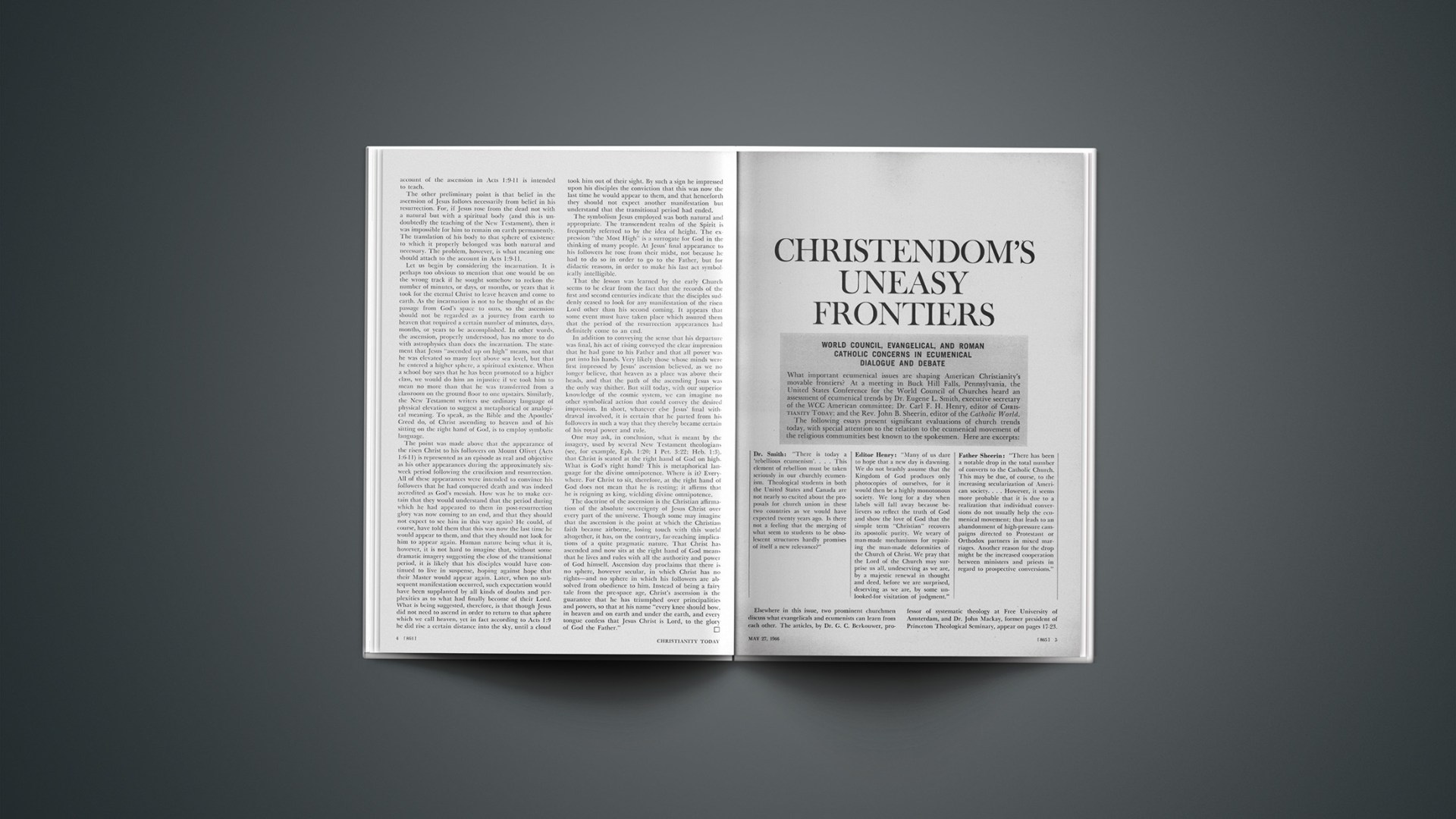
What important ecumenical issues are shaping American Christianity’s movable frontiers? At a meeting in Buck Hill Falls, Pennsylvania, the United States Conference for the World Council of Churches heard an assessment of ecumenical trends by Dr. Eugene L. Smith, executive secretary of the WCC American committee; Dr. Carl F. H. Henry, editor of CHRISTIANITY TODAY; and the Rev. John B. Sheerin, editor of the Catholic World.
The following essays present significant evaluations of church trends today, with special attention to the relation to the ecumenical movement of the religious communities best known to the spokesmen. Here are excerpts:
Dr. Smith: “There is today a ‘rebellious ecumenism’.… This element of rebellion must be taken seriously in our churchly ecumenism. Theological students in both the United States and Canada are not nearly so excited about the proposals for church union in these two countries as we would have expected twenty years ago. Is there not a feeling that the merging of what seem to students to be obsolescent structures hardly promises of itself a new relevance?”
Editor Henry: “Many of us dare to hope that a new day is dawning. We do not brashly assume that the Kingdom of God produces only photocopies of ourselves, for it would then be a highly monotonous society. We long for a day when labels will fall away because believers so reflect the truth of God and show the love of God that the simple term “Christian” recovers its apostolic purity. We weary of man-made mechanisms for repairing the man-made deformities of the Church of Christ. We pray that the Lord of the Church may surprise us all, undeserving as we are, by a majestic renewal in thought and deed, before we are surprised, deserving as we are, by some unlooked-for visitation of judgment.”
Father Sheerin: “There has been a notable drop in the total number of converts to the Catholic Church. This may be due, of course, to the increasing secularization of American society.… However, it seems more probable that it is due to a realization that individual conversions do not usually help the ecumenical movement; that leads to an abandonment of high-pressure campaigns directed to Protestant or Orthodox partners in mixed marriages. Another reason for the drop might be the increased cooperation between ministers and priests in regard to prospective conversions.”
Elsewhere in this issue, two prominent churchmen discuss what evangelicals and ecumenists can learn from each other. The articles, by Dr. G. C. Berkouwer, professor of systematic theology at Free University of Amsterdam, and Dr. John Mackay, former president of Princeton Theological Seminary, appear on pages 17–23.