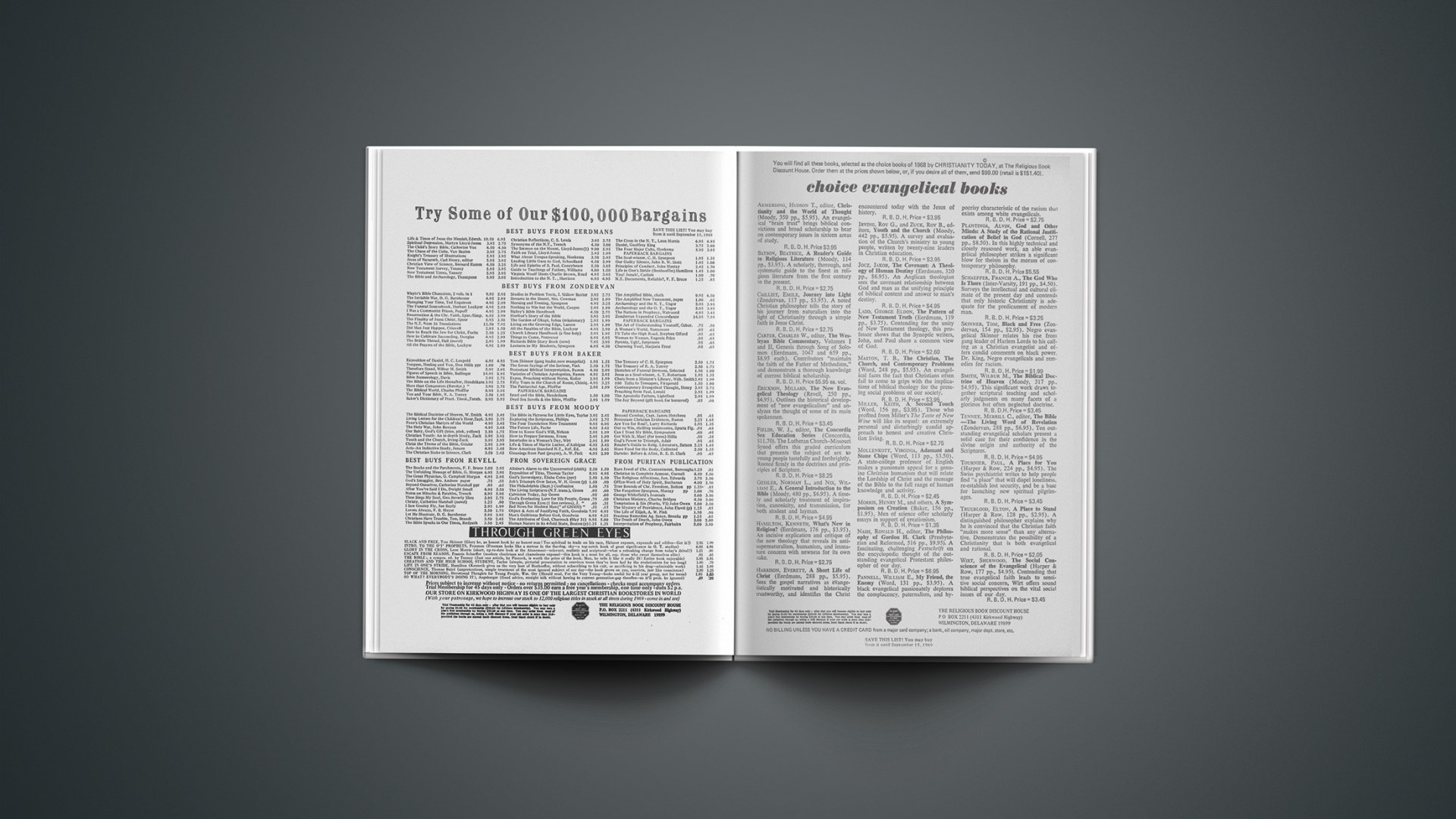

The excerpt from the volume A Place to Stand by D. Elton Trueblood appearing in this periodical under the title “Rational Christianity” (February 14 issue) conveyed to the reader the main thrust of the work. Dr. Trueblood has undertaken the impressive task of finding for today’s man, with all his perplexities, some point of stability that he can use as a base of operations. If the ancient Greek physicist felt the need for this, modern post-industrial and polycentric man should and does, deep down, sense the same need.
The volume contains a certain “philosophy of motif” in which it is suggested that there is a dialectic or periodicity in the Christian movement between belief and action. Trueblood sees a close parallel between the “cut flower” nature of our contemporary culture, on the one hand, and the dwindling role of faith in the dynamics of recent developments in church programming, on the other. He thinks the emphases within the Church during the past fifty years have been shaped by forms of action, issuing in three major developments: foreign missions, church union, and church renewal.
These represented bursts of speed, Trueblood feels, that have largely lost their ability to inspire great enthusiasm. In short, he believes they have run their course. He feels also that the Christian climate is now such that the next major drive will be in the direction of faith—of the belief that has been neglected and whose force, being spent, no longer undergirds major emphases. It is in these terms that our writer projects a kind of “scenario of the future.”
Trueblood is primarily concerned to sketch and defend a type of faith that will provide an Archimedean fulcrum for modern man. He recognizes the extent to which belief has been eroded, not primarily by the systematic and honest atheist, but by those professing allegiance to the Christian movement. The distinguished Friend is almost ruthlessly candid in his willingness to pinpoint problem areas and problem persons here.
His critiques are leveled particularly at those who do two things: first, profess allegiance to Jesus Christ while rejecting out of hand the central core of our Lord’s convictions concerning God; and second, in the name of either science or philosophy drain the conception of God from the element of his personality.
Professor Trueblood is only secondarily concerned for those who may have naive views of God that make him “too personal”; he finds his real quarrel with those who present a more “clear and present danger” by making God less than man. After all, the major biblical passages that are anthropomorphic in tone set, not a ceiling above which our conception of him may not rise, but a floor beneath which we ought not to formulate it.
The faith that must serve as an Archimedean point in any future vitalization of Christianity must, Trueblood suggests, begin with Jesus Christ. His apologetic at this point begins with the acceptance of the essential reliability of the Four Gospels. He refuses to permit the critics to drain the message of the Evangelists of its historical content. To the man whose faith has been undermined here, he says in effect: Begin to live with the four Gospels. For a year, make it your determined effort and quest to seek for him by “reading short consecutive passages, marking, questioning and if possible praying.” He warns the reader that “this is a dangerous experiment, for it may change your life.”
Underlying his challenge is the reasoned conviction that the Word of God possesses power to reveal One who in turn has an almost uncanny ability to seize the imagination and capture the heart. Further, to the seeking person who will permit Him thus to take him captive, the same Lord will unveil God in such a manner that he will be understood as nothing less than the Living God.
Our author feels that those who repudiate the existence of a personal God are accepting a position bristling with far more difficulties than are present in the one they reject. In this bracket he includes not only the “death of God” thinkers but also such men as Paul Tillich and Bishop John Robinson. He is even less impressed by those who feel that the dictum “God is love” affords an “out” for belief in God as a concrete being.
Faith, which has its beginning in acquaintance with Jesus Christ, is seen by Friend Trueblood as having implicit within itself not only clear-cut intimations concerning the existence of a personal God (yes, he is persuaded that it is proper to speak of His existence!) but a great deal more. He feels that our Lord’s attitudes toward the questions of prayer and “the life everlasting” are both definitive and convincing.
Discussing prayer, Trueblood shows that it is only a “stone of stumbling” or a form of soliloquy to the one who approaches it with a fallacious understanding of God’s will, or with a dogmatic “idea of a closed universe.” In prayer he sees the potent reality of bridging, in a provisional-yet-real way, the chasm between the human and the divine. This bridging is seen, not merely in terms of a therapeutic process, but as a means by which man can reach the conviction of the reality of the Living God.
This is not to say that the author has closed his eyes to the major objections leveled against the efficacy of prayer. Rather, he presses his apologetic at this point in terms of the dimension of personal relationship with God which prayer not only presupposes but also creates. To sum up Professor Trueblood’s position at this point, prayer is reality.
In considering the belief in life after death, our author again appeals to the two elements of the general thrust of our Lord’s teaching on the subject, and the reasonableness of belief upon the basis of the “balance of alternatives.” A reasonable conclusion is that without the life everlasting, problems are left dangling that are as serious for belief in a moral world as they are for faith in God. Moreover, the resurrection of our Lord seems to demand status as a fact in the light of the consequences that followed in the lives of his followers.
Enough has been said to indicate that Professor Trueblood finds strong grounds—rational grounds, if you will—for a type of faith that will bear the weight of the traffic he proposes to route over it. Admittedly, we do not and cannot have absolute proof in the areas noted above. But he finds that the converging lines of evidence constitute a strand of evidence strong enough to support a faith adequate (and credible) for today’s man. In the conviction of the trustworthiness of Jesus Christ, the thinking man can, with hard-headed thinking, find an Archimedean fulcrum.
HAROLD B. KUHN