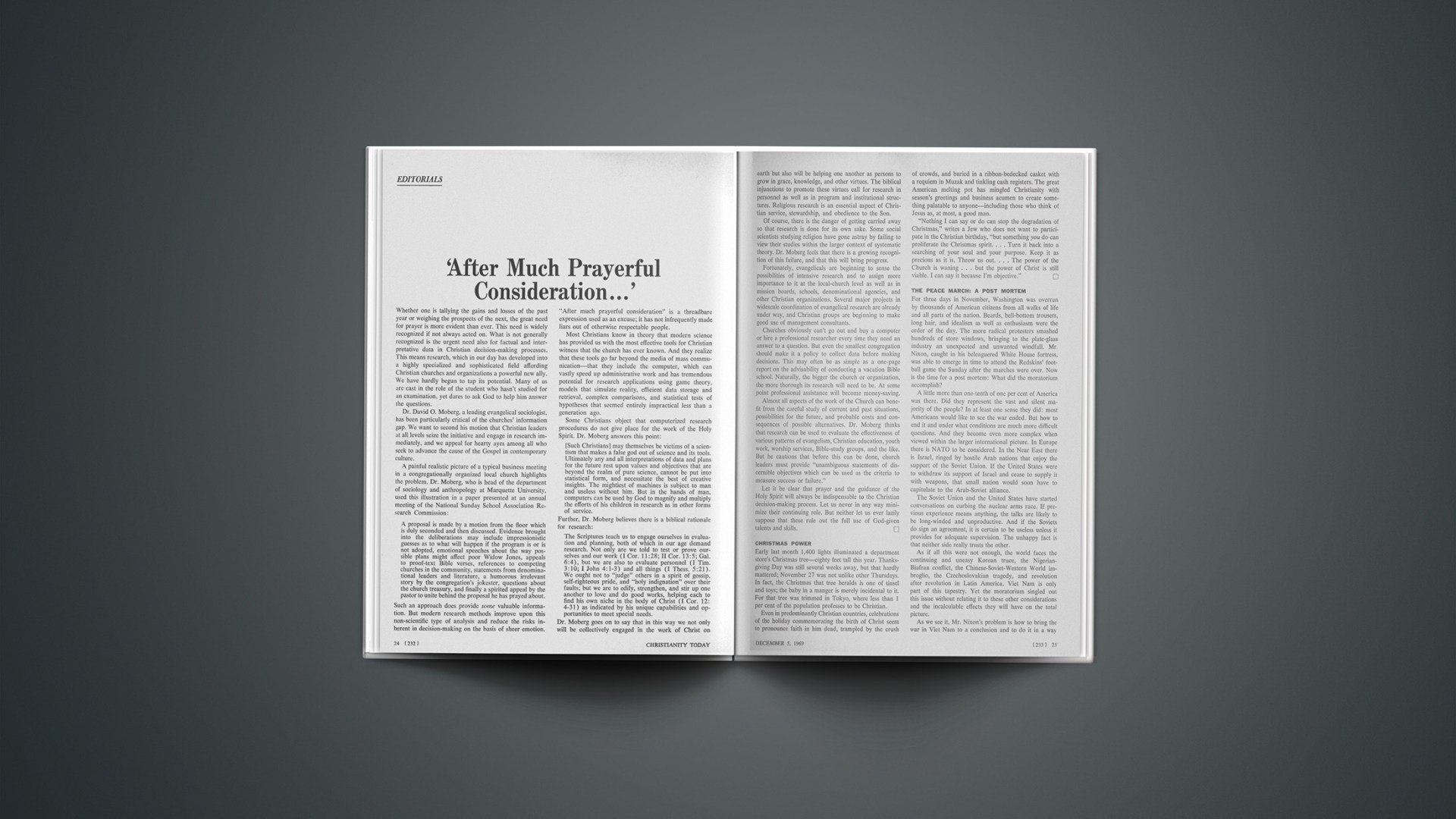

For three days in November, Washington was overrun by thousands of American citizens from all walks of life and all parts of the nation. Beards, bell-bottom trousers, long hair, and idealism as well as enthusiasm were the order of the day. The more radical protesters smashed hundreds of store windows, bringing to the plate-glass industry an unexpected and unwanted windfall. Mr. Nixon, caught in his beleaguered White House fortress, was able to emerge in time to attend the Redskins’ football game the Sunday after the marches were over. Now is the time for a post mortem: What did the moratorium accomplish?
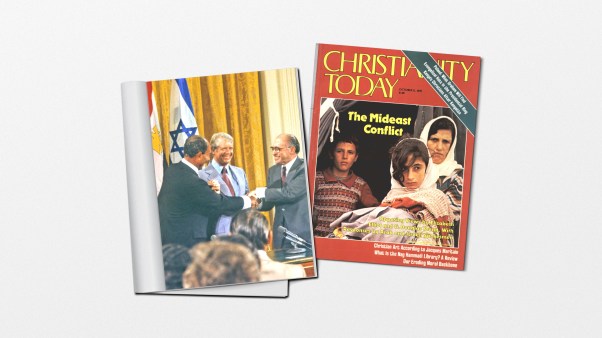
A little more than one-tenth of one per cent of America was there. Did they represent the vast and silent majority of the people? In at least one sense they did: most Americans would like to see the war ended. But how to end it and under what conditions are much more difficult questions. And they become even more complex when viewed within the larger international picture. In Europe there is NATO to be considered. In the Near East there is Israel, ringed by hostile Arab nations that enjoy the support of the Soviet Union. If the United States were to withdraw its support of Israel and cease to supply it with weapons, that small nation would soon have to capitulate to the Arab-Soviet alliance.
The Soviet Union and the United States have started conversations on curbing the nuclear arms race. If previous experience means anything, the talks are likely to be long-winded and unproductive. And if the Soviets do sign an agreement, it is certain to be useless unless it provides for adequate supervision. The unhappy fact is that neither side really trusts the other.
As if all this were not enough, the world faces the continuing and uneasy Korean truce, the Nigerian-Biafran conflict, the Chinese-Soviet-Western World imbroglio, the Czechoslovakian tragedy, and revolution after revolution in Latin America. Viet Nam is only part of this tapestry. Yet the moratorium singled out this issue without relating it to these other considerations and the incalculable effects they will have on the total picture.
As we see it, Mr. Nixon’s problem is how to bring the war in Viet Nam to a conclusion and to do it in a way that maintains U. S. viability in its total commitment around the world. It is doubtful that the march in Washington aided him greatly in that task or that the marchers supplied him or the nation with information they did not already have. Mr. Nixon is surely aware that the majority of the people want to see the war end. We think he shares their desire and sincerely believes his program is designed to accomplish that goal. But it takes two to tangle and likewise two to make a peace.
If there is another peace rally, we suggest that it be directed toward the Hanoi-led team in Paris. Maybe if equal pressure were placed on them, they would become less adamant and a stable peace could be established.
We urge our readers to ask God for special help in this situation, confident that he has power to bring about a just peace that will be acceptable to all.