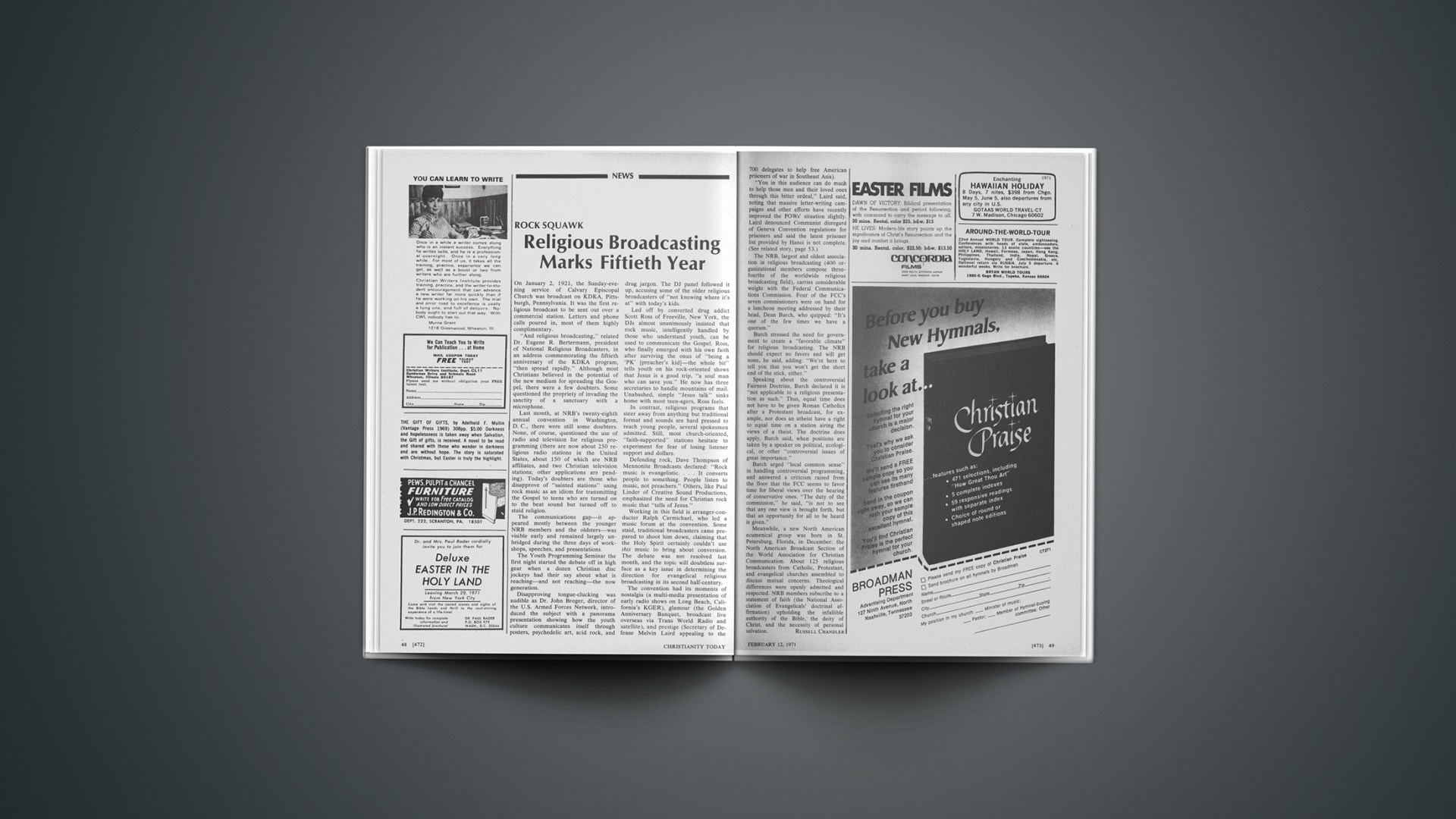

On January 2, 1921, the Sunday-evening service of Calvary Episcopal Church was broadcast on KDKA, Pittsburgh, Pennsylvania. It was the first religious broadcast to be sent out over a commercial station. Letters and phone calls poured in, most of them highly compliementary.
“And religious broadcasting,” related Dr. Eugene R. Bertermann, president of National Religious Broadcasters, in an address commemorating the fiftieth anniversary of the KDKA program, “then spread rapidly.” Although most Christians believed in the potential of the new medium for spreading the Gospel, there were a few doubters. Some questioned the propriety of invading the sanctity of a sanctuary with a microphone.
Last month, at NRB’s twenty-eighth annual convention in Washington, D. C., there were still some doubters. None, of course, questioned the use of radio and television for religious programming (there are now about 250 religious radio stations in the United States, about 150 of which are NRB affiliates, and two Christian television stations; other applications are pending). Today’s doubters are those who disapprove of “sainted stations” using rock music as an idiom for transmitting the Gospel to teens who are turned on to the beat sound but turned off to staid religion.
The communications gap—it appeared mostly between the younger NRB members and the oldsters—was visible early and remained largely unbridged during the three days of workshops, speeches, and presentations.
The Youth Programming Seminar the first night started the debate off in high gear when a dozen Christian disc jockeys had their say about what is reaching—and not reaching—the now generation.
Disapproving tongue-clucking was audible as Dr. John Broger, director of the U.S. Armed Forces Network, introduced the subject with a panorama presentation showing how the youth culture communicates itself through posters, psychedelic art, acid rock, and drug jargon. The DJ panel followed it up, accusing some of the older religious broadcasters of “not knowing where it’s at” with today’s kids.
Led off by converted drug addict Scott Ross of Freeville, New York, the DJs almost unanimously insisted that rock music, intelligently handled by those who understand youth, can be used to communicate the Gospel. Ross, who finally emerged with his own faith after surviving the onus of “being a ‘PK’ [preacher’s kid]—the whole bit” tells youth on his rock-oriented shows that Jesus is a good trip, “a soul man who can save you.” He now has three secretaries to handle mountains of mail. Unabashed, simple “Jesus talk” sinks home with most teen-agers, Ross feels.
In contrast, religious programs that steer away from anything but traditional format and sounds are hard pressed to reach young people, several spokesmen admitted. Still, most church-oriented, “faith-supported” stations hesitate to experiment for fear of losing listener support and dollars.
Defending rock, Dave Thompson of Mennonite Broadcasts declared: “Rock music is evangelistic.… It converts people to something. People listen to music, not preachers.” Others, like Paul Linder of Creative Sound Productions, emphasized the need for Christian rock music that “tells of Jesus.”
Working in this field is arranger-conducter Ralph Carmichael, who led a music forum at the convention. Some staid, traditional broadcasters came prepared to shoot him down, claiming that the Holy Spirit certainly couldn’t use this music to bring about conversion. The debate was not resolved last month, and the topic will doubtless surface as a key issue in determining the direction for evangelical religious broadcasting in its second half-century.
The convention had its moments of nostalgia (a multi-media presentation of early radio shows on Long Beach, California’s KGER), glamour (the Golden Anniversary Banquet, broadcast live overseas via Trans World Radio and satellite), and prestige (Secretary of Defense Melvin Laird appealing to the 700 delegates to help free American prisoners of war in Southeast Asia).
“You in this audience can do much to help those men and their loved ones through this bitter ordeal,” Laird said, noting that massive letter-writing campaigns and other efforts have recently improved the POWs’ situation slightly. Laird denounced Communist disregard of Geneva Convention regulations for prisoners and said the latest prisoner list provided by Hanoi is not complete. (See related story, page 53.)
The NRB, largest and oldest association in religious broadcasting (400 organizational members compose three-fourths of the worldwide religious broadcasting field), carries considerable weight with the Federal Communications Commission. Four of the FCC’s seven commissioners were on hand for a luncheon meeting addressed by their head, Dean Burch, who quipped: “It’s one of the few times we have a quorum.”
Burch stressed the need for government to create a “favorable climate” for religious broadcasting. The NRB should expect no favors and will get none, he said, adding: “We’re here to tell you that you won’t get the short end of the stick, either.”
Speaking about the controversial Fairness Doctrine, Burch declared it is “not applicable to a religious presentation as such.” Thus, equal time does not have to be given Roman Catholics after a Protestant broadcast, for example, nor does an atheist have a right to equal time on a station airing the views of a theist. The doctrine does apply, Burch said, when positions are taken by a speaker on political, ecological, or other “controversial issues of great importance.”
Burch urged “local common sense” in handling controversial programming, and answered a criticism raised from the floor that the FCC seems to favor time for liberal views over the hearing of conservative ones. “The duty of the commission,” he said, “is not to see that any one view is brought forth, but that an opportunity for all to be heard is given.”
Meanwhile, a new North American ecumenical group was born in St. Petersburg, Florida, in December: the North American Broadcast Section of the World Association for Christian Communication. About 125 religious broadcasters from Catholic, Protestant, and evangelical churches assembled to discuss mutual concerns. Theological differences were openly admitted and respected. NRB members subscribe to a statement of faith (the National Association of Evangelicals’ doctrinal affirmation) upholding the infallible authority of the Bible, the deity of Christ, and the necessity of personal salvation.