
NEWS
What did the furnishings of the Old Testament Tabernacle really look like?
Meir Ben Uri, 62, Israel’s foremost religious artist and synagogue designer, feels that the illustrations commonly used are based upon sketches drawn during the Middle Ages to catch the eyes of children. They bear scant resemblance, he says, to the actual objects the ancient Hebrews carted around the desert.
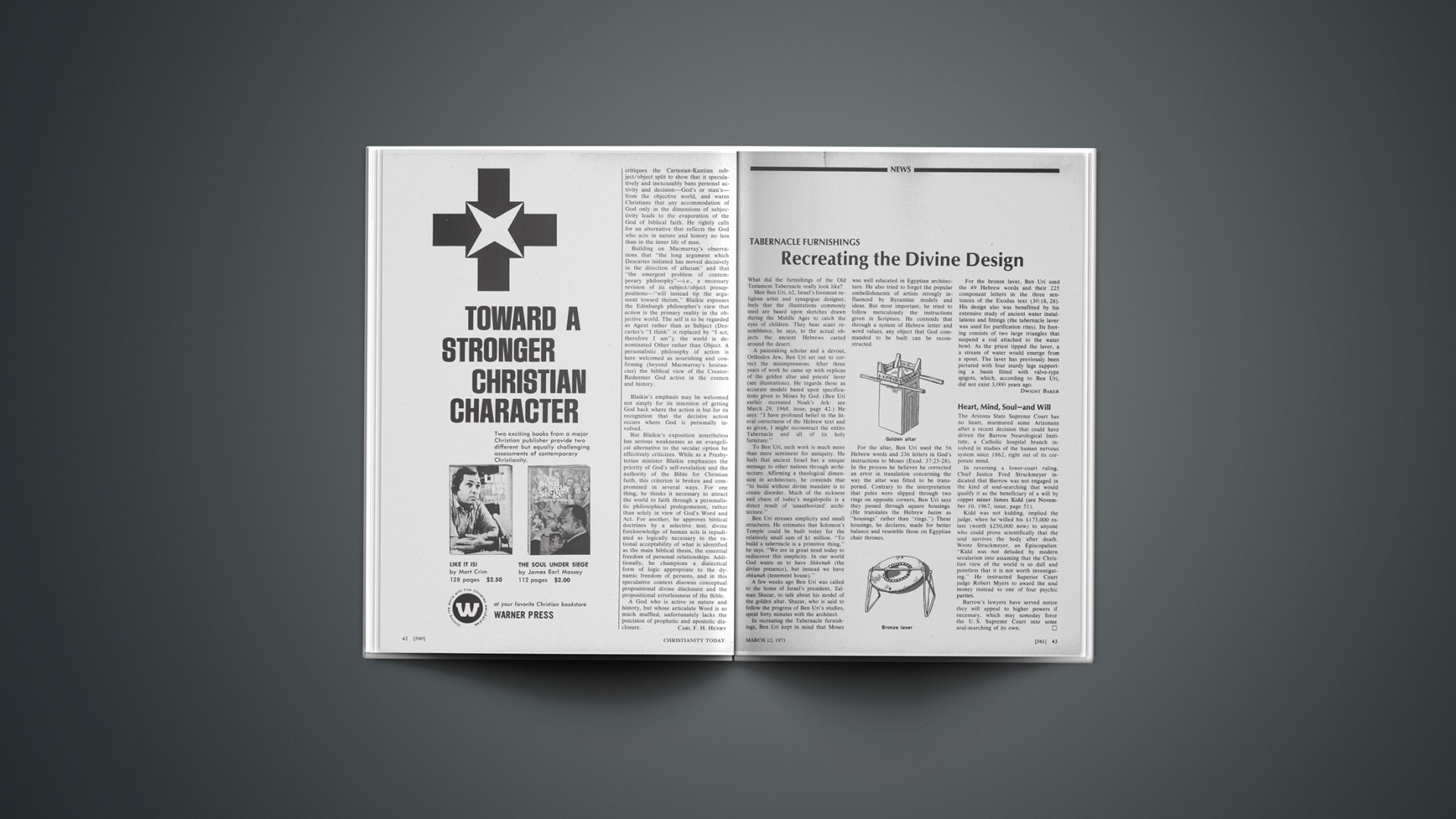
A painstaking scholar and a devout, Orthodox Jew, Ben Uri set out to correct the misimpressions. After three years of work he came up with replicas of the golden altar and priests’ laver (see illustrations). He regards these as accurate models based upon specifications given to Moses by God. (Ben Uri earlier recreated Noah’s Ark: see March 29, 1968, issue, page 42.) He says: “I have profound belief in the literal correctness of the Hebrew text and as given, I might reconstruct the entire Tabernacle and all of its holy furniture.”
To Ben Uri, such work is much more than mere sentiment for antiquity. He feels that ancient Israel has a unique message to other nations through architecture. Affirming a theological dimension in architecture, he contends that “to build without divine mandate is to create disorder. Much of the sickness and chaos of today’s megalopolis is a direct result of ‘unauthorized’ architecture.”
Ben Uri stresses simplicity and small structures. He estimates that Solomon’s Temple could be built today for the relatively small sum of $1 million. “To build a tabernacle is a primitive thing,” he says. “We are in great need today to rediscover this simplicity. In our world God wants us to have Shkenah (the divine presence), but instead we have shkunah (tenement house).”
A few weeks ago Ben Uri was called to the home of Israel’s president, Zalman Shazar, to talk about his model of the golden altar. Shazar, who is said to follow the progress of Ben Uri’s studies, spent forty minutes with the architect.
In recreating the Tabernacle furnishings, Ben Uri kept in mind that Moses was well educated in Egyptian architecture. He also tried to forget the popular embellishments of artists strongly influenced by Byzantine models and ideas. But most important, he tried to follow meticulously the instructions given in Scripture. He contends that through a system of Hebrew letter and word values, any object that God commanded to be built can be reconstructed.
For the altar, Ben Uri used the 56 Hebrew words and 236 letters in God’s instructions to Moses (Exod. 37:25–28). In the process he believes he corrected an error in translation concerning the way the altar was fitted to be transported. Contrary to the interpretation that poles were slipped through two rings on opposite corners, Ben Uri says they passed through square housings. (He translates the Hebrew batim as “housings” rather than “rings.”) These housings, he declares, made for better balance and resemble those on Egyptian chair thrones.
For the bronze laver, Ben Uri used the 49 Hebrew words and their 225 component letters in the three sentences of the Exodus text (30:18,28). His design also was benefitted by his extensive study of ancient water installations and fittings (the tabernacle laver was used for purification rites). Its footing consists of two large triangles that suspend a rod attached to the water bowl. As the priest tipped the laver, a a stream of water would emerge from a spout. The laver has previously been pictured with four sturdy legs supporting a basin fitted with valve-type spigots, which, according to Ben Uri, did not exist 3,000 years ago.
Heart, Mind, Soul—And Will
The Arizona State Supreme Court has no heart, murmured some Arizonans after a recent decision that could have driven the Barrow Neurological Institute, a Catholic hospital branch involved in studies of the human nervous system since 1862, right out of its corporate mind.
In reversing a lower-court ruling, Chief Justice Fred Struckmeyer indicated that Barrow was not engaged in the kind of soul-searching that would qualify it as the beneficiary of a will by copper miner James Kidd (see November 10, 1967, issue, page 51).
Kidd was not kidding, implied the judge, when he willed his $175,000 estate (worth $250,000 now) to anyone who could prove scientifically that the soul survives the body after death. Wrote Struckmeyer, an Episcopalian: “Kidd was not deluded by modern secularism into assuming that the Christian view of the world is so dull and pointless that it is not worth investigating.” He instructed Superior Court judge Robert Myers to award the soul money instead to one of four psychic parties.
Barrow’s lawyers have served notice they will appeal to higher powers if necessary, which may someday force the U. S. Supreme Court into some soul-searching of its own.