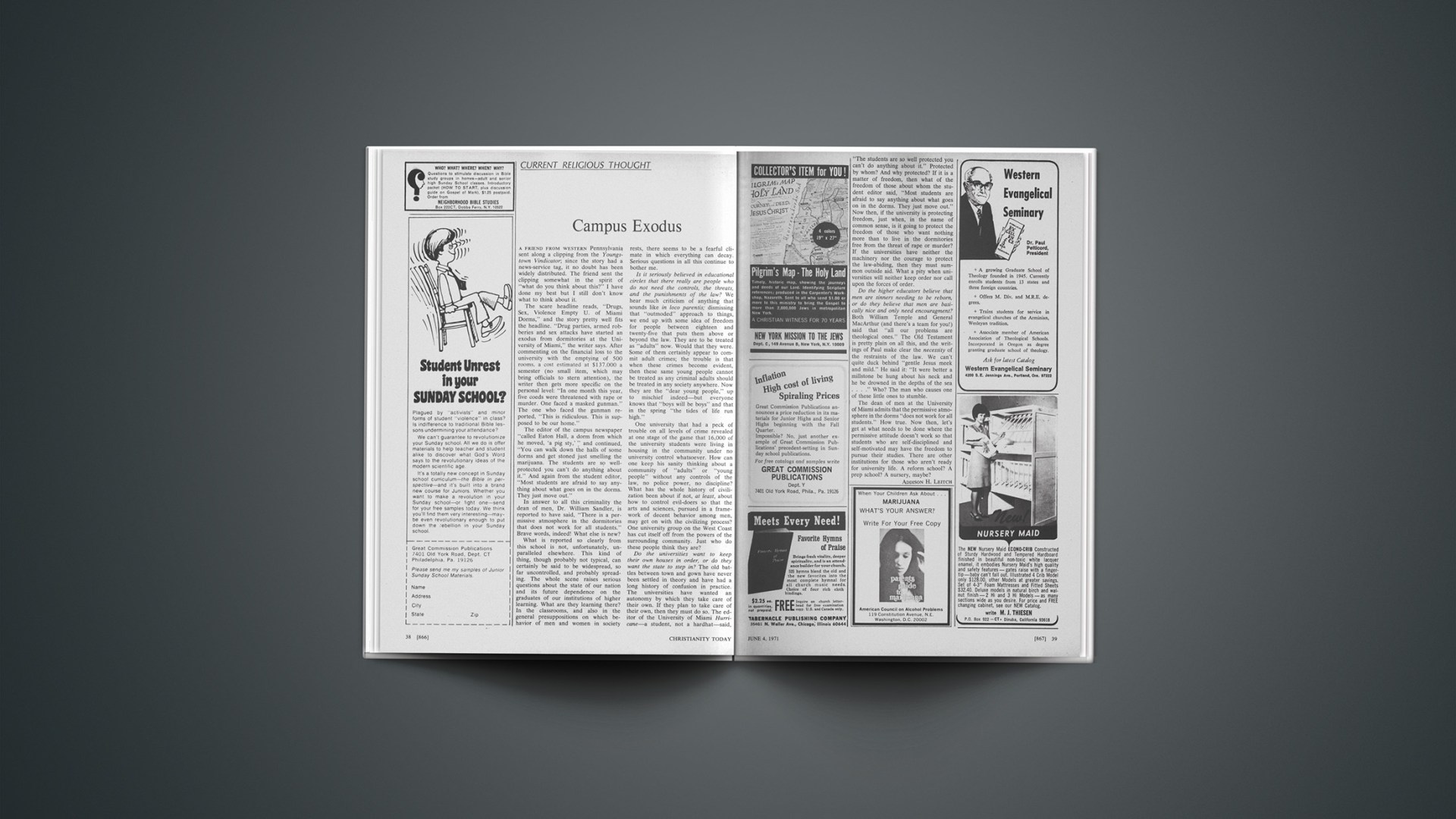

A friend from western Pennsylvania sent along a clipping from the Youngstown Vindicator, since the story had a news-service tag, it no doubt has been widely distributed. The friend sent the clipping somewhat in the spirit of “what do you think about this?” I have done my best but I still don’t know what to think about it.
The scare headline reads, “Drugs, Sex, Violence Empty U. of Miami Dorms,” and the story pretty well fits the headline. “Drug parties, armed robberies and sex attacks have started an exodus from dormitories at the University of Miami,” the writer says. After commenting on the financial loss to the university with the emptying of 500 rooms, a cost estimated at $137,000 a semester (no small item, which may bring officials to stern attention), the writer then gets more specific on the personal level: “In one month this year, five coeds were threatened with rape or murder. One faced a masked gunman.” The one who faced the gunman reported, “This is ridiculous. This is supposed to be our home.”
The editor of the campus newspaper “called Eaton Hall, a dorm from which he moved, ‘a pig sty,’ ” and continued, “You can walk down the halls of some dorms and get stoned just smelling the marijuana. The students are so well-protected you can’t do anything about it.” And again from the student editor, “Most students are afraid to say anything about what goes on in the dorms. They just move out.”
In answer to all this criminality the dean of men, Dr. William Sandler, is reported to have said, “There is a permissive atmosphere in the dormitories that does not work for all students.” Brave words, indeed! What else is new?
What is reported so clearly from this school is not, unfortunately, unparalleled elsewhere. This kind of thing, though probably not typical, can certainly be said to be widespread, so far uncontrolled, and probably spreading. The whole scene raises serious questions about the state of our nation and its future dependence on the graduates of our institutions of higher learning. What are they learning there? In the classrooms, and also in the general presuppositions on which behavior of men and women in society rests, there seems to be a fearful climate in which everything can decay. Serious questions in all this continue to bother me.
Is it seriously believed in educational circles that there really are people who do not need the controls, the threats, and the punishments of the law? We hear much criticism of anything that sounds like in loco parentis; dismissing that “outmoded” approach to things, we end up with some idea of freedom for people between eighteen and twenty-five that puts them above or beyond the law. They are to be treated as “adults” now. Would that they were. Some of them certainly appear to commit adult crimes; the trouble is that when these crimes become evident, then these same young people cannot be treated as any criminal adults should be treated in any society anywhere. Now they are the “dear young people,” up to mischief indeed—but everyone knows that “boys will be boys” and that in the spring “the tides of life run high.”
One university that had a peck of trouble on all levels of crime revealed at one stage of the game that 16,000 of the university students were living in housing in the community under no university control whatsoever. How can one keep his sanity thinking about a community of “adults” or “young people” without any controls of the law, no police power, no discipline? What has the whole history of civilization been about if not, at least, about how to control evil-doers so that the arts and sciences, pursued in a framework of decent behavior among men, may get on with the civilizing process? One university group on the West Coast has cut itself off from the powers of the surrounding community. Just who do these people think they are?
Do the universities want to keep their own houses in order, or do they want the state to step in? The old battles between town and gown have never been settled in theory and have had a long history of confusion in practice. The universities have wanted an autonomy by which they take care of their own. If they plan to take care of their own, then they must do so. The editor of the University of Miami Hurricane—a student, not a hardhat—said, “The students are so well protected you can’t do anything about it.” Protected by whom? And why protected? If it is a matter of freedom, then what of the freedom of those about whom the student editor said, “Most students are afraid to say anything about what goes on in the dorms. They just move out.” Now then, if the university is protecting freedom, just when, in the name of common sense, is it going to protect the freedom of those who want nothing more than to live in the dormitories free from the threat of rape or murder? If the universities have neither the machinery nor the courage to protect the law-abiding, then they must summon outside aid. What a pity when universities will neither keep order nor call upon the forces of order.
Do the higher educators believe that men are sinners needing to be reborn, or do they believe that men are basically nice and only need encouragment? Both William Temple and General MacArthur (and there’s a team for you!) said that “all our problems are theological ones.” The Old Testament is pretty plain on all this, and the writings of Paul make clear the necessity of the restraints of the law. We can’t quite duck behind “gentle Jesus meek and mild.” He said it: “It were better a millstone be hung about his neck and he be drowned in the depths of the sea.…” Who? The man who causes one of these little ones to stumble.
The dean of men at the University of Miami admits that the permissive atmosphere in the dorms “does not work for all students.” How true. Now then, let’s get at what needs to be done where the permissive attitude doesn’t work so that students who are self-disciplined and self-motivated may have the freedom to pursue their studies. There are other institutions for those who aren’t ready for university life. A reform school? A prep school? A nursery, maybe?