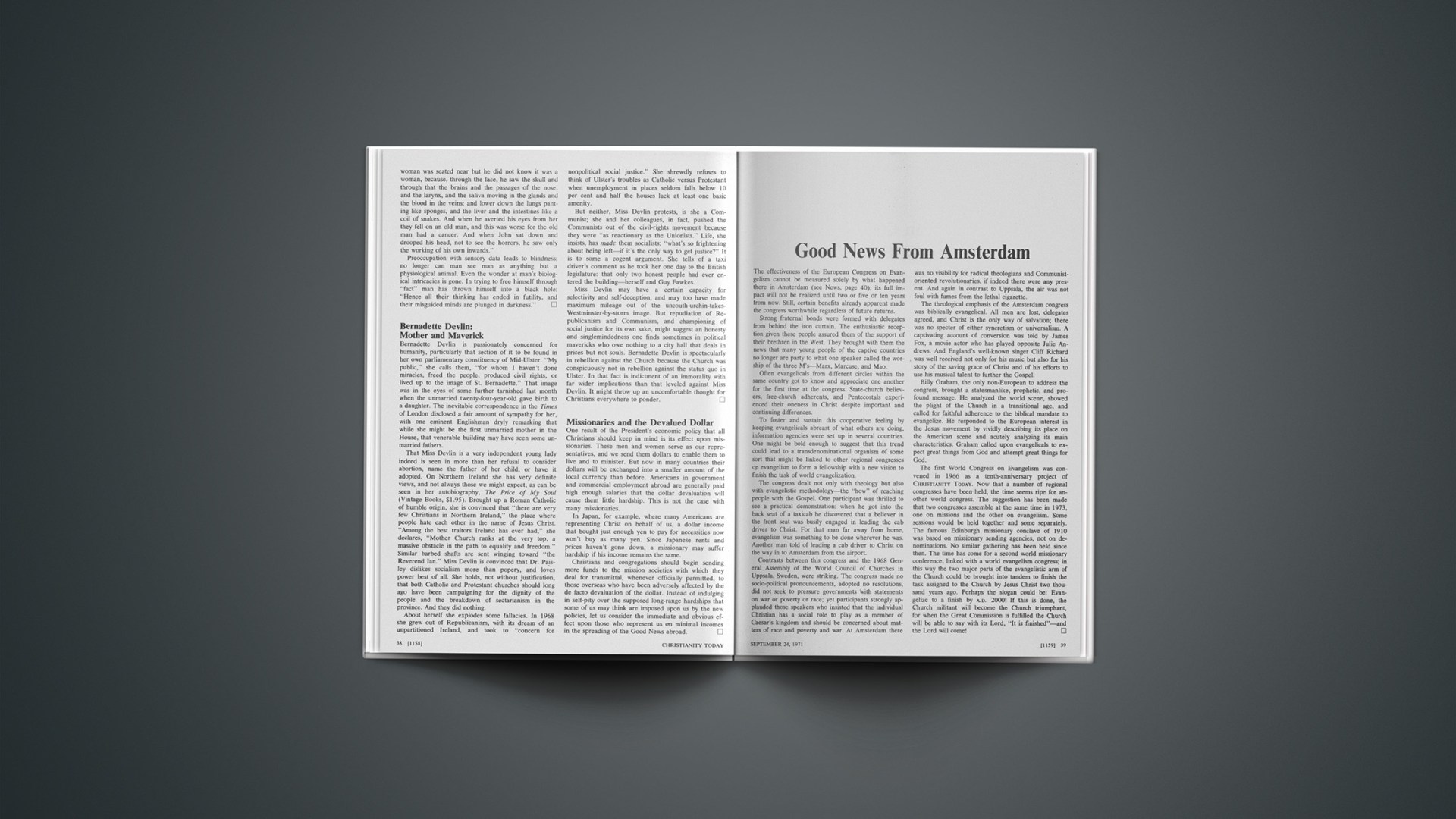

The effectiveness of the European Congress on Evangelism cannot be measured solely by what happened there in Amsterdam (see News, page 40); its full impact will not be realized until two or five or ten years from now. Still, certain benefits already apparent made the congress worthwhile regardless of future returns.
Strong fraternal bonds were formed with delegates from behind the iron curtain. The enthusiastic reception given these people assured them of the support of their brethren in the West. They brought with them the news that many young people of the captive countries no longer are party to what one speaker called the worship of the three M’s—Marx, Marcuse, and Mao.
Often evangelicals from different circles within the same country got to know and appreciate one another for the first time at the congress. State-church believers, free-church adherents, and Pentecostals experienced their oneness in Christ despite important and continuing differences.
To foster and sustain this cooperative feeling by keeping evangelicals abreast of what others are doing, information agencies were set up in several countries. One might be bold enough to suggest that this trend could lead to a transdenominational organism of some sort that might be linked to other regional congresses on evangelism to form a fellowship with a new vision to finish the task of world evangelization.
The congress dealt not only with theology but also with evangelistic methodology—the “how” of reaching people with the Gospel. One participant was thrilled to see a practical demonstration: when he got into the back seat of a taxicab he discovered that a believer in the front seat was busily engaged in leading the cab driver to Christ. For that man far away from home, evangelism was something to be done wherever he was. Another man told of leading a cab driver to Christ on the way in to Amsterdam from the airport.
Contrasts between this congress and the 1968 General Assembly of the World Council of Churches in Uppsala, Sweden, were striking. The congress made no socio-political pronouncements, adopted no resolutions, did not seek to pressure governments with statements on war or poverty or race; yet participants strongly applauded those speakers who insisted that the individual Christian has a social role to play as a member of Caesar’s kingdom and should be concerned about matters of race and poverty and war. At Amsterdam there was no visibility for radical theologians and Communist-oriented revolutionaries, if indeed there were any present. And again in contrast to Uppsala, the air was not foul with fumes from the lethal cigarette.
The theological emphasis of the Amsterdam congress was biblically evangelical. All men are lost, delegates agreed, and Christ is the only way of salvation; there was no specter of either syncretism or universalism. A captivating account of conversion was told by James Fox, a movie actor who has played opposite Julie Andrews. And England’s well-known singer Cliff Richard was well received not only for his music but also for his story of the saving grace of Christ and of his efforts to use his musical talent to further the Gospel.
Billy Graham, the only non-European to address the congress, brought a statesmanlike, prophetic, and profound message. He analyzed the world scene, showed the plight of the Church in a transitional age, and called for faithful adherence to the biblical mandate to evangelize. He responded to the European interest in the Jesus movement by vividly describing its place on the American scene and acutely analyzing its main characteristics. Graham called upon evangelicals to expect great things from God and attempt great things for God.
The first World Congress on Evangelism was convened in 1966 as a tenth-anniversary project of CHRISTIANITY TODAY. Now that a number of regional congresses have been held, the time seems ripe for another world congress. The suggestion has been made that two congresses assemble at the same time in 1973, one on missions and the other on evangelism. Some sessions would be held together and some separately. The famous Edinburgh missionary conclave of 1910 was based on missionary sending agencies, not on denominations. No similar gathering has been held since then. The time has come for a second world missionary conference, linked with a world evangelism congress; in this way the two major parts of the evangelistic arm of the Church could be brought into tandem to finish the task assigned to the Church by Jesus Christ two thousand years ago. Perhaps the slogan could be: Evangelize to a finish by a.d. 2000! If this is done, the Church militant will become the Church triumphant, for when the Great Commission is fulfilled the Church will be able to say with its Lord, “It is finished”—and the Lord will come!