
Novelist John Updike, in his poem “Seven Stanzas at Easter,” describes the lightheadedness that seems to infect normally sane persons when they contemplate the meaning of Christ’s resurrection. So “fuddled” are they by “the flowers, each soft Spring recurrent” that they arrive at views of the resurrection that destroy its entire significance. At the risk of tethering the Bambi in us, about to gambol through the flower-strewn meadows of spring delight, let us pause a moment to consider three varieties of endemic Easter irrationality.
Fuddlement No. 1: Jesus rose “spiritually.” Since the days of the old Fosdickian liberalism, the notion has gained currency that Jesus’ resurrection was really not bodily but spiritual. A more sophisticated variation on this theme was Paul Tillich’s. After noting that “the most primitive theory, and at the same time most beautifully expressed, is the physical one,” and after regarding both it and the “spiritualistic” and “psychological” interpretations as inadequate, Tillich sets forth his own “restitution theory”: “the ecstatic confirmation of the indestructible unity of the New Being and its bearer, Jesus of Nazareth.”
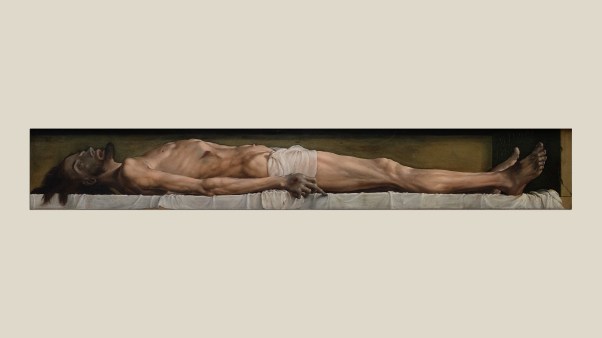
The insuperable problem with all such “theories” that downplay the physical facticity of the resurrection is that apart from the New Testament materials, no one can say anything significant about the resurrection, and these documents insist on a physical resurrection. The resurrected Jesus is expressly distinguished from a ghost and eats fish with his disciples (Luke 24); Thomas is shown the nail prints in Jesus’ hands and the wound in his side (John 20); etc., etc. To talk about the resurrection, described only in the New Testament documents, in a way inconsistent with their clear description is to talk nonsense. It was to counteract such muddled notions that Updike wrote his poem:
Make no mistake: if He rose at all it was as His body.… Let us not mock God with metaphor analogy, sidestepping, transcendence; making of the event a parable, a sign painted in the faded credulity of earlier ages: let us walk through the door.
Fuddlement No. 2: Jesus rose in “suprahistory.” As Updike has just suggested, another way of “mocking God” is by “transcendence.” That is to say, one can agree that the physical resurrection of Jesus “really happened,” but hold that it occurred in a transcendent realm—in Geschichte, not Historie (to use the terminology of Martin Kähler and the young Barth); in “suprahistory” or “metahistory,” not in the ordinary history subject to accepted canons of historical investigation.
On the surface, such an approach has much to commend it: you get your resurrection, but you don’t have to prove it (and, more important, no one can disprove it!). Unfortunately, however, this achieves a Pyrrhic victory, first class. What you lose is (1) the doctrine of justification (not so incidentally “the article by which the Church stands or falls,” according to the Reformers), since Christ was “raised again for our justification” (Rom. 4:25) and a resurrection outside our realm of historical need would do us no good; and (2) the genuine historicity of the event, since no criteria whatever exist for determining what is factual or unfactual in the cloud-cuckoo land of surprahistory. There is no way of knowing that poker games on Saturday night, much less resurrections on Easter morning, occur in a transcendent sphere subject to no historical testability.
Metahistory is evasion. Bultmann was right for once when he maintained, over against Barth, that if you are going to enter the sphere of geschichtliche resurrection, the only sensible thing to do is to engage in forthright demythologization. But, then, pace Bultmann, you must face the overwhelming primary-source testimony of eyewitnesses who unabashedly claim with Peter: “We have not followed cunningly devised fables [Gk. mythoi] when we made known unto you the power and coming of our Lord Jesus Christ, but were eyewitnesses of his majesty.”
Fuddlement No. 3: Jesus rose in history but you can’t “prove” it. One might suppose that the documentary passage just cited would constitute, at least hypothetically, the kind of “proof” that is marshalled for any historical event. “No matter,” the orthodox presuppositionalists and pietists inform us. “You can’t ‘prove’ the resurrection. It’s a matter of proper starting point and faith. To deny this is to deny total depravity and the power of the Spirit.”
Recently our seminary campus was visited by a team of class three fuddlers from a certain Calvinist institution that shall remain nameless; they distributed their periodical, Synapse II, which featured an article entitled, “The Impropriety of Evidentially Arguing for the Resurrection.” How sad! In former times, when minstrels traveled from hearth to hearth they brought merriment and hope.
The fuddled reasoning here is, as a matter of fact, revealed by another and better traveler—St. Paul. On the Areopagus he presents Christ’s resurrection as the capstone of his case for the truth of the Gospel; in First Corinthians 15 he blends kerygma with apologia by offering a list of eyewitness testimonies to the evidential fact of the resurrection; and in his stand before Agrippa and Festus (Acts 26) he not only assumes that these sin-blinded sinners can evidentially arrive at the facticity of the resurrection (“Why should it be thought a thing incredible with you that God should raise the dead?”) but also appeals to a common ground of evidential knowledge (“The king knoweth of these things, before whom also I speak freely: for I am persuaded that none of these things are hidden from him; for this thing was not done in a corner”).
How is it possible for Paul to do this, believing as he did in total depravity (Rom. 1–3) and in salvation through faith alone (Eph. 2:8, 9)? Simply because he recognized, as we all must, that sin did not make man non-human; and it is one of the defining characteristics of man that he is a thinking being who, by inductive and deductive processes, evaluates the data of the world to distinguish fact from fancy. Ironically, if man’s evidential reasoning were annulled by the fall, how would Adam have recognized God’s voice subsequently calling to him in the Garden, and how would the presuppositionalist distinguish the Bible he claims to start with a priori from Playboy magazine?
Christian faith is not blind faith or credulity; it is grounded in fact. To talk about a real but unprovable resurrection is as foolish as to talk about suprahistorical or spiritual resurrections. They are all cop-outs—sincere, certainly, but terribly harmful in an age longing to hear the meaningful affirmation, “He is risen!”
This Easter, let’s stop the fuddlement. Let’s go beyond A. H. Ackley’s “You ask me how I know he lives? He lives within my heart,” and proclaim to a lost society that Jesus lives in our hearts because he first of all rose in the very history in which we are embedded.
JOHN WARWICK MONTGOMERY