
If nothing else emerges from the three-year struggle over reorganization of the National Council of Churches, there may be at least some new theological definitions. Such a possibility arose at the NCC General Board’s four-day winter meeting in Charlotte.
The policy-makers took little conclusive action, but they started committee work that may influence American ecumenicity for many years. One panel was authorized to study the preamble of the twenty-one-year-old NCC constitution, with an eye to the suggestion that it might be more trinitarian with explicit reference to the Bible.
Another committee was asked to rethink the proposal for future ecumenical structure (see October 8, 1971, issue, page 44) at the point where it provides for representation from organizations “other than churches.” Currently all board members are named by member denominations. Questions were raised at the Charlotte meeting over whether the successor organization could truly be a council of churches if some of its policy-makers were not representing denominations.
How to define “church” came into focus during other discussions. A young Dutch minister, C. Henk Koetsier, gave the principal address on the subject of “development.” The Gereformeerde Kerken (Reformed Churches) executive suggested a new test, or mark, of the church. If a communion takes “development” seriously, he said, it passes God’s test.
While admitting that more theological work needs to be done on the subject, Dr. Koetsier included in his definition of development social, political, and economic action to change structures as well as individuals. Humanization is the goal, Koetsier said, and Christian groups taking him seriously run the risk of backing revolution that may be violent.
While many in the Netherlands agree on the traditional Lutheran and Calvinistic marks of the church, they do not consider development an appropriate test, he lamented.
Whether constituents of its member communions consider it appropriate or not, the NCC’s Executive Committee late last year created an ecumenical commission on justice, liberation, and development, the board was informed. In the initial stages its work is to be largely educational, but it will also encourage some of the types of action programs Koetsier described in his address. (A similar group is at work in the World Council of Churches.)
Theologians may debate the meaning of “church,” but government officials clearly may not, some members of the General Board emphasized. In a discussion of recent developments in the church-state issue, an American Baptist Convention home-missions executive, lames Christison, described a confrontation with Internal Revenue Service personnel. He related that agents asked him if he accepted for his organization their definition of “church.” The Baptist official refused to do so and also refused the IRS representatives permission to examine certain records despite the threat of prosecution. Now the matter is in the hands of lawyers, he said.
Christison’s remarks came as the board debated a resolution in which the NCC was put on record with a new definition of “free exercise of religion.” By a voice vote it approved a document reaffirming that “speaking out on public issues can be and for us is, part of the ‘free exercise of religion’ protected by the First Amendment.”
In effect, the resolution qualifies NCC spokesmen to testify in behalf of a Senate bill that would change the tax law granting exemptions only to organizations that put less than a “substantial” part of their resources into lobbying, political propaganda, and similar activities.
The concluding paragraph of the new pronouncement complains that “under the present wording of the law, particularly the vague and undefined term ‘substantial,’ it is not possible to know in advance what conduct will be construed to violate this section of the law and what will not.”
Passage of the resolution came after council policy-makers heard a review of recent church-state developments from the NCC director of governmental relations, Dean M. Kelley. He challenged the board and constituent denominations to “assert a ‘maximalist’ view of the scope of the First Amendment’s clauses rather than a ‘minimalist’ view.”
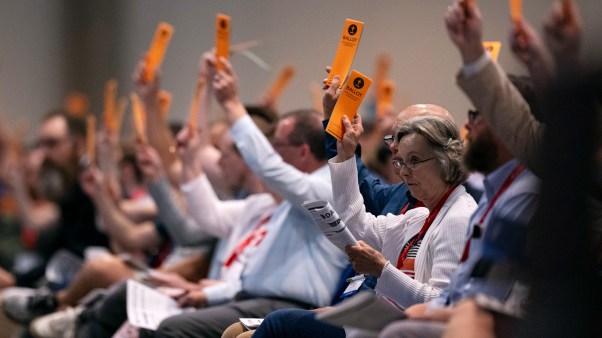
With only 125 of its 250 members registered, the board also:
• Approved 82 to 4 with one abstention a policy statement on “consumer rights and corporate responsibility” that calls for a variety of government, private, and church actions. To follow this up, the policy-makers directed a committee in charge of NCC investments to seek more advice on ethical implications of council investments.
• Heard a joint study-committee report that the time is right for Roman Catholic membership in the council and that the American hierarchy may possibly decide to apply within two years.
• Learned that its Division of Christian Education has authorized publication of a “Revised Standard Version Bible” that will include both deutero-canonical and non-canonical Apocryphal books in addition to the recognized Old and New Testament books.
• Approved a resolution on jails, prisons, and the courts that notes such “inhumanity in our present system” as the denial of bail to Angela Davis and proposes a variety of actions, including church discernment and rejection of “the patterns of racial and political oppression that are evident in our systems of criminal justice.”
• Passed a motion supporting a Washington conference March 26 and 27 on amnesty for Viet Nam era war resisters.
Church Pornography?
A suburban Milwaukee Unitarian church won the first round in a court case concerning the new sex-education course designed by the Unitarian Universalist Association in Boston. Federal district judge John W. Reynolds issued a fifteen-page decision last month halting threatened prosecution of the church by district attorney Richard B. McConnell.
McConnell, who said the course may violate the state’s obscenity laws (the course includes film strips of heterosexual and homosexual acts), threatened to prosecute unless church officials submitted the materials to him and consulted him about the way in which the course would be taught. The course is used by other Unitarian churches in the country; Unitarian Church West is the first to face opposition.