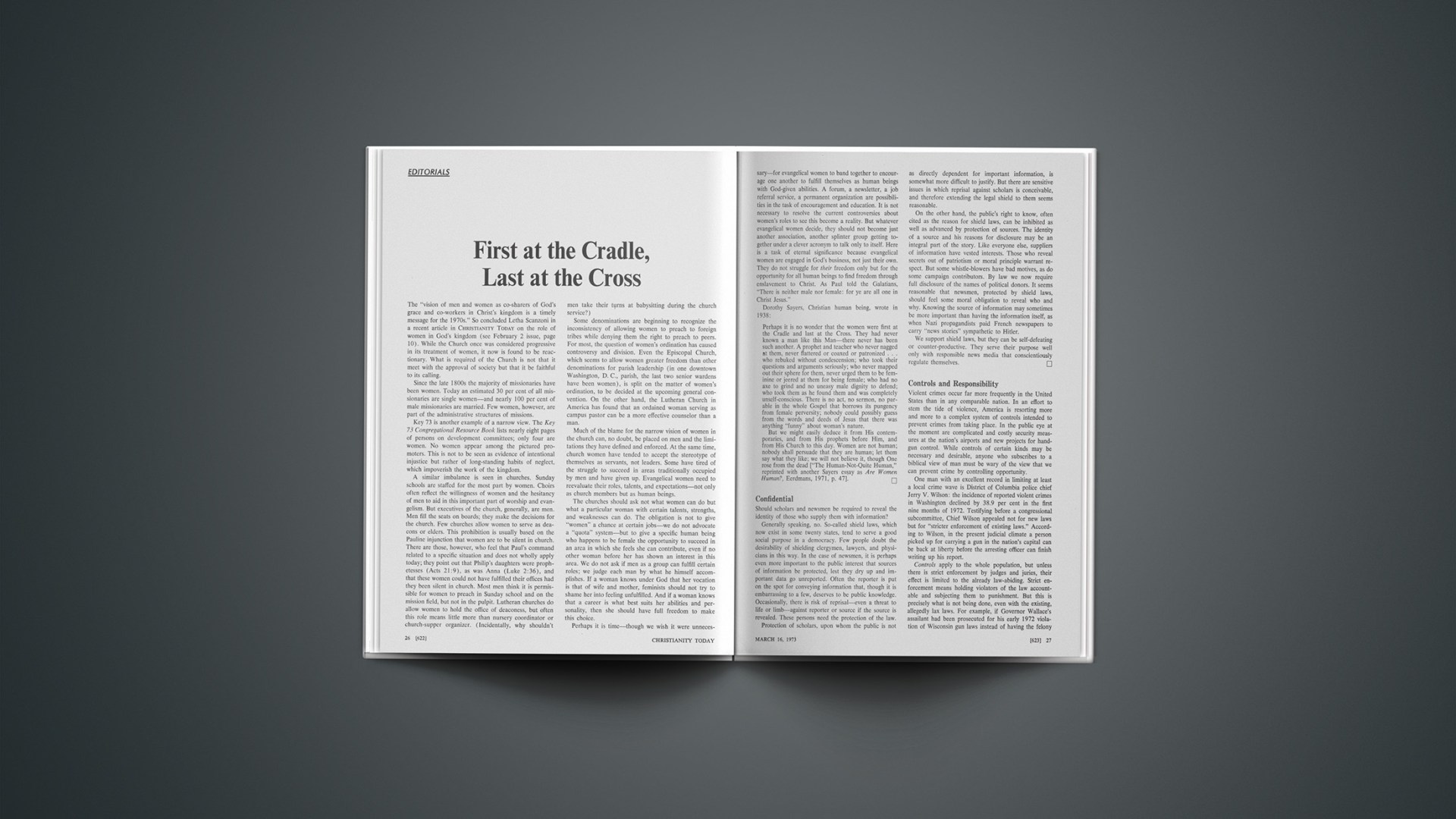

The “vision of men and women as co-sharers of God’s grace and co-workers in Christ’s kingdom is a timely message for the 1970s.” So concluded Letha Scanzoni in a recent article in CHRISTIANITY TODAY on the role of women in God’s kingdom (see February 2 issue, page 10). While the Church once was considered progressive in its treatment of women, it now is found to be reactionary. What is required of the Church is not that it meet with the approval of society but that it be faithful to its calling.
Since the late 1800s the majority of missionaries have been women. Today an estimated 30 per cent of all missionaries are single women—and nearly 100 per cent of male missionaries are married. Few women, however, are part of the administrative structures of missions.
Key 73 is another example of a narrow view. The Key 73 Congregational Resource Book lists nearly eight pages of persons on development committees; only four are women. No women appear among the pictured promoters. This is not to be seen as evidence of intentional injustice but rather of long-standing habits of neglect, which impoverish the work of the kingdom.
A similar imbalance is seen in churches. Sunday schools are staffed for the most part by women. Choirs often reflect the willingness of women and the hesitancy of men to aid in this important part of worship and evangelism. But executives of the church, generally, are men. Men fill the seats on boards; they make the decisions for the church. Few churches allow women to serve as deacons or elders. This prohibition is usually based on the Pauline injunction that women are to be silent in church. There are those, however, who feel that Paul’s command related to a specific situation and does not wholly apply today; they point out that Philip’s daughters were prophetesses (Acts 21:9), as was Anna (Luke 2:36), and that these women could not have fulfilled their offices had they been silent in church. Most men think it is permissible for women to preach in Sunday school and on the mission field, but not in the pulpit. Lutheran churches do allow women to hold the office of deaconess, but often this role means little more than nursery coordinator or church-supper organizer. (Incidentally, why shouldn’t men take their turns at babysitting during the church service?)
Some denominations are beginning to recognize the inconsistency of allowing women to preach to foreign tribes while denying them the right to preach to peers. For most, the question of women’s ordination has caused controversy and division. Even the Episcopal Church, which seems to allow women greater freedom than other denominations for parish leadership (in one downtown Washington, D. C., parish, the last two senior wardens have been women), is split on the matter of women’s ordination, to be decided at the upcoming general convention. On the other hand, the Lutheran Church in America has found that an ordained woman serving as campus pastor can be a more effective counselor than a man.
Much of the blame for the narrow vision of women in the church can, no doubt, be placed on men and the limitations they have defined and enforced. At the same time, church women have tended to accept the stereotype of themselves as servants, not leaders. Some have tired of the struggle to succeed in areas traditionally occupied by men and have given up. Evangelical women need to reevaluate their roles, talents, and expectations—not only as church members but as human beings.
The churches should ask not what women can do but what a particular woman with certain talents, strengths, and weaknesses can do. The obligation is not to give “women” a chance at certain jobs—we do not advocate a “quota” system—but to give a specific human being who happens to be female the opportunity to succeed in an area in which she feels she can contribute, even if no other woman before her has shown an interest in this area. We do not ask if men as a group can fulfill certain roles; we judge each man by what he himself accomplishes. If a woman knows under God that her vocation is that of wife and mother, feminists should not try to shame her into feeling unfulfilled. And if a woman knows that a career is what best suits her abilities and personality, then she should have full freedom to make this choice.
Perhaps it is time—though we wish it were unnecessary—for evangelical women to band together to encourage one another to fulfill themselves as human beings with God-given abilities. A forum, a newsletter, a job referral service, a permanent organization are possibilities in the task of encouragement and education. It is not necessary to resolve the current controversies about women’s roles to see this become a reality. But whatever evangelical women decide, they should not become just another association, another splinter group getting together under a clever acronym to talk only to itself. Here is a task of eternal significance because evangelical women are engaged in God’s business, not just their own. They do not struggle for their freedom only but for the opportunity for all human beings to find freedom through enslavement to Christ. As Paul told the Galatians, “There is neither male nor female: for ye are all one in Christ Jesus.”
Dorothy Sayers, Christian human being, wrote in 1938:
Perhaps it is no wonder that the women were first at the Cradle and last at the Cross. They had never known a man like this Man—there never has been such another. A prophet and teacher who never nagged at them, never flattered or coaxed or patronized … who rebuked without condescension; who took their questions and arguments seriously; who never mapped out their sphere for them, never urged them to be feminine or jeered at them for being female; who had no axe to grind and no uneasy male dignity to defend; who took them as he found them and was completely unself-conscious. There is no act, no sermon, no parable in the whole Gospel that borrows its pungency from female perversity; nobody could possibly guess from the words and deeds of Jesus that there was anything “funny” about woman’s nature.
But we might easily deduce it from His contemporaries, and from His prophets before Him, and from His Church to this day. Women are not human; nobody shall persuade that they are human; let them say what they like; we will not believe it, though One rose from the dead [“The Human-Not-Quite Human,” reprinted with another Sayers essay as Are Women Human?, Eerdmans, 1971, p. 47].