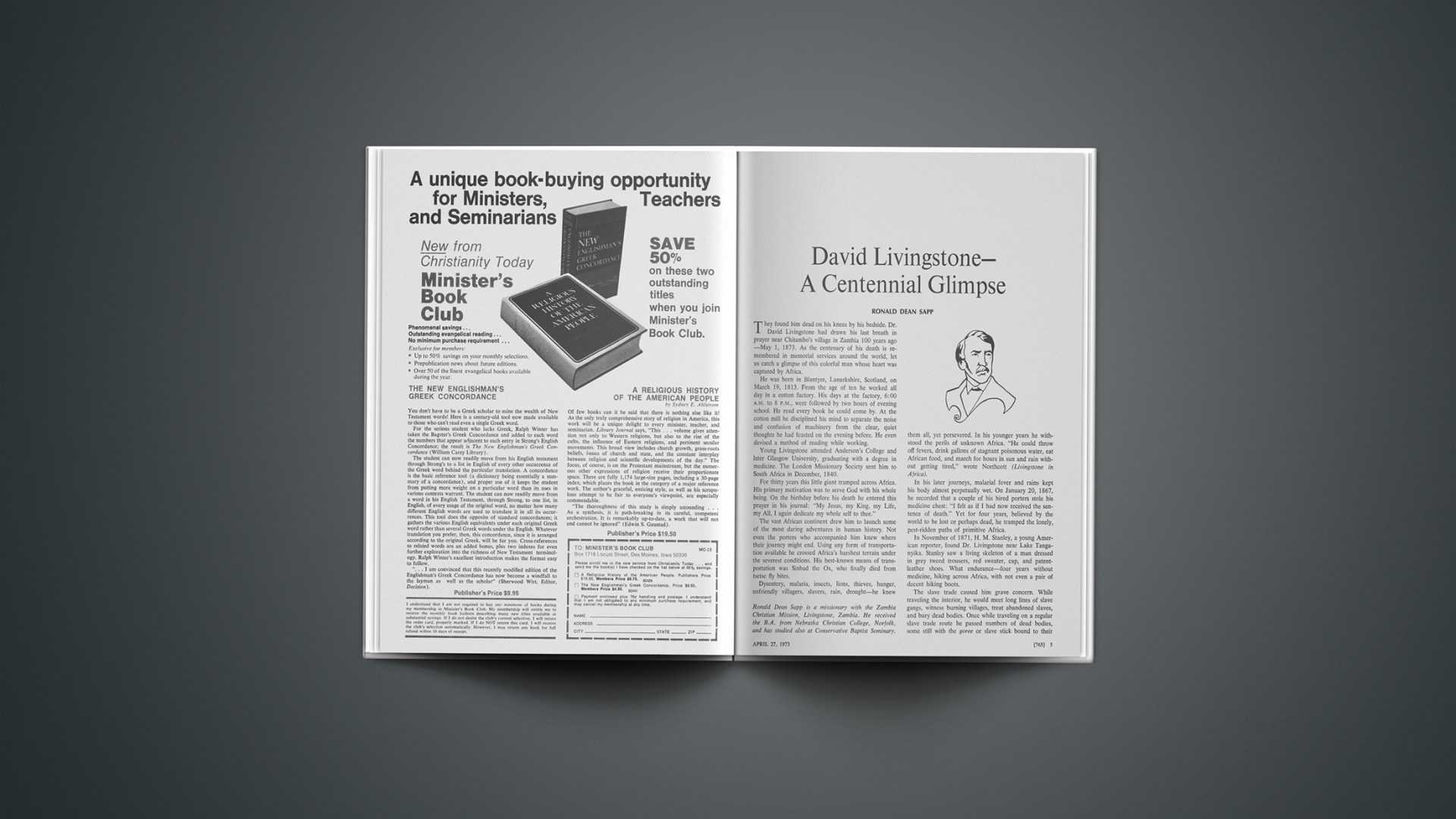

They found him dead on his knees by his bedside. Dr. David Livingstone had drawn his last breath in prayer near Chitambo’s village in Zambia 100 years ago—May 1, 1873. As the centenary of his death is remembered in memorial services around the world, let us catch a glimpse of this colorful man whose heart was captured by Africa.
He was born in Blantyre, Lanarkshire, Scotland, on March 19, 1813. From the age of ten he worked all day in a cotton factory. His days at the factory, 6:00 A.M. to 8 P.M., were followed by two hours of evening school. He read every book he could come by. At the cotton mill he disciplined his mind to separate the noise and confusion of machinery from the clear, quiet thoughts he had feasted on the evening before. He even devised a method of reading while working.
Young Livingstone attended Anderson’s College and later Glasgow University, graduating with a degree in medicine. The London Missionary Society sent him to South Africa in December, 1840.
For thirty years this little giant tramped across Africa. His primary motivation was to serve God with his whole being. On the birthday before his death he entered this prayer in his journal: “My Jesus, my King, my Life, my All, I again dedicate my whole self to thee.”
The vast African continent drew him to launch some of the most daring adventures in human history. Not even the porters who accompanied him knew where their journey might end. Using any form of transportation available he crossed Africa’s harshest terrain under the severest conditions. His best-known means of transportation was Sinbad the Ox, who finally died from tsetse fly bites.
Dysentery, malaria, insects, lions, thieves, hunger, unfriendly villagers, slavers, rain, drought—he knew them all, yet persevered. In his younger years he withstood the perils of unknown Africa. “He could throw off fevers, drink gallons of stagnant poisonous water, eat African food, and march for hours in sun and rain without getting tired,” wrote Northcott (Livingstone in Africa).
In his later journeys, malarial fever and rains kept his body almost perpetually wet. On January 20, 1867, he recorded that a couple of his hired porters stole his medicine chest: “I felt as if I had now received the sentence of death.” Yet for four years, believed by the world to be lost or perhaps dead, he tramped the lonely, pest-ridden paths of primitive Africa.
In November of 1871, H. M. Stanley, a young American reporter, found Dr. Livingstone near Lake Tanganyika. Stanley saw a living skeleton of a man dressed in grey tweed trousers, red sweater, cap, and patent-leather shoes. What endurance—four years without medicine, hiking across Africa, with not even a pair of decent hiking boots.
The slave trade caused him grave concern. While traveling the interior, he would meet long lines of slave gangs, witness burning villages, treat abandoned slaves, and bury dead bodies. Once while traveling on a regular slave trade route he passed numbers of dead bodies, some still with the goree or slave stick bound to their necks. The dead bore wounds that showed they had been killed because they delayed the rapid pace of the slave group.
Innumerable scenes of this sort spurred the little Scotsman on. “If the good Lord permits me to put a stop to the enormous evils of the inland slave-trade I shall not grudge my hunger and toils,” he wrote shortly before his death. His zeal to stop the slave trade never waned.
He was an outstanding explorer and geographer. His sketches of rivers and notes on position and terrain are amazingly accurate.
But what of the missionary Livingstone? Let him speak for himself. When challenged that his explorations were primarily geographical, he stated emphatically: “I would not consent to go simply as a geographer, but as a missionary, and do geography by the way, because I feel I am in the way of duty when trying either to enlighten these poor people, or open their land to lawful commerce.” And in his journal we find this comment: “I am a missionary heart and soul. God had an only Son, and He was a missionary and a physician. A poor, poor imitation of Him I am, or wish to be. In this service I hope to live, in it I wish to die.”
Mission-station life in South Africa he found confining. After listing his daily duties he once concluded: “I do not enumerate these duties by way of telling how much we do, but to let you know a cause of sorrow I have that so little of my time is devoted to real missionary work.” He soon left the station for his journeys.
As a preacher, it is said, he was never fluent. He presented the Gospel in short, jerky sentences and a conversational tone. Yet he was a good linguist and could teach and preach with ease in the African languages.
On methodology Livingstone ruffled the feathers of mission-station colleagues by asserting: “I have no hesitation in saying one or two pious native agents are equal if not superior to Europeans in the beginning of the work. The natives look so much upon the Gospel as just ways and customs of white men that little progress is made, but from their fellows the truth comes quickly.”
His honesty caused him to oppose the idea of making large numbers of conversions in order to please supporting constituencies in England. He withheld communion from a polygamous chief, yet advised him to take care of his personal wives lest they fall into even more dangerous sin.
His 1845 marriage to Mary Moffat, eldest daughter of missionary Robert Moffat, was for the large part marriage at a distance. Although his family traveled with him for some time, they returned to England in 1852.
Dr. Livingstone never spent much time in one place and cannot be credited with many conversions in his lifetime. However, following his lead many dedicated missionaries have gone to Africa to spend their lives presenting the Christ he so selflessly served. The myriads of Africans who have turned to Christ in the hundred years since his death have him to thank for opening the door and letting light into the dark country.
George M. Marsden is associate professor of history at Calvin College, Grand Rapids, Michigan. He has the Ph.D. (Yale University) and has written “The Evangelical Mind and the New School Presbyterian Experience.”