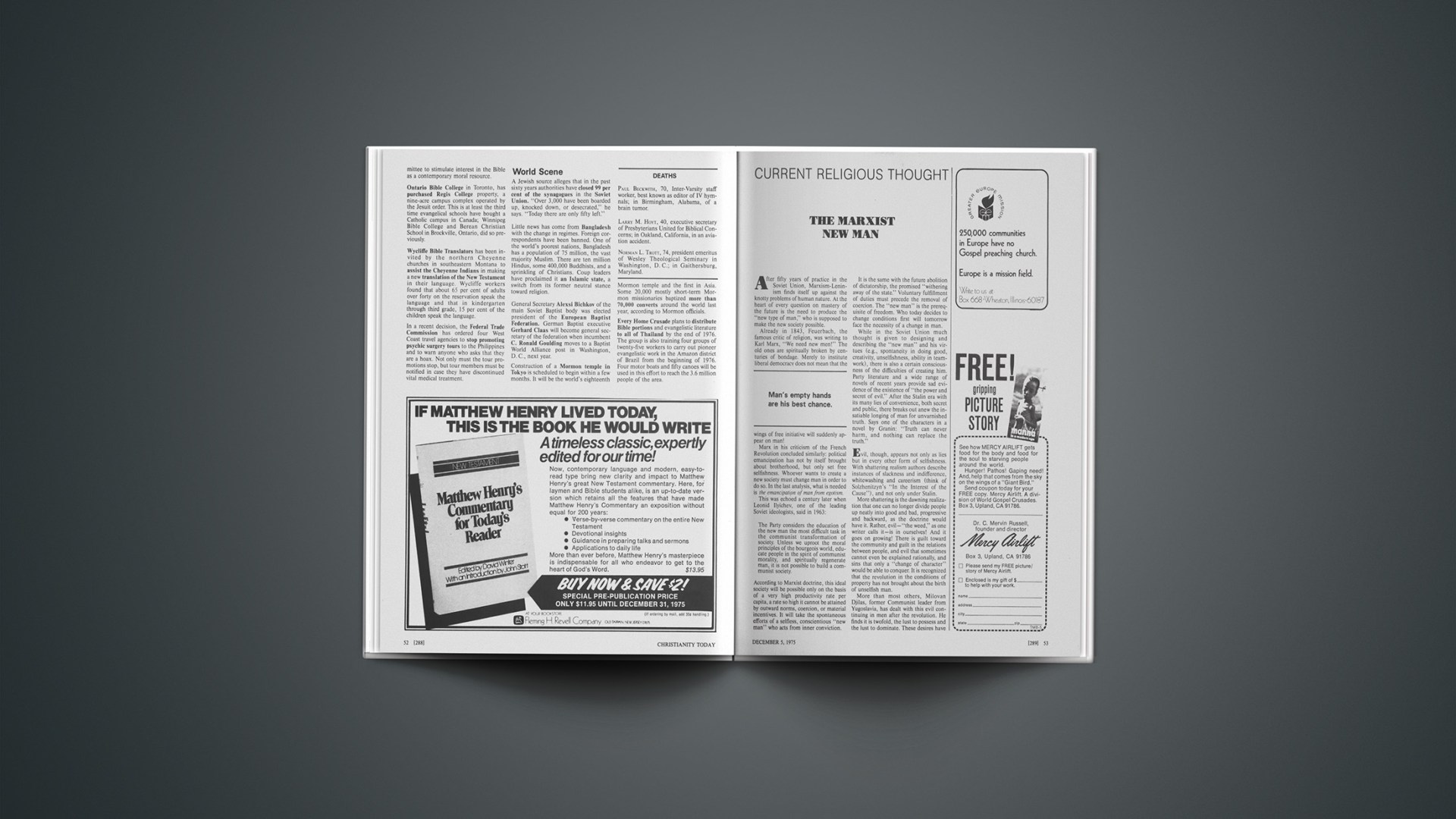

After fifty years of practice in the Soviet Union, Marxism-Leninism finds itself up against the knotty problems of human nature. At the heart of every question on mastery of the future is the need to produce the “new type of man,” who is supposed to make the new society possible.
Already in 1843, Feuerbach, the famous critic of religion, was writing to Karl Marx, “We need new men!” The old ones are spiritually broken by centuries of bondage. Merely to institute liberal democracy does not mean that the wings of free initiative will suddenly appear on man!
Marx in his criticism of the French Revolution concluded similarly: political emancipation has not by itself brought about brotherhood, but only set free selfishness. Whoever wants to create a new society must change man in order to do so. In the last analysis, what is needed is the emancipation of man from egotism.
This was echoed a century later when Leonid Ilyichev, one of the leading Soviet ideologists, said in 1963:
The Party considers the education of the new man the most difficult task in the communist transformation of society. Unless we uproot the moral principles of the bourgeois world, educate people in the spirit of communist morality, and spiritually regenerate man, it is not possible to build a communist society.
According to Marxist doctrine, this ideal society will be possible only on the basis of a very high productivity rate per capita, a rate so high it cannot be attained by outward norms, coercion, or material incentives. It will take the spontaneous efforts of a selfless, conscientious “new man” who acts from inner conviction.
It is the same with the future abolition of dictatorship, the promised “withering away of the state.” Voluntary fulfillment of duties must precede the removal of coercion. The “new man” is the prerequisite of freedom. Who today decides to change conditions first will tomorrow face the necessity of a change in man.
While in the Soviet Union much thought is given to designing and describing the “new man” and his virtues (e.g., spontaneity in doing good, creativity, unselfishness, ability in teamwork), there is also a certain consciousness of the difficulties of creating him. Party literature and a wide range of novels of recent years provide sad evidence of the existence of “the power and secret of evil.” After the Stalin era with its many lies of convenience, both secret and public, there breaks out anew the insatiable longing of man for unvarnished truth. Says one of the characters in a novel by Granin: “Truth can never harm, and nothing can replace the truth.”
Evil, though, appears not only as lies but in every other form of selfishness. With shattering realism authors describe instances of slackness and indifference, whitewashing and careerism (think of Solzhenitzyn’s “In the Interest of the Cause”), and not only under Stalin.
More shattering is the dawning realization that one can no longer divide people up neatly into good and bad, progressive and backward, as the doctrine would have it. Rather, evil—“the weed,” as one writer calls it—is in ourselves! And it goes on growing! There is guilt toward the community and guilt in the relations between people, and evil that sometimes cannot even be explained rationally, and sins that only a “change of character” would be able to conquer. It is recognized that the revolution in the conditions of property has not brought about the birth of unselfish man.
More than most others, Milovan Djilas, former Communist leader from Yugoslavia, has dealt with this evil continuing in men after the revolution. He finds it is twofold, the lust to possess and the lust to dominate. These desires have not become less under socialism but on the contrary have grown to be all the more unbearable because of the greater powers that are available in a totalitarian state. It produces the soullessness of a bureaucracy that completely regiments man.
Even without private property, man remains his own best friend. “The weakness of the official Marxists,” as one present-day observer, Duchrow, sums it up, “seems to be that they have overlooked the fact that the changing of conditions is a necessary but not adequate condition for producing the new humanity.”
There is a fundamental antagonism between Christianity and Marxism not in the description of the ideal of the new man but in the choice of the road to take in order to reach it. The motto of Marxism runs, “Prometheus is the finest saint in the philosophical calendar.” This means: Man must help himself; there is no one else. The “new man” must be produced by man himself.
Against this the Bible says: It is impossible for man to master guilt and sin and the evil in himself. A liberation of man from selfishness is necessary, but it must come from God. It must be received. Man’s obviously empty hands are his best chance; he can hold them out to God and accept what he needs. Here we find a wisdom and a power that overcome our human weakness and fallibility and make us new people. From listening to God the doing of good follows without material incentives. Obedience to God produces creativity and spontaneity in doing the good, brotherhood, and reconciliation—in short, an ever richer sense of humanity.
Some lines from one of the great Russian poets of our time, a non-Marxist, express something of the experience of the nearness and reality of God from which the true renewal of man will grow, the renewal that Christians and Marxists seek and indeed are bound to seek. After severe illness Boris Pasternak wrote to the widow of the Georgian poet Tizian Tabidze who died in Stalin’s camps:
In the minute which seemed to me the last one of my life, I experienced more strength than ever before, and the desire to talk to God, and to praise the visible.… “My God,” I whispered, “I thank you that you paint with such vivid colors and that you have created life and death. I thank you that your language is sublimity and music, that you have made me an artist, that creativity is learnt in your school, and that you have prepared me a whole life long for this night.” And I rejoiced and wept with happiness.
Will Christians again so live under God as to give the practical evidence of the answer to those who, though in disguise, are desperately seeking it?
KLAUS BOCKMUHL