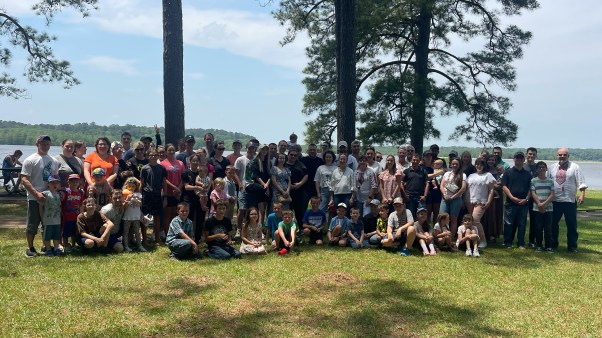

Last summer I led a group of twenty college students on a cultural tour through the Far East. For three weeks we traveled in the People’s Republic of China by train and bus through six provinces. We saw schools, communes, factories, museums, exhibition halls, private homes, and numerous historical and scenic sites. Authorities gave us ample information on agriculture, industry, education, health care, wages, history, politics, revolution, and production. And we had a number of private and public discussions with our Chinese hosts. Not content with the planned tour, many of us played basketball, volleyball, table tennis, and fris-bees with the Chinese people. The language barrier—most of the students had had some Chinese—disappeared in laughter and good will. The one ingredient missing was religion.
The China I remember was dotted with temples, pagodas, and churches with a constant flow of worshipers through their doors. Yet a few months ago I saw no signs that the Chinese have any interest in religion, much less Christianity. I saw no open churches or temples. Religion is not taught in schools and religious books are not sold in the bookstores. No one discusses religion, either publicly or privately.
I looked for Catholic churches. I found civic centers, social institutions, schools, and stores. I saw fallen or tilted crosses on roof tops and wondered whether the younger generation knows what they mean. I walked through my old high school grounds; the school was founded by the Marianist brothers. We rode by my former seminary with its beautiful Gothic cathedral. The buildings are almost intact—just as I remember them. But the atmosphere is different. So are the people. The wall posters, slogans, and decorations are new. Chairman Mao’s portrait hangs high.
My students and I visited an ancient Buddhist monastery, which at one time had five hundred monks living in it. Now it is a mere historical relic. Only visitors view faces of Buddhas carved on the cliffs, the dilapidated pagodas, the cemetery, and the winding paths. We also saw a beautiful Taoist monastery, which was built during the Sung dynasty and restored in Ming. Its upturning and curved roofs with lines of mythological animals, its wood carvings, statues, and wall paintings are marvelous. Our guides enthusiastically called our attention to the structure, the artistic value, and the refined skill with which these objects were created. But on the religious meaning? Not a word. We asked questions about the significance of the wall paintings. No answer. When I explained the meanings of the scenes to my students the Chinese guides were surprised.
What happened to the monks? “Tamen huansu le,” they replied: they became secularized. Unaware that I am a Catholic priest, our host in Shanghai told me of a Catholic bishop who was tried because authorities found weapons and anti-communist literature at his home. He hastened to add that “there is freedom of belief in China, but there is also freedom of unbelief, and freedom of speaking against belief.” I saw the results of that principle.
After twenty-five years of silence people under forty are devoid of religious knowledge. One of our guides had never heard the name of Christ. When she saw one of my students reading The Last Temptation of Christ, by Nikos Kazantzakis, we got into a discussion about Jesus. What appalled me even more was the situation in my own family. I spent three days with my brothers. They were raised in a devout Catholic family, which produced two priests and one religious sister. As children they went to church, said their prayers, and studied their catechism. Now, like anybody else in the People’s Republic of China, they are indifferent, uninterested, and ignorant. When I told them I had become a priest, I saw no expression on their faces. My seventy-nine-year-old mother, however, has kept her faith. She asked me about the church in the United States, rejoiced that I am a priest, and treasured the medal we gave her. If most of my family is no longer practicing Christianity, I can easily understand what has happened to the whole of China.
D. Bruce Lockerbie is chairman of the Fine Arts department at The Stony Brook School, Stony Brook, New York. This article is taken from his 1976 lectures on Christian Life and Thought, delivered at Conservative Baptist Theological Seminary in Denver, Colorado.