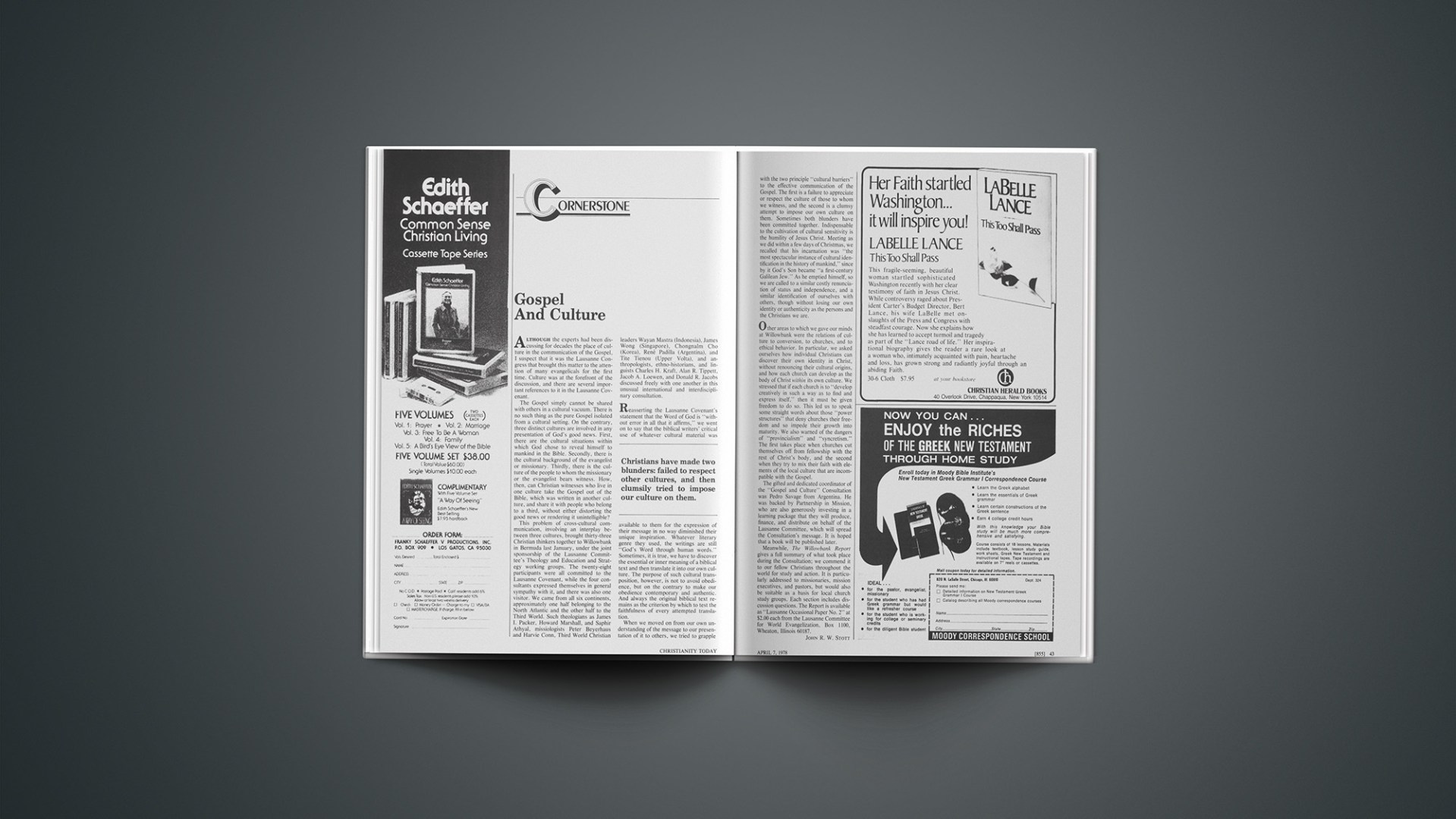

Although the experts had been discussing for decades the place of culture in the communication of the Gospel, I suspect that it was the Lausanne Congress that brought this matter to the attention of many evangelicals for the first time. Culture was at the forefront of the discussion, and there are several important references to it in the Lausanne Covenant.
The Gospel simply cannot be shared with others in a cultural vacuum. There is no such thing as the pure Gospel isolated from a cultural setting. On the contrary, three distinct cultures are involved in any presentation of God’s good news. First, there are the cultural situations within which God chose to reveal himself to mankind in the Bible. Secondly, there is the cultural background of the evangelist or missionary. Thirdly, there is the culture of the people to whom the missionary or the evangelist bears witness. How, then, can Christian witnesses who live in one culture take the Gospel out of the Bible, which was written in another culture, and share it with people who belong to a third, without either distorting the good news or rendering it unintelligible?
This problem of cross-cultural communication, involving an interplay between three cultures, brought thirty-three Christian thinkers together to Willowbank in Bermuda last January, under the joint sponsorship of the Lausanne Committee’s Theology and Education and Strategy working groups. The twenty-eight participants were all committed to the Lausanne Covenant, while the four consultants expressed themselves in general sympathy with it, and there was also one visitor. We came from all six continents, approximately one half belonging to the North Atlantic and the other half to the Third World. Such theologians as James I. Packer, Howard Marshall, and Saphir Athyal, missiologists Peter Beyerhaus and Harvie Conn, Third World Christian leaders Wayan Mastra (Indonesia), James Wong (Singapore), Chongnalm Cho (Korea), René Padilla (Argentina), and Tite Tienou (Upper Volta), and anthropologists, ethno-historians, and linguists Charles H. Kraft, Alan R. Tippett, Jacob A. Loewen, and Donald R. Jacobs discussed freely with one another in this unusual international and interdisciplinary consultation.
Christians have made two blunders: failed to respect other cultures, and then clumsily tried to impose our culture on them.
Reasserting the Lausanne Covenant’s statement that the Word of God is “without error in all that it affirms,” we went on to say that the biblical writers’ critical use of whatever cultural material was available to them for the expression of their message in no way diminished their unique inspiration. Whatever literary genre they used, the writings are still “God’s Word through human words.” Sometimes, it is true, we have to discover the essential or inner meaning of a biblical text and then translate it into our own culture. The purpose of such cultural transposition, however, is not to avoid obedience, but on the contrary to make our obedience contemporary and authentic. And always the original biblical text remains as the criterion by which to test the faithfulness of every attempted translation.
When we moved on from our own understanding of the message to our presentation of it to others, we tried to grapple with the two principle “cultural barriers” to the effective communication of the Gospel. The first is a failure to appreciate or respect the culture of those to whom we witness, and the second is a clumsy attempt to impose our own culture on them. Sometimes both blunders have been committed together. Indispensable to the cultivation of cultural sensitivity is the humility of Jesus Christ. Meeting as we did within a few days of Christmas, we recalled that his incarnation was “the most spectacular instance of cultural identification in the history of mankind,” since by it God’s Son became “a first-century Galilean Jew.” As he emptied himself, so we are called to a similar costly renunciation of status and independence, and a similar identification of ourselves with others, though without losing our own identity or authenticity as the persons and the Christians we are.
Other areas to which we gave our minds at Willowbank were the relations of culture to conversion, to churches, and to ethical behavior. In particular, we asked ourselves how individual Christians can discover their own identity in Christ, without renouncing their cultural origins, and how each church can develop as the body of Christ within its own culture. We stressed that if each church is to “develop creatively in such a way as to find and express itself,” then it must be given freedom to do so. This led us to speak some straight words about those “power structures” that deny churches their freedom and so impede their growth into maturity. We also warned of the dangers of “provincialism” and “syncretism.” The first takes place when churches cut themselves off from fellowship with the rest of Christ’s body, and the second when they try to mix their faith with elements of the local culture that are incompatible with the Gospel.
The gifted and dedicated coordinator of the “Gospel and Culture” Consultation was Pedro Savage from Argentina. He was backed by Partnership in Mission, who are also generously investing in a learning package that they will produce, finance, and distribute on behalf of the Lausanne Committee, which will spread the Consultation’s message. It is hoped that a book will be published later.
Meanwhile, The Willowbank Report gives a full summary of what took place during the Consultation; we commend it to our fellow Christians throughout the world for study and action. It is particularly addressed to missionaries, mission executives, and pastors, but would also be suitable as a basis for local church study groups. Each section includes discussion questions. The Report is available as “Lausanne Occasional Paper No. 2” at $2.00 each from the Lausanne Committee for World Evangelization, Box 1100, Wheaton, Illinois 60187.