
A Reputed South African Monolith Turns Multiform
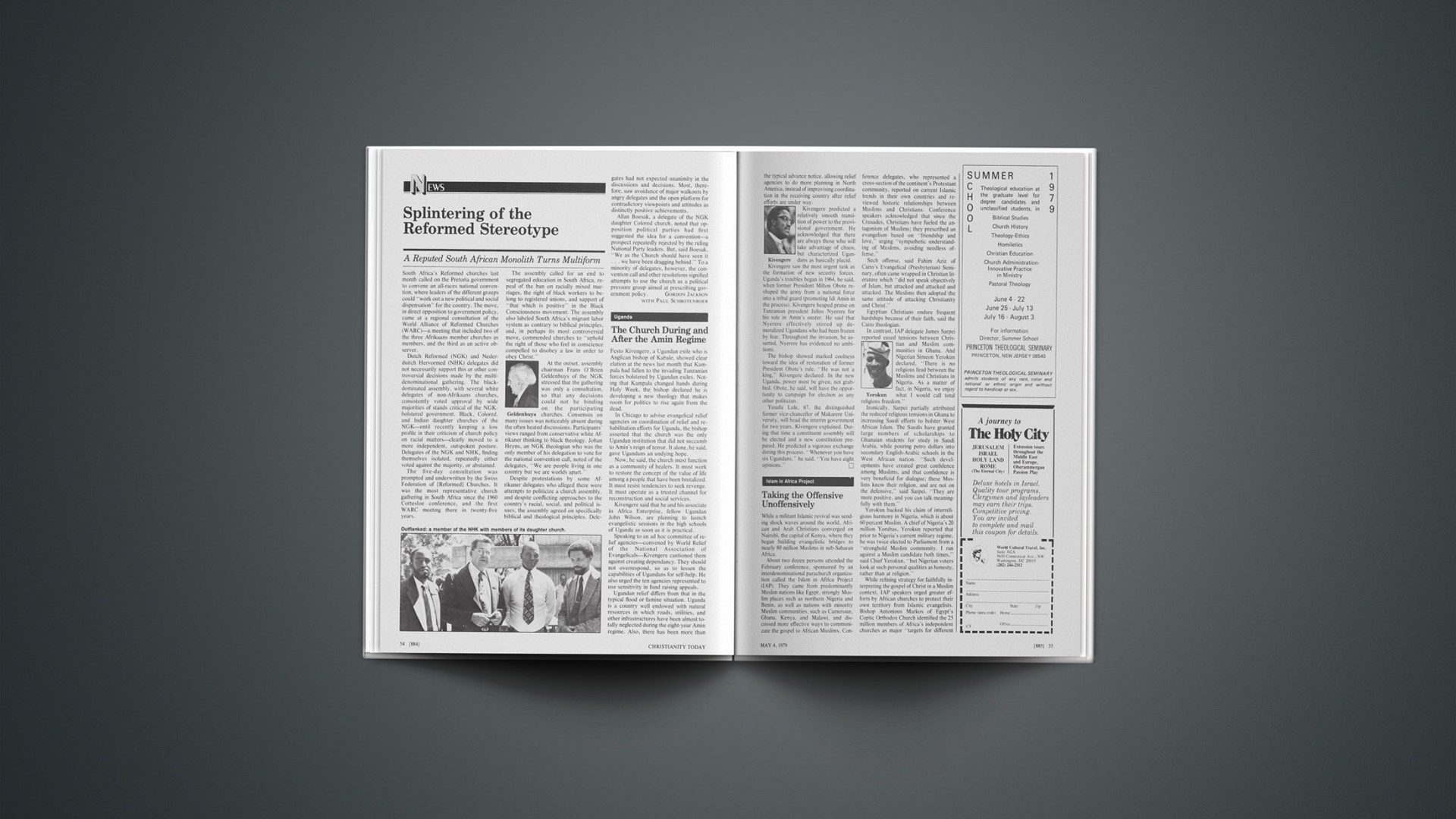
South Africa’s Reformed churches last month called on the Pretoria government to convene an all-races national convention, where leaders of the different groups could “work out a new political and social dispensation” for the country. The move, in direct opposition to government policy, came at a regional consultation of the World Alliance of Reformed Churches (WARC)—a meeting that included two of the three Afrikaans member churches as members, and the third as an active observer.
Dutch Reformed (NGK) and Nederduitch Hervormed (NHK) delegates did not necessarily support this or other controversial decisions made by the multi-denominational gathering. The black-dominated assembly, with several white delegates of non-Afrikaans churches, consistently voted approval by wide majorities of stands critical of the NGK-bolstered government. Black, Colored, and Indian daughter churches of the NGK—until recently keeping a low profile in their criticism of church policy on racial matters—clearly moved to a more independent, outspoken posture. Delegates of the NGK and NHK, finding themselves isolated, repeatedly either voted against the majority, or abstained.
The five-day consultation was prompted and underwritten by the Swiss Federation of [Reformed] Churches. It was the most representative church gathering in South Africa since the 1960 Cottesloe conference, and the first WARC meeting there in twenty-five years.
The assembly called for an end to segregated education in South Africa, repeal of the ban on racially mixed marriages, the right of black workers to belong to registered unions, and support of “that which is positive” in the Black Consciousness movement. The assembly also labeled South Africa’s migrant labor system as contrary to biblical principles, and, in perhaps its most controversial move, commended churches to “uphold the right of those who feel in conscience compelled to disobey a law in order to obey Christ.”
At the outset, assembly chairman Frans O’Brien Geldenhuys of the NGK stressed that the gathering was only a consultation, so that any decisions could not be binding on the participating churches. Consensus on many issues was noticeably absent during the often heated discussions. Participants’ views ranged from conservative white Afrikaner thinking to black theology. Johan Heyns, an NGK theologian who was the only member of his delegation to vote for the national convention call, noted of the delegates, “We are people living in one country but we are worlds apart.”
Despite protestations by some Afrikaner delegates who alleged there were attempts to politicize a church assembly, and despite conflicting approaches to the country’s racial, social, and political issues, the assembly agreed on specifically biblical and theological principles. Delegates had not expected unanimity in the discussions and decisions. Most, therefore, saw avoidance of major walkouts by angry delegates and the open platform for contradictory viewpoints and attitudes as distinctly positive achievements.
Allan Boesak, a delegate of the NGK daughter Colored church, noted that opposition political parties had first suggested the idea for a convention—a prospect repeatedly rejected by the ruling National Party leaders. But, said Boesak, “We as the Church should have seen it … we have been dragging behind.” To a minority of delegates, however, the convention call and other resolutions signified attempts to use the church as a political pressure group aimed at prescribing government policy.
WITH PAUL SCHROTENBOER