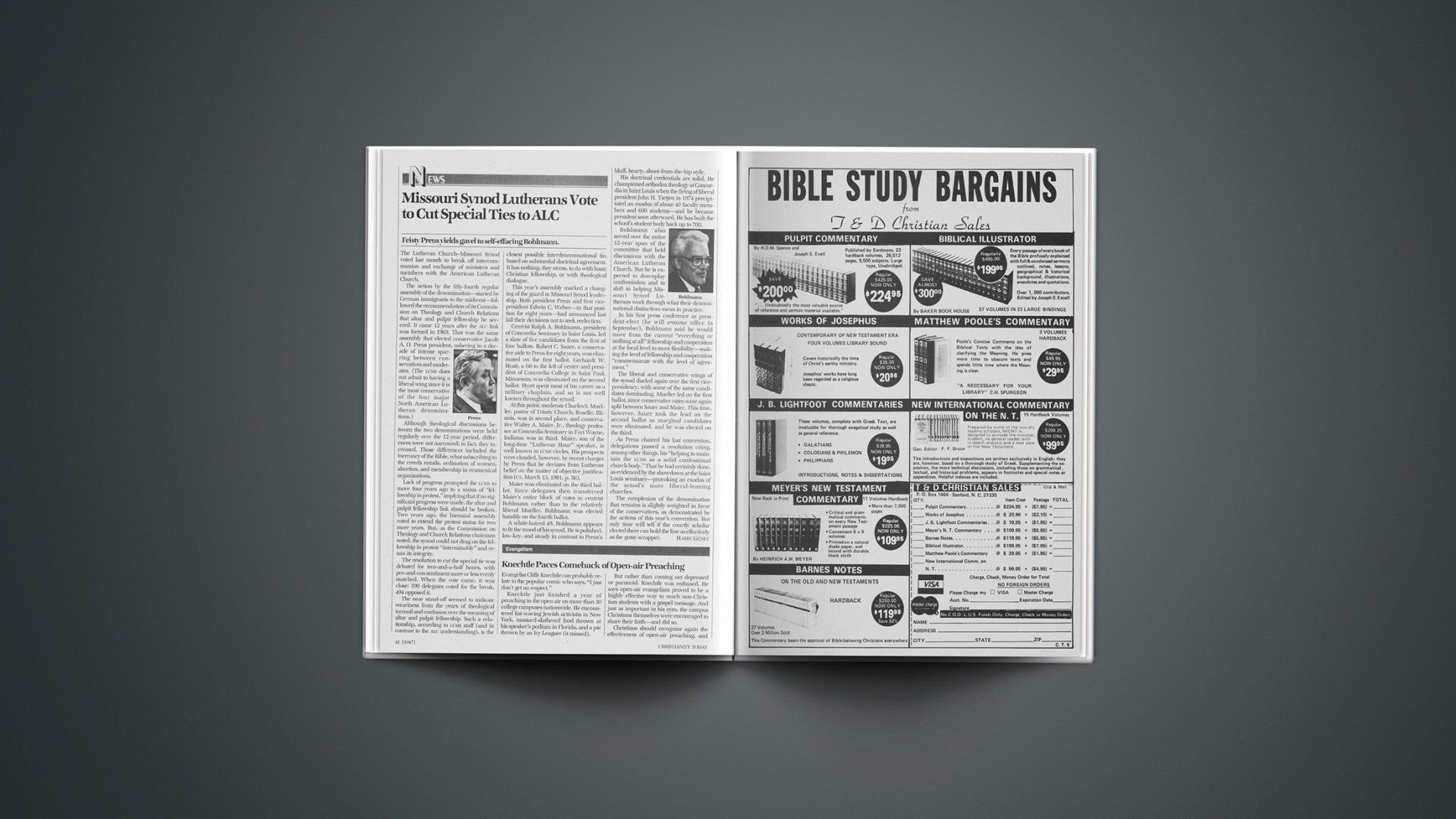
The Lutheran Church-Missouri Synod voted last month to break off intercommunion and exchange of ministers and members with the American Lutheran Church.
The action by the fifty-fourth regular assembly of the denomination—started by German immigrants to the midwest—followed the recommendation of its Commission on Theology and Church Relations that altar and pulpit fellowship be severed. It came 12 years after the ALC link was formed in 1969. That was the same assembly that elected conservative Jacob A. O. Preus president, ushering in a decade of intense sparring between conservatives and moderates. (The LCMS does not admit to having a liberal wing since it is the most conservative of the four major North American Lutheran denominations.)
Although theological discussions between the two denominations were held regularly over the 12-year period, differences were not narrowed; in fact, they increased. Those differences included the inerrancy of the Bible, what subscribing to the creeds entails, ordination of women, abortion, and membership in ecumenical organizations.
Lack of progress prompted the LCMS to move four years ago to a status of “fellowship in protest,” implying that if no significant progress were made, the altar and pulpit fellowship link should be broken. Two years ago, the biennial assembly voted to extend the protest status for two more years. But, as the Commission on Theology and Church Relations chairman noted, the synod could not drag on the fellowship in protest “interminably” and retain its integrity.
The resolution to cut the special tie was debated for two-and-a-half hours, with pro-and-con sentiment more or less evenly matched. When the vote came, it was close: 590 delegates voted for the break, 494 opposed it.
The near stand-off seemed to indicate weariness from the years of theological turmoil and confusion over the meaning of altar and pulpit fellowship. Such a relationship, according to LCMS staff (and in contrast to the ALC understanding), is the closest possible interdenominational tie, based on substantial doctrinal agreement. It has nothing, they stress, to do with basic Christian fellowship, or with theological dialogue.
This year’s assembly marked a changing of the guard in Missouri Synod leadership. Both president Preus and first vice-president Edwin C. Weber—in that position for eight years—had announced last fall their decisions not to seek reelection.
Centrist Ralph A. Bohlmann, president of Concordia Seminary in Saint Louis, led a slate of five candidates from the first of four ballots. Robert C. Sauer, a conservative aide to Preus for eight years, was eliminated on the first ballot. Gerhardt W. Hyatt, a bit to the left of center and president of Concordia College in Saint Paul, Minnesota, was eliminated on the second ballot. Hyatt spent most of his career as a military chaplain, and so is not well known throughout the synod.
At this point, moderate Charles S. Mueller, pastor of Trinity Church, Roselle, Illinois, was in second place, and conservative Walter A. Maier, Jr., theology professor at Concordia Seminary in Fort Wayne, Indiana, was in third. Maier, son of the long-time “Lutheran Hour” speaker, is well known in LCMS circles. His prospects were clouded, however, by recent charges by Preus that he deviates from Lutheran belief on the matter of objective justification (CT, March 13, 1981, p. 56).
Maier was eliminated on the third ballot. Since delegates then transferred Maier’s entire block of votes to centrist Bohlmann rather than to the relatively liberal Mueller, Bohlmann was elected handily on the fourth ballot.
A white-haired 49, Bohlmann appears to fit the mood of his synod. He is polished, low-key, and steady in contrast to Preus’s bluff, hearty, shoot-from-the-hip style.
His doctrinal credentials are solid. He championed orthodox theology at Concordia in Saint Louis when the firing of liberal president John H. Tietjen in 1974 precipitated an exodus of about 40 faculty members and 600 students—and he became president soon afterward. He has built the school’s student body back up to 700.
Bohlmann also served over the entire 12-year span of the committee that held discussions with the American Lutheran Church. But he is expected to downplay confrontation and to shift to helping Missouri Synod Lutherans work through what their denominational distinctives mean in practice.
In his first press conference as president-elect (he will assume office in September), Bohlmann said he would move from the current “everything or nothing at all” fellowship and cooperation at the local level to more flexibility—making the level of fellowship and cooperation “commensurate with the level of agreement.”
The liberal and conservative wings of the synod dueled again over the first vice-presidency, with some of the same candidates dominating. Mueller led on the first ballot, since conservative votes were again split between Sauer and Maier. This time, however, Sauer took the lead on the second ballot as marginal candidates were eliminated, and he was elected on the third.
As Preus chaired his last convention, delegations passed a resolution citing, among other things, his “helping to maintain the LCMS as a solid confessional church body.” That he had certainly done, as evidenced by the showdown at the Saint Louis seminary—provoking an exodus of the synod’s more liberal-leaning churches.
The complexion of the denomination that remains is slightly weighted in favor of the conservatives, as demonstrated by the actions of this year’s convention. But only time will tell if the courtly scholar elected there can hold the line as effectively as the gutsy scrapper.
Corresponding Issue