Dissident Adventists suggest she was.
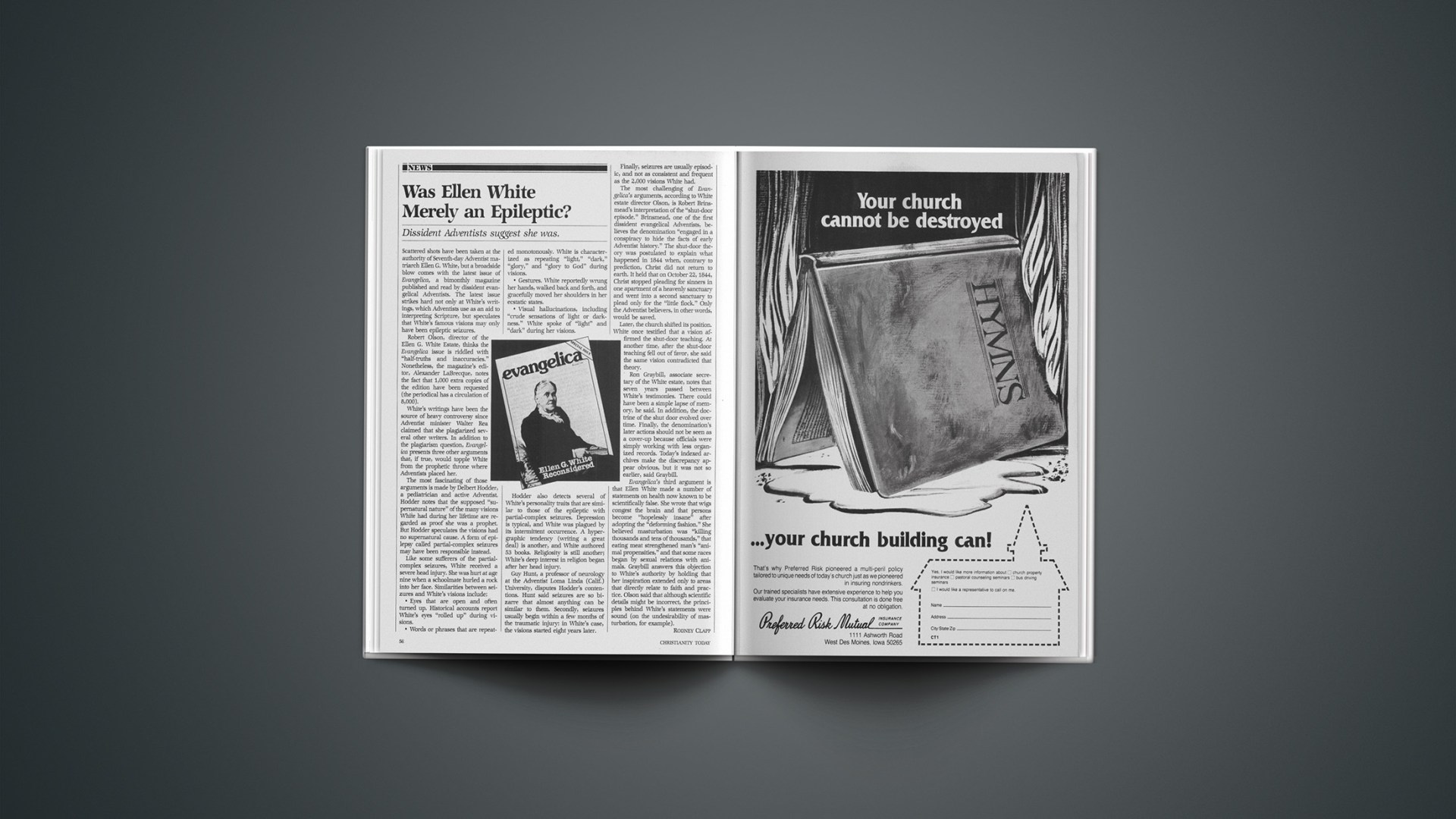
Scattered shots have been taken at the authority of Seventh-day Adventist matriarch Ellen G. White, but a broadside blow comes with the latest issue of Evangelica, a bimonthly magazine published and read by dissident evangelical Adventists. The latest issue strikes hard not only at White’s writings, which Adventists use as an aid to interpreting Scripture, but speculates that White’s famous visions may only have been epileptic seizures.
Robert Olson, director of the Ellen G. White Estate, thinks the Evangelica issue is riddled with “half-truths and inaccuracies.” Nonetheless, the magazine’s editor, Alexander LaBrecque, notes the fact that 1,000 extra copies of the edition have been requested (the periodical has a circulation of 8,000).
White’s writings have been the source of heavy controversy since Adventist minister Walter Rea claimed that she plagiarized several other writers. In addition to the plagiarism question, Evangelica presents three other arguments that, if true, would topple White from the prophetic throne where Adventists placed her.
The most fascinating of those arguments is made by Delbert Hodder, a pediatrician and active Adventist. Hodder notes that the supposed “supernatural nature” of the many visions White had during her lifetime are regarded as proof she was a prophet. But Hodder speculates the visions had no supernatural cause. A form of epilepsy called partial-complex seizures may have been responsible instead.
Like some sufferers of the partial-complex seizures, White received a severe head injury. She was hurt at age nine when a schoolmate hurled a rock into her face. Similarities between seizures and White’s visions include:
• Eyes that are open and often turned up. Historical accounts report White’s eyes “rolled up” during visions.
• Words or phrases that are repeated monotonously. White is characterized as repeating “light,” “dark,” “glory,” and “glory to God” during visions.
• Gestures. White reportedly wrung her hands, walked back and forth, and gracefully moved her shoulders in her ecstatic states.
• Visual hallucinations, including “crude sensations of light or darkness.” White spoke of “light” and “dark” during her visions.
Hodder also detects several of White’s personality traits that are similar to those of the epileptic with partial-complex seizures. Depression is typical, and White was plagued by its intermittent occurrence. A hypergraphic tendency (writing a great deal) is another, and White authored 53 books. Religiosity is still another; White’s deep interest in religion began after her head injury.
Guy Hunt, a professor of neurology at the Adventist Loma Linda (Calif.) University, disputes Hodder’s contentions. Hunt said seizures are so bizarre that almost anything can be similar to them. Secondly, seizures usually begin within a few months of the traumatic injury: in White’s case, the visions started eight years later.
Finally, seizures are usually episodic, and not as consistent and frequent as the 2,000 visions White had.
The most challenging of Evangelica’s arguments, according to White estate director Olson, is Robert Brinsmead’s interpretation of the “shut-door episode.” Brinsmead, one of the first dissident evangelical Adventists, believes the denomination “engaged in a conspiracy to hide the facts of early Adventist history.” The shut-door theory was postulated to explain what happened in 1844 when, contrary to prediction, Christ did not return to earth. It held that on October 22, 1844, Christ stopped pleading for sinners in one apartment of a heavenly sanctuary and went into a second sanctuary to plead only for the “little flock.” Only the Adventist believers, in other words, would be saved.
Later, the church shifted its position. White once testified that a vision affirmed the shut-door teaching. At another time, after the shut-door teaching fell out of favor, she said the same vision contradicted that theory.
Ron Graybill, associate secretary of the White estate, notes that seven years passed between White’s testimonies. There could have been a simple lapse of memory, he said. In addition, the doctrine of the shut door evolved over time. Finally, the denomination’s later actions should not be seen as a cover-up because officials were simply working with less organized records. Today’s indexed archives make the discrepancy appear obvious, but it was not so earlier, said Graybill.
Evangelica’s third argument is that Ellen White made a number of statements on health now known to be scientifically false. She wrote that wigs congest the brain and that persons become “hopelessly insane” after adopting the “deforming fashion.” She believed masturbation was “killing thousands and tens of thousands,” that eating meat strengthened man’s “animal propensities,” and that some races began by sexual relations with animals. Graybill answers this objection to White’s authority by holding that her inspiration extended only to areas that directly relate to faith and practice. Olson said that although scientific details might be incorrect, the principles behind White’s statements were sound (on the undesirability of masturbation, for example).