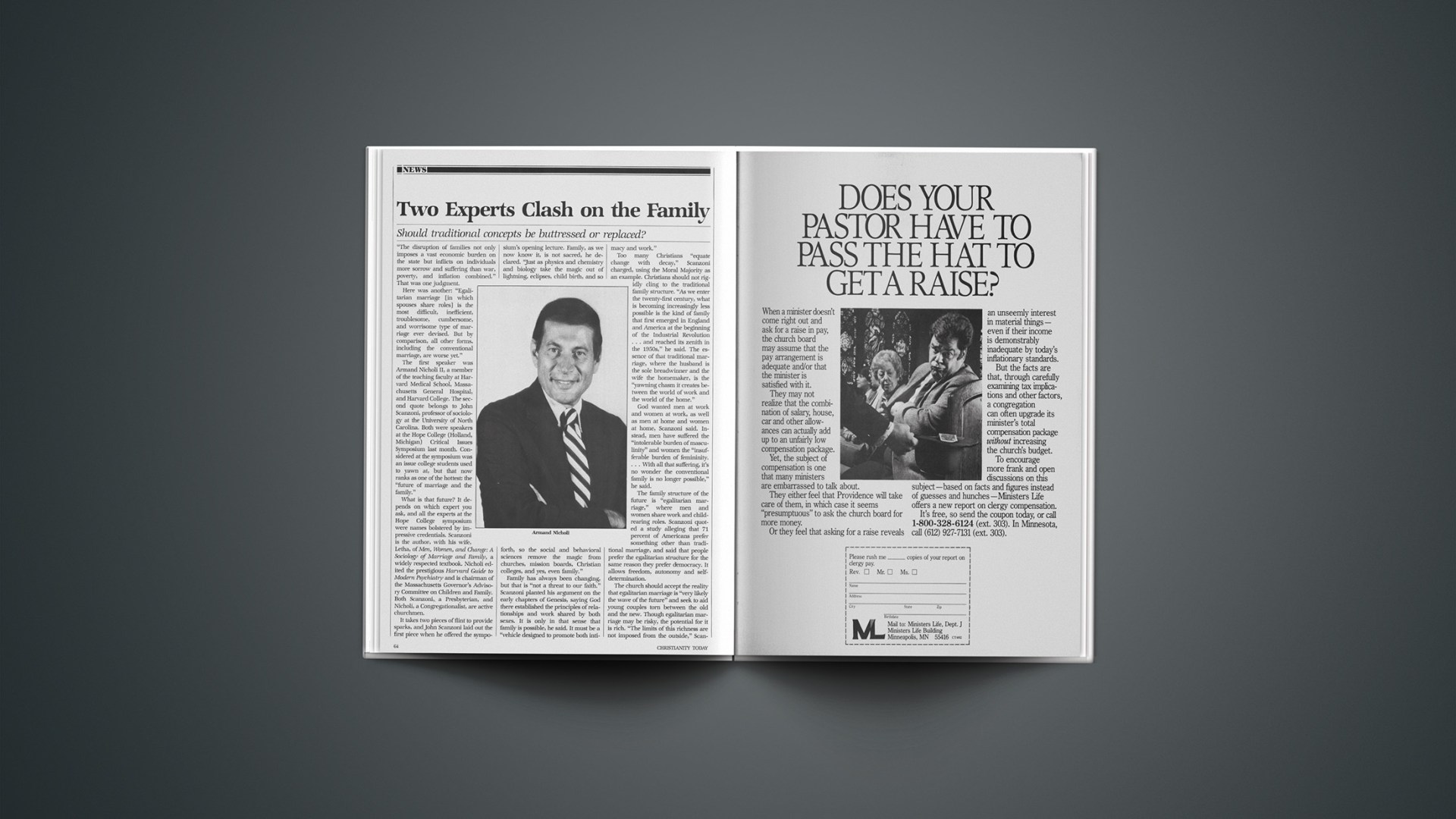

Should traditional concepts be buttressed or replaced?
“The disruption of families not only imposes a vast economic burden on the state but inflicts on individuals more sorrow and suffering than war, poverty, and inflation combined.” That was one judgment.
Here was another: “Egalitarian marriage [in which spouses share roles] is the most difficult, inefficient, troublesome, cumbersome, and worrisome type of marriage ever devised. But by comparison, all other forms, including the conventional marriage, are worse yet.”
The first speaker was Armand Nicholi II, a member of the teaching faculty at Harvard Medical School, Massachusetts General Hospital, and Harvard College. The second quote belongs to John Scanzoni, professor of sociology at the University of North Carolina. Both were speakers at the Hope College (Holland, Michigan) Critical Issues Symposium last month. Considered at the symposium was an issue college students used to yawn at, but that now ranks as one of the hottest: the “future of marriage and the family.”
What is that future? It depends on which expert you ask, and all the experts at the Hope College symposium were names bolstered by impressive credentials. Scanzoni is the author, with his wife, Letha, of Men, Women, and Change: A Sociology of Marriage and Family, a widely respected textbook. Nicholi edited the prestigious Harvard Guide to modern Psychiatry and is chairman of the Massachusetts Governor’s Advisory Committee on Children and Family. Both Scanzoni, a Presbyterian, and Nicholi, a Congregationalist, are active churchmen.
It takes two pieces of flint to provide sparks, and John Scanzoni laid out the first piece when he offered the symposium’s opening lecture. Family, as we now know it, is not sacred, he declared. “Just as physics and chemistry and biology take the magic out of lightning, eclipses, child birth, and so forth, so the social and behavioral sciences remove the magic from churches, mission boards, Christian colleges, and yes, even family.”
Family has always been changing, but that is “not a threat to our faith.” Scanzoni planted his argument on the early chapters of Genesis, saying God there established the principles of relationships and work shared by both sexes. It is only in that sense that family is possible, he said. It must be a “vehicle designed to promote both intimacy and work.”
Too many Christians “equate change with decay,” Scanzoni charged, using the Moral Majority as an example. Christians should not rigidly cling to the traditional family structure. “As we enter the twenty-first century, what is becoming increasingly less possible is the kind of family that first emerged in England and America at the beginning of the Industrial Revolution … and reached its zenith in the 1950s,” he said. The essence of that traditional marriage, where the husband is the sole breadwinner and the wife the homemaker, is the “yawning chasm it creates between the world of work and the world of the home.”
God wanted men at work and women at work, as well as men at home and women at home, Scanzoni said. Instead, men have suffered the “intolerable burden of masculinity” and women the “insufferable burden of femininity.… With all that suffering, it’s no wonder the conventional family is no longer possible,” he said.
The family structure of the future is “egalitarian marriage,” where men and women share work and childrearing roles. Scanzoni quoted a study alleging that 71 percent of Americans prefer something other than traditional marriage, and said that people prefer the egalitarian structure for the same reason they prefer democracy. It allows freedom, autonomy and self-determination.
The church should accept the reality that egalitarian marriage is “very likely the wave of the future” and seek to aid young couples tom between the old and the new. Though egalitarian marriage may be risky, the potential for it is rich. “The limits of this richness are not imposed from the outside,” Scanzoni said in conclusion. “The limits are what we choose to make them.”
Less sanguine about trends pushing toward a new form of family was Nicholi, who began by voicing “reservations” about Scanzoni’s lecture. Nicholi doubted that traditional marriage rules out equality. He also addressed the issue of intimacy. “I’m not at all sure that the changes that have been taking place, away from the traditional family, have indeed created a more satisfactory vehicle for intimacy,” he said. Fulfillment comes primarily from family relationships and not careers, he added.
But colleges, businesses, and government are “antifamily in very subtle ways,” Nicholi remarked. Colleges have a tendency to convey the impression that the role of wife and mother is second-class citizenship. Business conferences are frequently held great distances from home, and spouses are not invited, thus separating the family.
Yet, said Nicholi, extensive research shows that “no human experience has [a] greater influence on our lives than the family experience.”
He had strong words against divorce, which he said has soared 700 percent in this century. Nicholi cited scriptural references about the undesirability of divorce and invoked C. S. Lewis, who called it an “amputation,” a last-resort, lifesaving measure. A study determined that 75 percent of all divorced persons think their divorce a mistake within one year of it, Nicholi said.
Nicholi also had strong medicine for the college women in his audience planning on both career and marriage with children. “I’ve concluded that it’s very difficult for a woman to raise small children and to have a career without sacrificing one or the other—the quality of the work, or the quality of child care”—he said, adding that his conclusion was “strongly supported by a great deal of research data and my observations.”
The news was no better for absent fathers. Research shows that the child “experiences an absent or emotionally inaccessible parent as rejection, and rejection inevitably breeds resentment and hostility.” Nicholi related a lack of control over aggressive and sexual impulses to absent fathers.
Trends like the absent parent and the accelerating divorce rate may cause more violence and societal disintegration, Nicholi warned. “We need to take steps to reverse the process of producing empty and angry people whose rage erupts either in uncontrolled violence or in depression and self-destruction.”
He concluded by observing that Jesus appeared to have an “overriding concern with our relationships” and noted the two great commandments: to serve God fully and to love your neighbor as yourself. “It seems to me that our neighbor includes first and foremost our family,” Nicholi said.
Five other specialists presented workshops and lectures about the family. The Critical Issues Symposium was Hope College’s third, with the previous two focusing on the Middle East conflict and the energy crisis. But this year’s organizer, psychology professor David Myers, said student interest peaked with family as the subject. Family has become a burning issue, and the rhetorical fire ignited at Hope College illuminated nothing so much as the wide divergence of opinion about what modern Christians believe family should be.
RODNEY CLAPP in Holland, Michigan
Personalia
James I. McCord, president of Princeton Theological Seminary for 23 years, will retire in August. McCord was the fourth president of the seminary. He will become chancellor of the Center of Theological Inquiry, also at Princeton, after his retirement as president. The center is a new endeavor said to sponsor research in many subjects related to theology.
Robert J. Beck, a Saint Paul, Minnesota, family medicine practioner, received the first Humanitarian Service Award. The award was presented by World Relief Corporation, Wheaton, Illinois, in recognition of Beck’s work as medical director of World Relief. The organization is the relief and development arm of the National Association of Evangelicals.
W. Stanley Mooneyham has resigned as president of World Vision International, the relief and development organization based in Monrovia, California. Mooneyham’s resignation is effective September 30. World Vision’s president for 13 years, Mooneyham will remain with the organization as senior adviser to the chairman of the board.
W. A. Welsh, president of the publishing house of the Christian Church (Disciples of Christ), will retire next December. Welsh has been president of the board of publications for eight years. During Welsh’s presidency, the board’s annual net sales increased from $6 million to $10 million.
Paul Ramsey has been appointed research professor at Princeton Theological Seminary’s new Center of Theological Inquiry. The ecumenical postdoctoral institution sponsors research in subjects related to theology. Ramsey specializes in Christian ethics and social theory.
Alfred W. Gordon is the new director of the Bowery Mission in New York City. The mission has provided rehabilitation outreach to alcoholics on the Bowery for 103 years. Gordon was formerly a chaplain at the mission.
J. Allen Thompson announced his resignation as president of World-team, the ministry of West Indies Mission. Thompson’s resignation, effective March 2, marks the end of a 26-year association between Worldteam and Thompson.
Joni Eareckson, known for books and a film chronicling her Christian life as a quadriplegic, will marry in July. The groom will be Ken Tada, a high school teacher and coach in the Special Olympics for handicapped youngsters. Eareckson was paralyzed in a swimming accident 15 years ago.