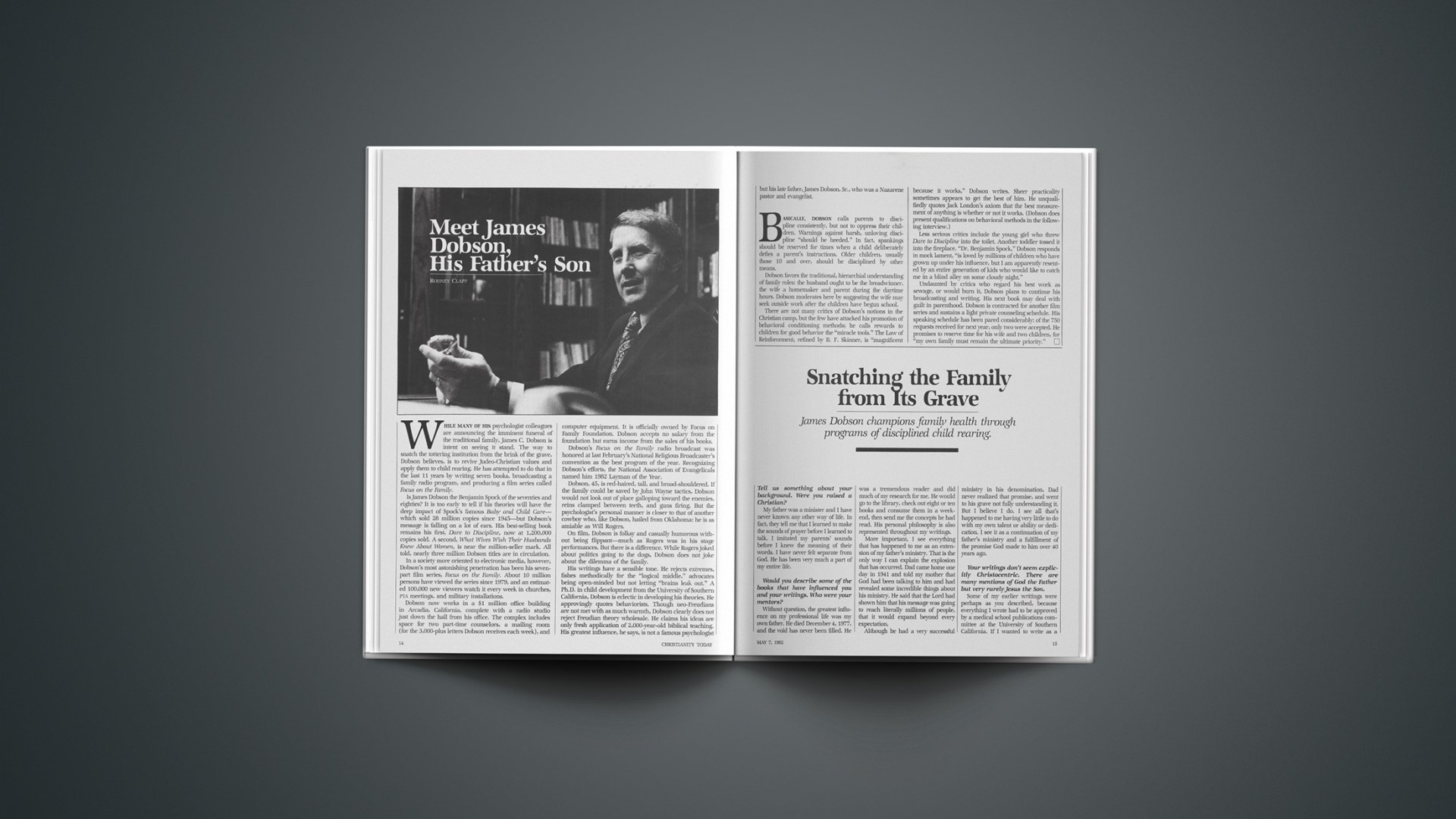

While many of his psychologist colleagues are announcing the imminent funeral of the traditional family, James C. Dobson is intent on seeing it stand. The way to snatch the tottering institution from the brink of the grave, Dobson believes, is to revive Judeo-Christian values and apply them to child rearing. He has attempted to do that in the last 11 years by writing seven books, broadcasting a family radio program, and producing a film series called Focus on the Family.
Is James Dobson the Benjamin Spock of the seventies and eighties? It is too early to tell if his theories will have the deep impact of Spock’s famous Baby and Child Care—which sold 28 million copies since 1945—but Dobson’s message is falling on a lot of ears. His best-selling book remains his first, Dare to Discipline, now at 1,200,000 copies sold. A second, What Wives Wish Their Husbands Knew About Women, is near the million-seller mark. All told, nearly three million Dobson titles are in circulation.
In a society more oriented to electronic media, however, Dobson’s most astonishing penetration has been his seven-part film series, Focus on the Family. About 10 million persons have viewed the series since 1979, and an estimated 100,000 new viewers watch it every week in churches, PTA meetings, and military installations.
Dobson now works in a $1 million office building in Arcadia, California, complete with a radio studio just down the hall from his office. The complex includes space for two part-time counselors, a mailing room (for the 3,000-plus letters Dobson receives each week), and computer equipment. It is officially owned by Focus on Family Foundation. Dobson accepts no salary from the foundation but earns income from the sales of his books.
Dobson’s Focus on the Family radio broadcast was honored at last February’s National Religious Broadcaster’s convention as the best program of the year. Recognizing Dobson’s efforts, the National Association of Evangelicals named him 1982 Layman of the Year.
Dobson, 45, is red-haired, tall, and broad-shouldered. If the family could be saved by John Wayne tactics, Dobson would not look out of place galloping toward the enemies, reins clamped between teeth, and guns firing. But the psychologist’s personal manner is closer to that of another cowboy who, like Dobson, hailed from Oklahoma: he is as amiable as Will Rogers.
On film, Dobson is folksy and casually humorous without being flippant—much as Rogers was in his stage performances. But there is a difference. While Rogers joked about politics going to the dogs, Dobson does not joke about the dilemma of the family.
His writings have a sensible tone. He rejects extremes, fishes methodically for the “logical middle,” advocates being open-minded but not letting “brains leak out.” A Ph.D. in child development from the University of Southern California, Dobson is eclectic in developing his theories. He approvingly quotes behaviorists. Though neo-Freudians are not met with as much warmth, Dobson clearly does not reject Freudian theory wholesale. He claims his ideas are only fresh application of 2,000-year-old biblical teaching. His greatest influence, he says, is not a famous psychologist but his late father, James Dobson, Sr., who was a Nazarene pastor and evangelist.
Basically, Dobson calls parents to discipline consistently, but not to oppress their children. Warnings against harsh, unloving discipline “should be heeded.” In fact, spankings should be reserved for times when a child deliberately defies a parent’s instructions. Older children, usually those 10 and over, should be disciplined by other means.
Dobson favors the traditional, hierarchial understanding of family roles: the husband ought to be the breadwinner, the wife a homemaker and parent during the daytime hours. Dobson moderates here by suggesting the wife may seek outside work after the children have begun school.
There are not many critics of Dobson’s notions in the Christian camp, but the few have attacked his promotion of behavioral conditioning methods; he calls rewards to children for good behavior the “miracle tools.” The Law of Reinforcement, refined by B. F. Skinner, is “magnificent because it works,” Dobson writes. Sheer practicality sometimes appears to get the best of him. He unqualifiedly quotes Jack London’s axiom that the best measurement of anything is whether or not it works. (Dobson does present qualifications on behavioral methods in the following interview.)
Less serious critics include the young girl who threw Dare to Discipline into the toilet. Another toddler tossed it into the fireplace. “Dr. Benjamin Spock,” Dobson responds in mock lament, “is loved by millions of children who have grown up under his influence, but I am apparently resented by an entire generation of kids who would like to catch me in a blind alley on some cloudy night.”
Undaunted by critics who regard his best work as sewage, or would burn it, Dobson plans to continue his broadcasting and writing. His next book may deal with guilt in parenthood. Dobson is contracted for another film series and sustains a light private counseling schedule. His speaking schedule has been pared considerably: of the 750 requests received for next year, only two were accepted. He promises to reserve time for his wife and two children, for “my own family must remain the ultimate priority.”