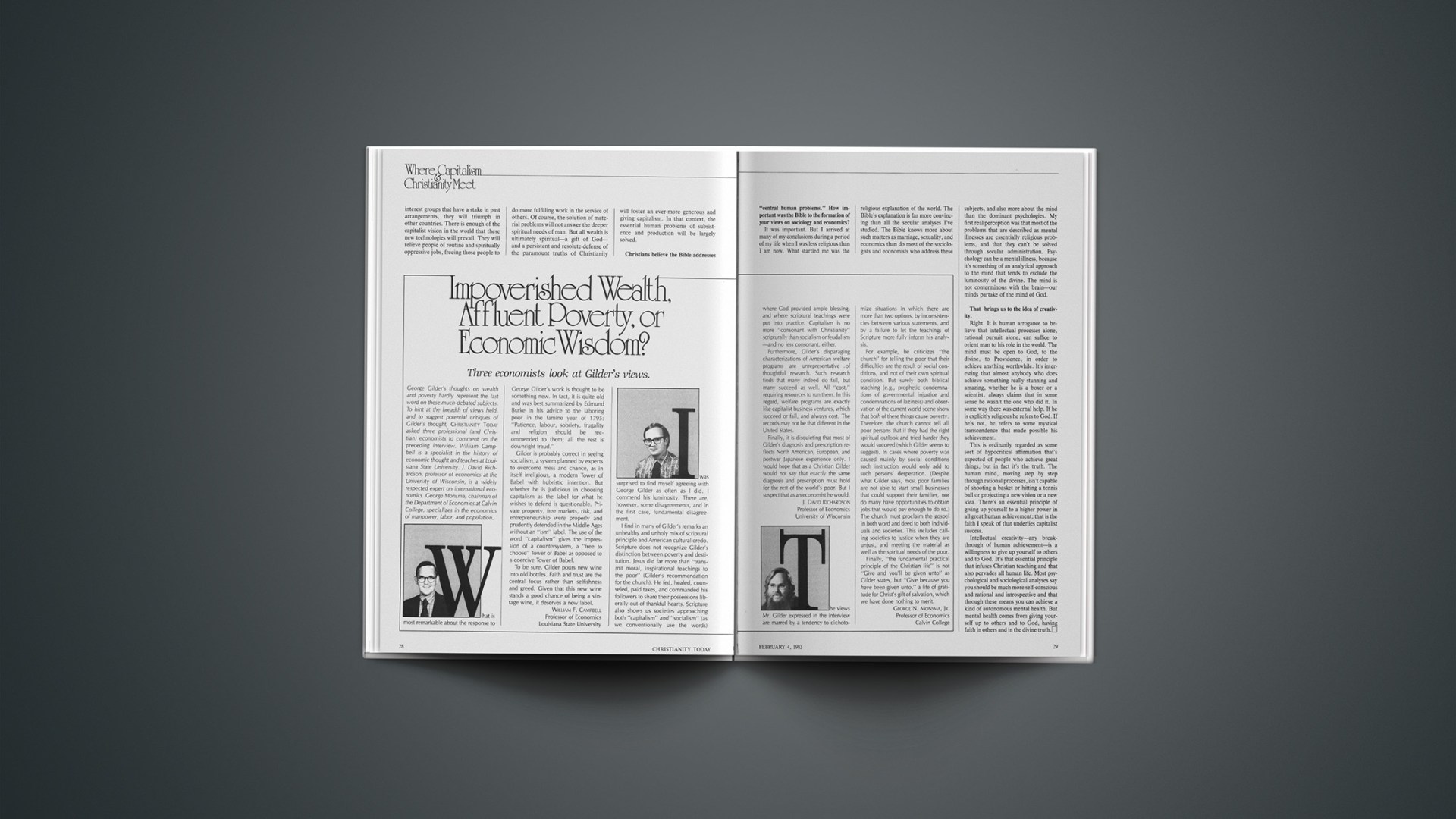

George Gilder’s thoughts on wealth and poverty hardly represent the last word on these much-debated subjects. To hint at the breadth of views held, and to suggest potential critiques of Gilder’s thought, CHRISTIANITY TODAYasked three professional (and Christian) economists to comment on the preceding interview. William Campbell is a specialist in the history of economic thought and teaches at Louisiana State University. J. David Richardson, professor of economics at the University of Wisconsin, is a widely respected expert on international economics. George Monsma, chairman of the Department of Economics at Calvin College, specializes in the economics of manpower, labor, and population.
What is most remarkable about the response to George Gilder’s work is thought to be something new. In fact, it is quite old and was best summarized by Edmund Burke in his advice to the laboring poor in the famine year of 1795: “Patience, labour, sobriety, frugality and religion should be recommended to them; all the rest is downright fraud.”
Gilder is probably correct in seeing socialism, a system planned by experts to overcome mess and chance, as in itself irreligious, a modern Tower of Babel with hubristic intention. But whether he is judicious in choosing capitalism as the label for what he wishes to defend is questionable. Private property, free markets, risk, and entrepreneurship were properly and prudently defended in the Middle Ages without an “ism” label. The use of the word “capitalism” gives the impression of a countersystem, a “free to choose” Tower of Babel as opposed to a coercive Tower of Babel.
To be sure, Gilder pours new wine into old bottles. Faith and trust are the central focus rather than selfishness and greed. Given that this new wine stands a good chance of being a vintage wine, it deserves a new label.
Professor of Economics
Louisiana State University
I was surprised to find myself agreeing with George Gilder as often as I did. I commend his luminosity. There are, however, some disagreements, and in the first case, fundamental disagreement.
I find in many of Gilder’s remarks an unhealthy and unholy mix of scriptural principle and American cultural credo. Scripture does not recognize Gilder’s distinction between poverty and destitution. Jesus did far more than “transmit moral, inspirational teachings to the poor” (Gilder’s recommendation for the church). He fed, healed, counseled, paid taxes, and commanded his followers to share their possessions liberally out of thankful hearts. Scripture also shows us societies approaching both “capitalism” and “socialism” (as we conventionally use the words) where God provided ample blessing, and where scriptural teachings were put into practice. Capitalism is no more “consonant with Christianity” scripturally than socialism or feudalism—and no less consonant, either.
Furthermore, Gilder’s disparaging characterizations of American welfare programs are unrepresentative, of thoughtful research. Such research finds that many indeed do fail, but many succeed as well. All “cost,” requiring resources to run them. In this regard, welfare programs are exactly like capitalist business ventures, which succeed or fail, and always cost. The records may not be that different in the United States.
Finally, it is disquieting that most of Gilder’s diagnosis and prescription reflects North American, European, and postwar Japanese experience only. I would hope that as a Christian Gilder would not say that exactly the same diagnosis and prescription must hold for the rest of the world’s poor. But I suspect that as an economist he would.
Professor of Economics
University of Wisconsin
The views Mr. Gilder expressed in the interview are marred by a tendency to dichotomize situations in which there are more than two options, by inconsistencies between various statements, and by a failure to let the teachings of Scripture more fully inform his analysis.
For example, he criticizes “the church” for telling the poor that their difficulties are the result of social conditions, and not of their own spiritual condition. But surely both biblical teaching (e.g., prophetic condemnations of governmental injustice and condemnations of laziness) and observation of the current world scene show that both of these things cause poverty. Therefore, the church cannot tell all poor persons that if they had the right spiritual outlook and tried harder they would succeed (which Gilder seems to suggest). In cases where poverty was caused mainly by social conditions such instruction would only add to such persons’ desperation. (Despite what Gilder says, most poor families are not able to start small businesses that could support their families, nor do many have opportunities to obtain jobs that would pay enough to do so.) The church must proclaim the gospel in both word and deed to both individuals and societies. This includes calling societies to justice when they are unjust, and meeting the material as well as the spiritual needs of the poor.
Finally, “the fundamental practical principle of the Christian life” is not “Give and you’ll be given unto” as Gilder states, but “Give because you have been given unto,” a life of gratitude for Christ’s gift of salvation, which we have done nothing to merit.
Professor of Economics
Calvin College